Your data is messy. You know it. Every analyst who touches it knows it. But "clean it up" gets added to the backlog each quarter and bumped for more urgent work. The data stays messy. The same problems recur. The cleanup never seems to stick.
That's because most data cleaning efforts treat the symptom — the bad records — rather than the cause — why bad records keep entering your systems. Understanding the root causes of poor data quality is the first step to fixing it permanently.
Root Cause 1: No Validation at the Point of Entry
The most common root cause of bad data is a complete absence of validation at the moment data enters your systems. Forms that accept any input. CRM fields that allow free text where they should have dropdowns. Imports that load files without a schema check. Manual data entry with no required-field enforcement.
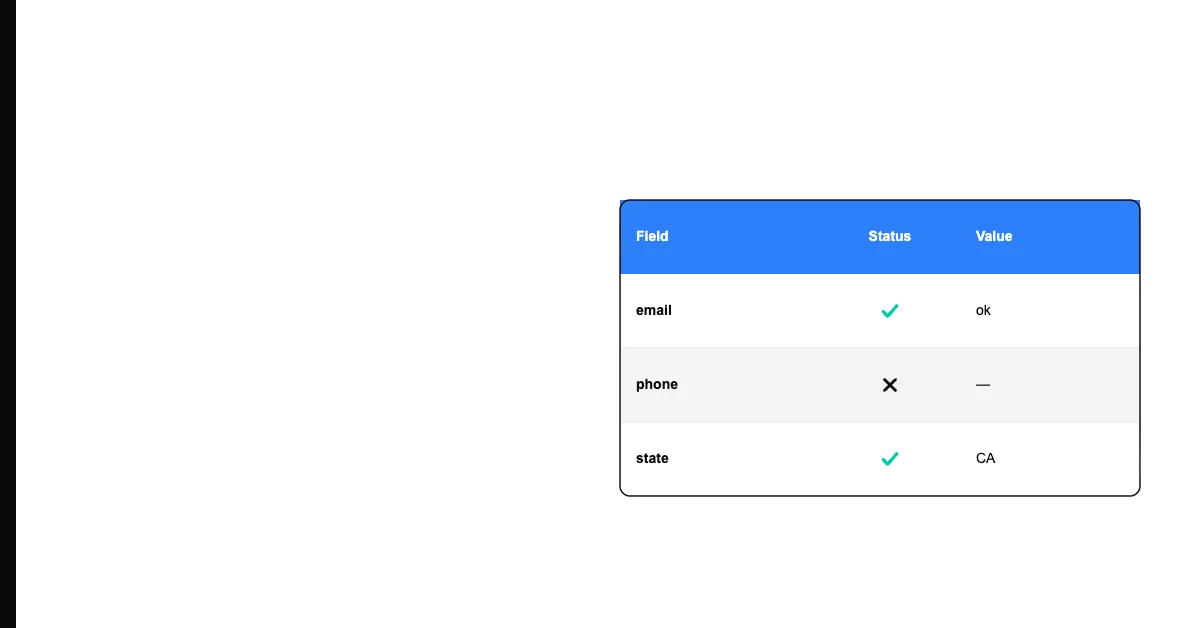
Sohovi lets you set up validation rules for any column and instantly see which rows fall outside them — no code or SQL required.
When data can enter incorrectly without any friction, it does — at scale. The person entering data isn't being careless; they're just not constrained to enter it correctly.
The fix: Add validation at every entry point. Email format checks on forms. Required fields that can't be bypassed. Dropdown menus for categorical fields. Pre-import validation scripts. Prevention is dramatically cheaper than cleanup.
Root Cause 2: Multiple Systems Without a Single Source of Truth
Most businesses have the same entity — a customer, a product, a vendor — in multiple systems: a CRM, a billing system, a marketing platform, a support tool. Each system maintains its own version of the record, and they drift apart over time. The same customer appears with different addresses, different phone numbers, different contact names across systems.
Sohovi finds gaps, duplicates, and format errors in your CRM data — so your team is working from records they can trust.
When no single system is designated as authoritative, every system is equally wrong. Reports that join data across systems produce wrong results because the records don't agree.
The fix: Designate one system as the source of truth for each entity type. Build integrations that reference the authoritative record rather than maintaining independent copies.
Root Cause 3: Data Entry by People Under Time Pressure
The people entering data — sales reps logging call notes, customer service agents entering tickets, warehouse staff recording shipments — are not thinking about data quality. They're thinking about closing the call, resolving the issue, processing the shipment. Data entry is overhead that competes with their primary task.
Sohovi validates your dataset before it enters the warehouse — catching format errors, nulls, and duplicates at the source.
Under time pressure, people skip optional fields, use inconsistent formatting, create new records when they can't find an existing one, and make transcription errors.
The fix: Reduce friction through better system design: auto-populate fields where possible, use dropdowns instead of free text, make required fields truly required, and build deduplication checks into record creation workflows.
Root Cause 4: No Ownership
Data quality doesn't improve without someone accountable for improving it. When data quality is "everyone's responsibility," it's effectively no one's. Problems are noticed but not fixed. Standards are set but not enforced. Cleanup happens reactively when something breaks, not proactively.
The fix: Assign named owners to each critical dataset. Make data quality metrics part of those owners' performance objectives. Quality improves when someone is accountable for it.
Root Cause 5: Bad Data Imported from External Sources
Every time your team imports a purchased list, a partner's export, a vendor file, or an event attendee list, you're potentially importing that source's quality problems into your system. If the external file has 15% invalid email addresses, 8% duplicates, and inconsistent date formats — and you import it without validation — all of those problems become your problems.
The fix: Run a validation check on every external file before importing. Check for duplicates against existing records. Validate formats for key fields. Return files that fail to the source with a description of the failures.
Frequently Asked Questions
Q: What are the most common root causes of messy data? The five most common root causes are: no validation at data entry points, multiple systems without a single source of truth, data entry under time pressure, no named ownership for data quality, and importing bad data from external sources without validation.
Q: Why doesn't a one-time data cleanup fix messy data permanently? Because cleaning existing data doesn't change the processes that created the messy data. If you clean your email list but don't add email format validation to your lead capture forms, new invalid emails continue to enter at the same rate. Permanent improvement requires fixing the sources, not just the symptoms.
Q: What is the relationship between time pressure and data quality? When data entry is overhead competing with a primary task, people under time pressure take shortcuts — skipping fields, using inconsistent formats, creating duplicate records. System design should minimize the cognitive load of correct data entry, making the right thing to do the easy thing to do.
Q: How does the absence of a single source of truth cause data quality problems? When multiple systems maintain independent copies of the same entity, those copies drift apart over time — different updates applied to different systems, different fields populated in each. Joining data across these systems produces inconsistent results, and there's no authoritative answer to which version is correct.
Q: What is the most cost-effective root cause to fix? Prevention at the point of entry provides the highest ROI. Adding validation to a form costs hours and prevents ongoing data quality problems indefinitely. Cleaning up bad records costs the same hours every time the problem recurs. Prevention is a one-time investment; cleanup is a recurring tax.
Q: Can data quality problems be entirely prevented? No. Some root causes — like external data imports and user behavior under time pressure — can be mitigated but not eliminated. The goal is to reduce the flow of bad data into your systems to a manageable level, not to achieve zero quality failures.
Q: How does lack of ownership cause data quality problems? When no one is accountable for a dataset's quality, problems are noticed but not fixed. Standards exist on paper but aren't enforced. Cleanup happens reactively when something breaks. Named ownership converts a collective vague responsibility into an individual specific one that can actually be acted on.
Q: Why do mergers and acquisitions create data quality problems? When two organizations merge, they bring two different data structures, naming conventions, quality standards, and system configurations. Combining these creates a perfect storm of reference data inconsistencies, duplicate entities, and conflicting records that takes significant effort to reconcile.
Q: What is technical debt in data quality? Data quality technical debt is accumulated quality problems that weren't fixed when they occurred, creating a growing cleanup burden. Like code technical debt, it compounds — each new system built on messy data inherits and amplifies the messiness.
Q: How do I identify the root cause of a specific data quality problem? For each type of quality problem, ask: "How did this value enter the system?" Trace the record back through the import, form, integration, or manual entry that created it. The entry point is almost always where the root cause lives.
Messy data is the predictable output of systems without validation, ownership, or source controls. The path to clean data isn't a bigger cleanup effort — it's fixing the processes that create messy data in the first place.