You ran a data quality project. The data was clean. Three years later, it's messy again. The question isn't why it got messy — it's why it stayed messy. Data quality degrades because the forces that degrade it are constant, and the forces maintaining it are periodic at best.
The Mechanisms of Data Quality Degradation
Natural Decay — The Real World Changes
The most fundamental cause of data quality degradation is that the real world changes, and data doesn't automatically update to reflect those changes.
People change jobs at a rate that implies roughly 30% of B2B contact data becomes inaccurate within a year. Companies move, rename, merge, and close. Product catalogs change. Prices change. Regulations change classification codes. Every change in the real world that isn't reflected in your data is another data quality failure accumulating.
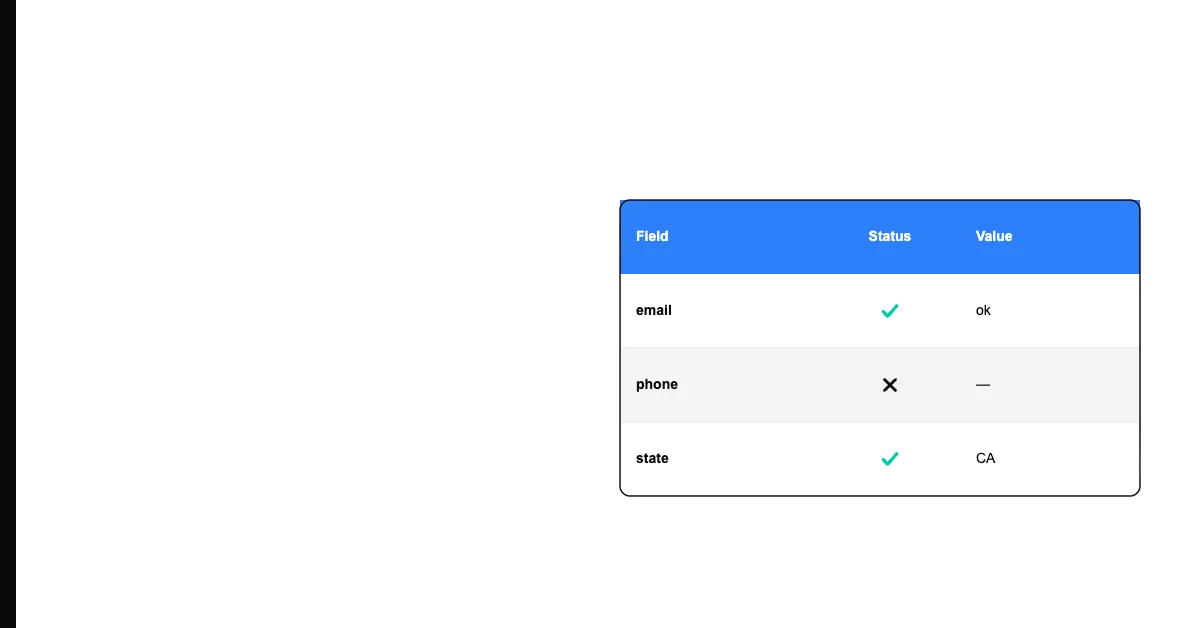
Sohovi scores your dataset against your own accuracy standards and highlights the columns and rows where values fall outside expected ranges.
Process Drift — Standards Erode Without Enforcement
When a new field is added to a form and marked required, compliance is typically high. Six months later, users have found workarounds — they put "N/A" in required text fields, they skip fields that have confusing validation, they use shortcut values that technically pass validation but don't match the intended controlled vocabulary.
This is process drift: standards that were clear when introduced gradually erode as users adapt and edge cases accumulate. Without regular audits and enforcement, the erosion is invisible until the data is significantly degraded.
Accumulating Imports Without Quality Checks
Every list import that doesn't run a deduplication check adds duplicates. Every vendor file that isn't validated for format and completeness adds invalid and inconsistent records. Every system integration that doesn't use upsert logic adds duplicate entities.
Sohovi automatically finds every duplicate in your dataset — including near-matches — and shows you exactly which rows are affected.
These accumulate. A database that runs 4 major imports per year without quality gates adds degradation four times annually. Over 3 years, that's 12 rounds of unvalidated imports layering on top of each other.
System Changes That Break Assumptions
New fields get added. Old fields get deprecated (but often kept in the schema and left blank). Business definitions change. A "premium customer" definition that was clear when the field was created may mean something different after two product launches and a pricing model change.
System changes degrade data quality because the data carries the old assumptions while the business has moved to new ones.
No Active Monitoring
Perhaps the most fundamental driver of gradual degradation: if no one is watching, no one notices when quality slips below acceptable. A completeness rate that drops from 97% to 89% over 18 months isn't visible without monitoring. By the time it causes a visible failure, the problem is already significant.
Sohovi profiles every column in your dataset for completeness and flags the exact rows where values are missing — free to try.
Frequently Asked Questions
Q: Why does data quality degrade over time? Data quality degrades because the real world changes faster than data gets updated, process standards erode without enforcement, imports and integrations add new quality problems continuously, system changes break old assumptions, and quality monitoring is often insufficient to catch gradual decline early.
Q: How fast does data quality degrade? The rate depends on the type of data. B2B contact data loses roughly 30% accuracy per year. Reference data (price lists, product catalogs) degrades based on how frequently changes occur. Financial transaction data degrades more slowly but accumulates format and completeness issues from ongoing entries. Without monitoring, most organizations don't notice until quality has dropped 15-20 percentage points below the baseline.
Q: What is the relationship between data quality degradation and business age? Older businesses tend to have more degraded data because they've accumulated more years of process drift, system migrations (each of which introduces data quality problems), and natural decay. A company that has operated for 20 years without a systematic data governance program typically has significantly more degraded data than a 3-year-old company.
Q: What is process drift in the context of data quality? Process drift is the gradual erosion of data entry standards over time as users find workarounds, edge cases accumulate, and enforcement becomes inconsistent. A field that was being completed correctly in year one may have a 40% compliance rate in year three because the standards weren't actively maintained.
Q: How does system migration cause data quality degradation? System migrations often introduce quality degradation through field mapping errors (fields that don't have a direct equivalent in the new system), format conversions that don't handle edge cases correctly, historical records that don't map cleanly to the new data model, and data that was stored in non-standard ways in the old system.
Q: What is the economic impact of gradual data quality degradation? The economic impact grows with time. Early degradation may have minimal visible impact. After 2-3 years of accumulated degradation, the impact shows up in marketing underperformance, forecasting errors, customer experience failures, and compliance risk. The longer degradation goes unaddressed, the more expensive remediation becomes.
Q: What is the most effective way to slow data quality degradation? Active monitoring combined with prevention at entry points. Monitoring catches degradation early when it's cheap to fix. Prevention — validation rules, controlled vocabularies, deduplication checks at import — reduces the rate at which new quality problems accumulate.
Q: Can data quality degradation be reversed? Yes, through focused remediation — cleansing existing bad records and fixing the processes that created them. Reversal takes time and effort proportional to how long degradation was allowed to continue unchecked. Early intervention (fixing quality when it's 5% below target) is dramatically cheaper than late intervention (fixing quality when it's 30% below target).
Q: How does staff turnover affect data quality? Staff turnover contributes to data quality degradation through knowledge loss (the person who knew the data's quirks and maintained it correctly leaves), inconsistent handoffs (new staff may not follow the same data standards), and re-entry errors (contacts re-entered by new staff who can't find existing records).
Q: What is a data quality baseline and how does it help manage degradation? A data quality baseline is the documented quality state of a dataset at a specific point in time — a reference for measuring subsequent change. By comparing current quality to the baseline, you can quantify how much degradation has occurred and at what rate. Without a baseline, you can't measure whether degradation is occurring or at what pace.
Data quality degradation is the default outcome without active maintenance. The mechanisms are consistent and predictable. Monitor quality over time, fix the processes that drive the fastest degradation, and prevent what you can at the source.