You send a campaign and 8% hard bounce. Your email platform sends you a warning. Your deliverability score drops. Future campaigns land in spam for your best contacts. All because of a data quality problem that could have been caught before the send.
High email bounce rates aren't a mystery. There are predictable causes, and each one has a specific fix.
What Causes High Email Bounce Rates
1. List Decay — The Silent Killer
Email lists lose roughly 22-25% of their deliverable contacts every year (ZeroBounce research). People change jobs, abandon old email addresses, switch providers. A list that was 95% deliverable when you built it two years ago may now have 50-55% valid addresses.
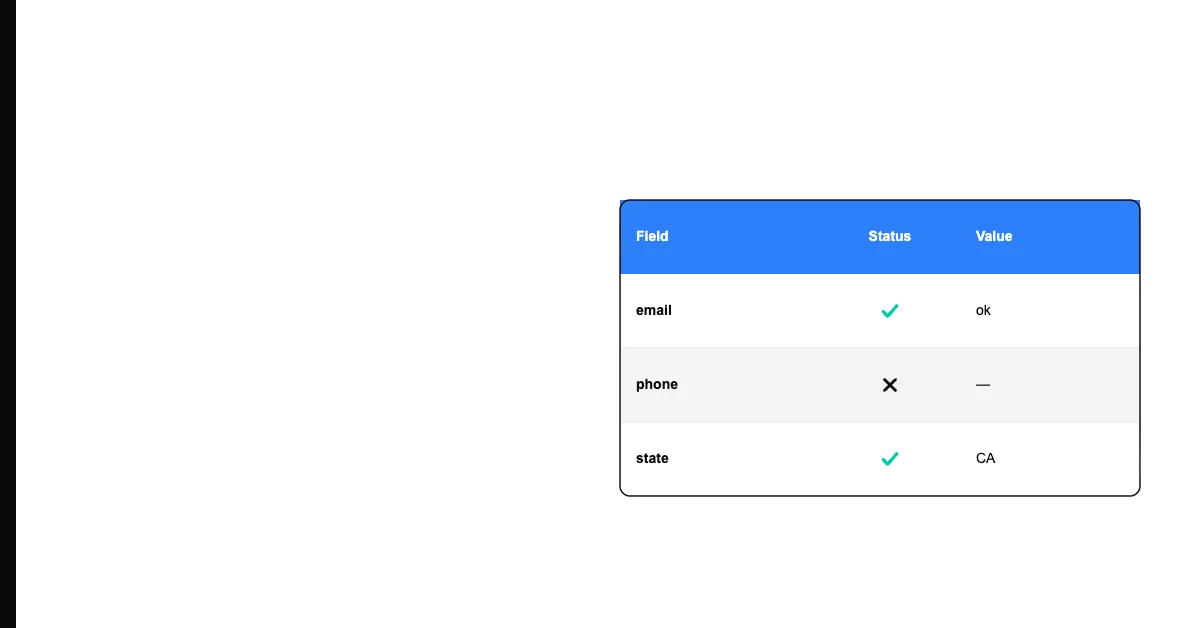
Sohovi validates your email list for invalid formats, duplicates, and missing fields before you send — protecting your sender reputation.
If you haven't cleaned your list in 18 months or more, list decay alone explains most of your bounces.
2. Role-Based Addresses
Email addresses like info@, support@, sales@, noreply@, and admin@ are not individual inboxes — they go to shared queues managed by multiple people. They're also frequently misconfigured, overloaded, or set to auto-reject bulk email. Sending to role-based addresses produces both hard bounces (rejected) and spam complaints (ignored or marked).
3. Invalid Syntax at Collection
If your email capture forms don't validate format at submission, people enter typos — "gmial.com" instead of "gmail.com," emails without "@," email addresses with spaces. These look like real addresses in your database but produce instant hard bounces on every send.
Sohovi lets you set up validation rules for any column and instantly see which rows fall outside them — no code or SQL required.
4. Purchased or Third-Party Lists
Purchased email lists are notorious for high bounce rates. These lists often contain stale, harvested, or never-verified addresses. Even "fresh" purchased lists from reputable vendors typically have 5-15% invalid addresses that produce bounces.
5. Disposable Email Addresses
Signups using temporary email services (Mailinator, Guerrilla Mail, 10 Minute Mail) produce addresses that appear valid at signup but may not accept messages — or may have expired by the time you send.
6. Spam Traps
Spam traps are email addresses maintained by inbox providers specifically to identify senders with poor list hygiene. Sending to a spam trap doesn't produce a visible hard bounce — it silently damages your sender reputation. If your bounce rate is high AND deliverability has dropped across the board, spam traps may be the cause.
How to Fix a High Bounce Rate
Immediate action (before your next send): Validate your list against an email validation service (ZeroBounce, NeverBounce, Hunter.io). Remove hard bounces from previous campaigns. Remove obvious invalid formats (no "@," no domain).
Medium-term (next 30 days): Remove role-based addresses from campaign segments. Identify contacts who haven't engaged (opened or clicked) in 12+ months and move them to a re-engagement segment or suppress them.
Long-term (ongoing): Add email format validation to every capture form. Never import an external list without running email validation first. Monitor bounce rate after every campaign and investigate any increase.
Frequently Asked Questions
Q: What is an email hard bounce vs. a soft bounce? A hard bounce means the email address is permanently undeliverable — the address doesn't exist, the domain is invalid, or the recipient server has permanently rejected it. A soft bounce is temporary — the server was unavailable, the mailbox was full. Hard bounces damage sender reputation; soft bounces do not if occasional.
Q: What bounce rate should trigger concern? A hard bounce rate above 0.5% is worth investigating. Above 2%, your sender reputation is actively degrading. Above 5%, major inbox providers may be filtering your email to spam across all recipients.
Q: How does email list decay cause bounces? As people change jobs and abandon old email addresses, those addresses become invalid. ZeroBounce research puts annual email list decay at 22-25%. A list not cleaned in 18 months may have lost a quarter of its valid contacts.
Q: What is a spam trap and how does it affect my bounce rate? A spam trap is an email address maintained by inbox providers to identify senders with poor list hygiene. Sending to a spam trap doesn't produce a visible bounce — it silently damages your sender reputation. High bounce rates combined with declining deliverability may indicate spam trap exposure.
Q: How long does it take to recover from a damaged sender reputation? Sender reputation recovery takes time — typically 1-3 months of consistently low bounce rates and high engagement. There's no fast fix. Prevention (maintaining a clean list) is far less costly than reputation recovery.
Q: Should I remove contacts who haven't engaged in 12 months? At minimum, move them to a re-engagement sequence. If they don't re-engage after 2-3 attempts, suppress them from regular campaigns. Sending to disengaged contacts drags down engagement rates and signals to inbox providers that your content isn't relevant.
Q: What is a role-based email address and should I send to them? Role-based addresses (info@, support@, admin@) go to shared inboxes rather than individuals. They typically have low engagement and higher rejection rates. Most email marketing best practices recommend suppressing role-based addresses from campaigns.
Q: What happens if I keep sending to hard-bounced addresses? Sending to addresses that have already hard bounced compounds the reputation damage. Your email platform should automatically suppress hard bounces — but verify this in your platform settings.
Q: How do I know if a purchased list will have high bounce rates? Most purchased lists do. Even from reputable vendors, industry estimates suggest 5-15% of purchased list addresses are invalid or outdated. Always run email validation on any purchased list before using it in a campaign.
Q: What is the difference between email validation and email verification? Email validation checks format and domain existence — fast, local, doesn't touch the target server. Email verification goes further, attempting to confirm the mailbox exists. Verification is more accurate but slower and increasingly blocked by major providers. For most use cases, validation is sufficient.
High bounce rates are a data quality problem with identifiable causes and specific fixes. Clean your list, add validation at capture, and monitor bounce rates as your leading indicator of list health.