The instinct when discovering bad data is to blame the person who entered it. But that almost always misses the real cause. Human data entry errors aren't random — they're the predictable output of systems that make it easy to enter data incorrectly and hard to enter it correctly.
Understanding how human error causes data quality problems is the first step to designing systems that prevent it.
The Types of Human Data Entry Errors
Transcription Errors
The simplest category: typing something incorrectly. A phone number with a digit transposed. A ZIP code one digit off. A price entered as $1,200 instead of $12,000. These errors happen when people copy data from one place to another — from a business card to a CRM, from a printed form to a database, from one screen to another.
Sohovi finds gaps, duplicates, and format errors in your CRM data — so your team is working from records they can trust.
Transcription errors are more common when: data is entered from physical documents, entry is done at high volume and high speed, fields don't have format validation that would catch the error, and no verification step exists to catch errors before they're saved.
Interpretation Errors
These occur when ambiguous data is interpreted differently by different people. "August 5" entered by a US-based employee becomes 08/05. The same date entered by a European employee becomes 05/08. Neither is "wrong" by itself — but in a mixed dataset, they create a date format consistency problem.
Interpretation errors are particularly common for: date formats, phone number formats, address formatting conventions, categorical fields with ambiguous approved values, and any field without a clear definition.
Truncation and Omission Errors
People under time pressure skip optional fields or cut inputs short. The company name is "International Business Machines Corporation" but only "IBM Corp" gets typed. The address has an apartment number but it's left off because the form accepts just a street address. The phone number extension is noted on the paper form but not entered in the CRM.
These errors don't produce obviously wrong values — they produce incomplete values that look superficially acceptable but lack precision.
Copy-Paste Errors
Copying data between applications or fields introduces errors that are harder to catch than typographical mistakes. Copying a column of email addresses may capture trailing spaces. Copying a formatted phone number into a field that expects only digits may include parentheses and dashes that break validation. Copying an entire row may include extra leading or trailing text.
Why System Design Matters More Than People
The key insight: human error rates are relatively consistent across settings — but the rate of errors that enter your systems is determined by system design, not individual carefulness.
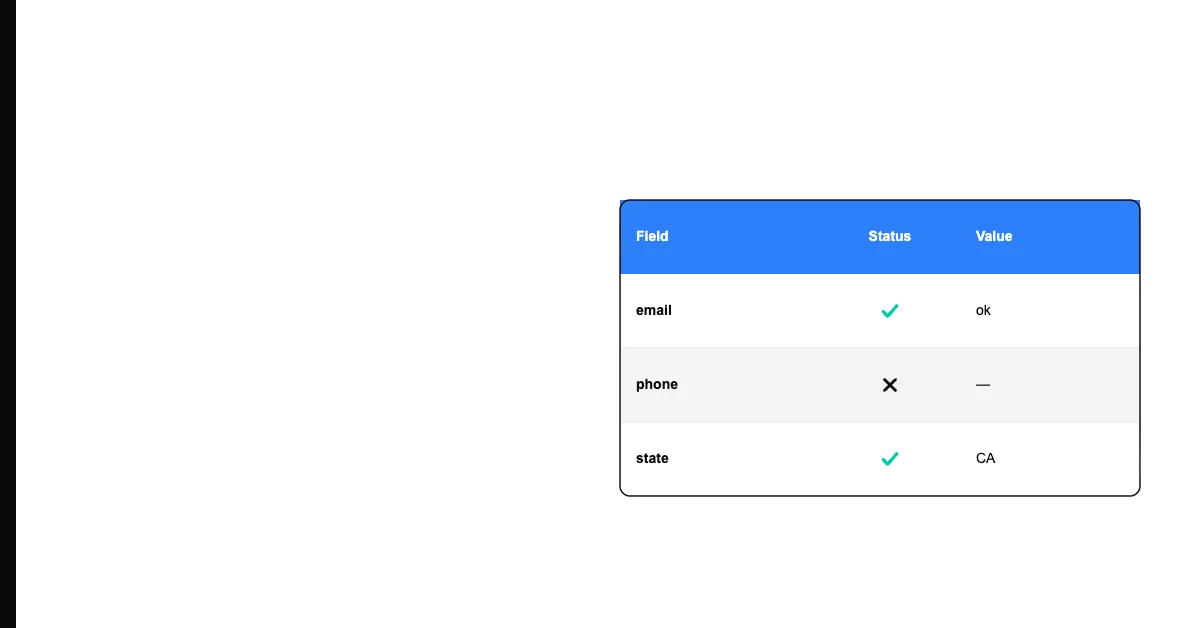
A form with real-time email format validation catches typos before they're saved. A CRM with required fields and dropdown menus for categorical data prevents blank values and inconsistent entries. An import workflow with pre-import validation rejects files with format problems before they load.
Sohovi lets you set up validation rules for any column and instantly see which rows fall outside them — no code or SQL required.
The same person making the same errors produces very different data quality outcomes depending on whether the system catches the errors or allows them to pass.
Frequently Asked Questions
Q: Is human error the main cause of data quality problems? Human error is a major contributor, but it's most accurate to say that inadequate system design is the main cause. Human errors are predictable and consistent — the question is whether the system is designed to catch them before they enter the database or allow them to pass.
Q: What types of human errors cause the most data quality damage? Transcription errors (typing incorrectly) and omission errors (skipping fields) are the most common. Interpretation errors (different people encoding the same information differently) are the most insidious because they're consistent within a person's behavior and therefore hard to detect as errors.
Q: How does time pressure affect data entry error rates? Directly and significantly. Under time pressure, users skip optional fields more frequently, use shortcut values that technically pass validation, create new records without checking for existing ones, and make more transcription errors. Data entry systems that add to an already-busy user's workload produce lower-quality outputs.
Q: What is the most effective way to prevent human data entry errors? Reduce the opportunity for error through system design: use dropdown menus instead of free-text for categorical fields, add real-time format validation to entry forms, implement autocomplete for addresses and company names, make genuinely required fields mandatory, and provide immediate feedback when a value doesn't meet requirements.
Q: Why are transcription errors especially common when copying from physical documents? Physical documents can't be copy-pasted — they must be manually re-keyed. Manual re-keying has a higher error rate than digital transfer. Add in poor handwriting, small print, or unusual formats on the source document, and error rates climb further. Reducing manual transcription (through digital capture, OCR, or direct system-to-system transfer) significantly reduces this error type.
Q: What is double-keying and does it work for preventing transcription errors? Double-keying is having two different people enter the same data independently and comparing the results. It's the gold standard for preventing transcription errors in critical data entry (like medical records or legal documents) but is too expensive for most business applications. Single-entry with immediate validation catches most errors at much lower cost.
Q: How do copy-paste operations introduce data quality problems? Copy-paste from one application to another often includes invisible characters (leading/trailing spaces, non-breaking spaces, line breaks, formatting codes) that aren't visible to the user but cause validation failures and matching problems in the destination. Pasting into a field that expects plain text from a rich-text source is a particularly common culprit.
Q: Can training people to enter data more carefully solve data quality problems? Partially and temporarily. Training helps, but it addresses the symptom rather than the cause. Trained people still make errors under time pressure, still interpret ambiguous fields differently, and still create duplicates when they can't find existing records. System design that prevents errors is more durable than training that reduces them.
Q: What is the relationship between data entry volume and error rates? Error rates typically increase with volume — people entering 10 records are more careful and accurate than people entering 100 records in the same time period. High-volume data entry environments need stronger system-level error prevention because individual caution becomes harder to maintain.
Q: How do role and expertise level affect data entry quality? More experienced users typically make fewer errors but may also have more deeply embedded shortcuts and workarounds. New users make more transcription errors but may follow instructions more carefully. Neither is inherently better — system design should produce quality output regardless of user experience level.
Human errors are predictable. The goal isn't to find and blame the person who entered bad data — it's to design systems that catch predictable errors before they become database problems.