Your direct mail campaign generated 12% returned mail. Your e-commerce fulfillment system reports 3% of orders undeliverable. Your field sales team is showing up at addresses that no longer exist. Your address data is wrong — and it's costing you money.
Address data quality problems are among the most expensive because they have immediate, tangible consequences: returned mail, failed deliveries, and wasted outreach effort. Here's why they happen and how to fix them.
Why Address Data Goes Wrong
1. Manual Entry Without Validation
The most common source of bad addresses is manual entry without any real-time validation. When a customer service agent, sales rep, or data entry specialist types an address without autocomplete or verification, errors are inevitable — transposed digits in house numbers, misspelled street names, wrong ZIP codes, missing apartment numbers.
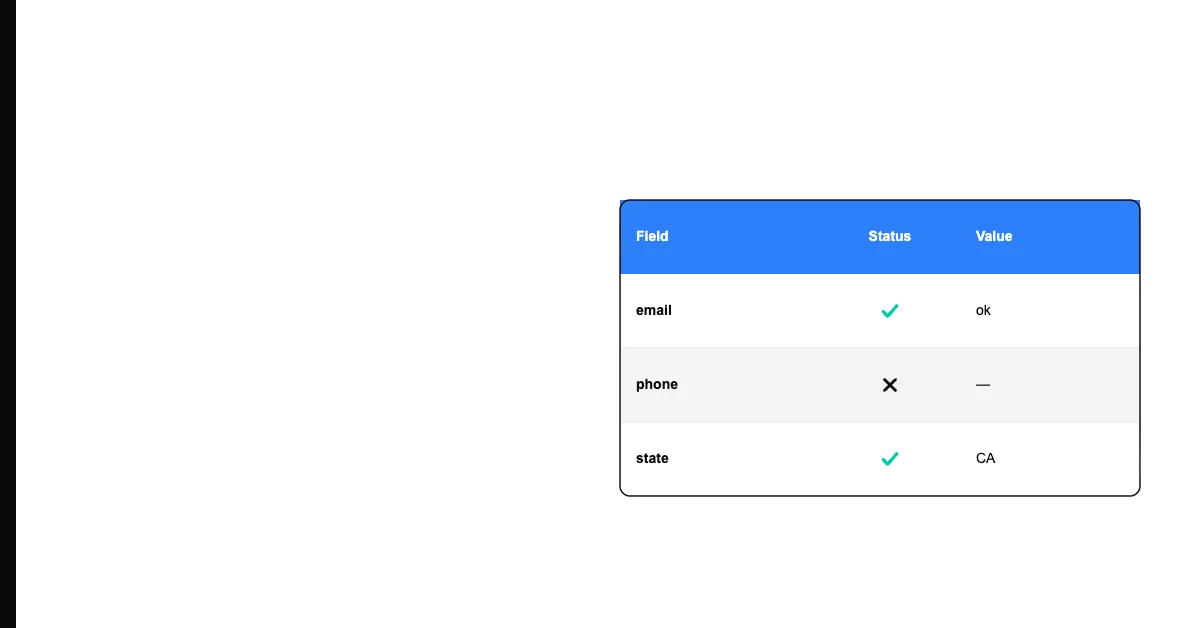
Sohovi lets you set up validation rules for any column and instantly see which rows fall outside them — no code or SQL required.
Without a validation step at the point of entry, these errors enter your database unchecked.
2. Customer Self-Entry with Typos
When customers enter their own addresses in online forms, typos are common — especially on mobile devices where keyboards are small. "Stret" instead of "Street." A ZIP code one digit off. An apartment number in the street address field.
The customer knows what they meant. The address lookup system doesn't.
3. Natural Address Change Over Time
People and businesses move. The address that was accurate at signup is no longer accurate 2-3 years later. A CRM that hasn't been refreshed in 18 months has accumulated significant address decay — even if every address was correct when originally entered.
Sohovi finds gaps, duplicates, and format errors in your CRM data — so your team is working from records they can trust.
The USPS estimates that about 40 million Americans change addresses each year. B2B addresses decay as companies move offices, expand to new locations, or downsize.
4. Imported Data from External Sources
Addresses imported from partner files, purchased lists, or vendor exports inherit those sources' address quality problems. A vendor that validated addresses 3 years ago and hasn't refreshed since will provide you with a list that's partially stale.
5. International Address Format Confusion
Different countries have different address formats. A system that assumes US address structure (street number, street name, city, state, ZIP) will misparse addresses from countries that use different component ordering. International addresses entered into a US-centric form often end up in wrong fields.
How to Fix Address Data Quality
Immediate fix: Run your address database through an address validation service (USPS CASS, SmartyStreets, Google Maps Platform). For US addresses, USPS CASS certification standardizes and corrects addresses and confirms deliverability.
At point of entry: Add address autocomplete to forms (Google Places API, Smarty) — users select from verified addresses rather than typing. This is the single most effective prevention measure.
For existing data: Identify records with obviously incomplete addresses (no street number, no ZIP code, wrong ZIP code for the stated city). Flag these for follow-up. For your most valuable records, conduct re-verification through direct customer contact.
Frequently Asked Questions
Q: Why are addresses in my database wrong? The most common causes are: manual entry without validation, customer self-entry with typos, natural address change over time (people move), imported data from external sources with their own address quality issues, and international address format confusion.
Q: How quickly do addresses become outdated? The USPS estimates roughly 40 million Americans change addresses each year. In a B2B context, companies move offices regularly. Industry estimates suggest that address accuracy degrades at 5-10% per year under normal conditions, faster for databases that aren't actively maintained.
Q: What is USPS CASS certification and how does it improve address quality? CASS (Coding Accuracy Support System) is the USPS standard for address validation and standardization. CASS-certified address validation services verify addresses against the USPS master address database, standardize format, add ZIP+4 codes, and flag undeliverable addresses. For US mail, CASS validation is the gold standard.
Q: How much does a failed delivery cost? Industry estimates put the cost of a failed delivery attempt at $15-30 when accounting for carrier fees, reattempt handling, and customer service overhead. For businesses with significant mail or shipping volume, address quality directly translates to cost savings.
Q: What is the most effective way to prevent bad addresses at the point of capture? Address autocomplete — Google Places API or Smarty's US Address Autocomplete — lets users select from verified addresses rather than typing. This prevents the majority of typo-related address errors at the point of capture, eliminating them before they enter your database.
Q: Can addresses be validated in bulk after the fact? Yes. Address validation APIs (SmartyStreets, Melissa, USPS WebTools) support batch processing of existing address databases. You upload a file of addresses and receive back a standardized, validated version. This is the standard approach for retroactive address quality improvement.
Q: How does address quality affect marketing ROI for direct mail? Every piece of returned mail is wasted postage, printing, and list cost. For a campaign at $1.50 per piece, a 10% undeliverable rate means $0.15 per piece is wasted — $150 per 1,000 pieces. Address quality improvement is one of the clearest direct-ROI investments in data quality.
Q: What is an NCOA (National Change of Address) service? NCOA is the USPS service that matches your address list against a database of address changes reported to the Post Office. When a match is found, your record is updated with the new address. NCOA is the primary tool for keeping address databases current as people and businesses move.
Q: Should I remove unverifiable addresses from my database? It depends on the use case. For active direct mail or shipping purposes, unverifiable addresses should be suppressed until corrected. For historical records or customer relationship management, flagging as "address needs verification" is more appropriate than deletion.
Q: How often should I validate my address database? For direct mail programs: before every major campaign. For shipping databases: validation at order time (real-time API check) plus quarterly database validation. For CRM/contact records: annual NCOA processing to capture moved contacts.
Wrong addresses cost real money — returned mail, failed deliveries, wasted outreach. The fix is address validation at entry, NCOA processing for existing data, and monitoring for the 3% of addresses that validation can't catch.