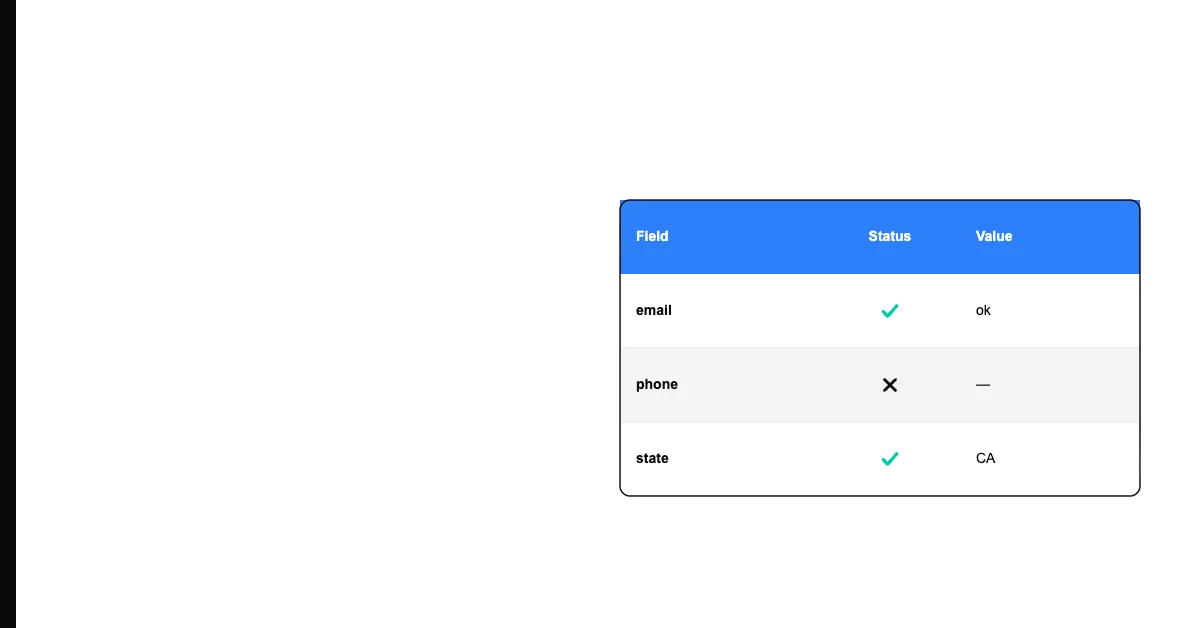
Most businesses need five to six data quality dimensions: completeness, accuracy, validity, uniqueness, consistency, and timeliness. The full list of ten or more dimensions is useful for enterprise governance programs; for practical data quality work, five or six covers 90% of real-world problems.
The number of dimensions in a data quality framework ranges from 6 (the DAMA standard) to 15 or more in some enterprise frameworks. More dimensions is not automatically better — dimensions that do not correspond to actual problems in your data add overhead without adding value.
The Core Five That Matter for Most Businesses
Completeness — Are required fields populated? This is almost always the first problem to check. Missing data is invisible and common.
Sohovi profiles every column in your dataset for completeness and flags the exact rows where values are missing — free to try.
Validity — Do values conform to expected formats and rules? Email addresses that are not valid emails, dates that do not parse, phone numbers with the wrong digit count — all validity failures.
Uniqueness — Are there duplicate records? Duplicates inflate every count and split the history of an entity across multiple records.
Accuracy — Are values correct? This is the hardest to measure but directly affects the quality of decisions and outputs.
Sohovi scores your dataset against your own accuracy standards and highlights the columns and rows where values fall outside expected ranges.
Consistency — Is the same information represented the same way across fields and systems? "CA" and "California" in two fields that will be joined causes the join to fail.
When to Add a Sixth: Timeliness
Timeliness — whether data is current enough for its intended use — is critical for:
- Contact data (people move, change jobs, change phone numbers)
- Pricing data (prices change)
- Status fields (opportunities close, projects end, contracts expire)
If your use case depends on current information, add timeliness to your framework.
The Extended Dimensions and When They Matter
Integrity — Whether relationships between records are intact. Matters for relational databases where foreign key relationships must be maintained.
Conformity — Whether data follows a defined standard (an industry code list, a classification taxonomy). Matters for regulated industries and data exchange.
Precision — Whether data has enough detail for its use case. Matters for scientific, financial, or location-based data.
Relevance — Whether the data applies to the current business context. A niche concern unless you are running analytics on data that was collected under different business conditions.
Matching Dimensions to Problems
Rather than starting with a framework and asking "which dimensions do we need," start with your actual data problems and ask "which dimensions describe them":
Sohovi shows you exactly what is wrong with your data — completeness gaps, type mismatches, duplicates — in one clear report.
- Lots of empty fields? Completeness.
- Duplicate customers or contacts? Uniqueness.
- Format inconsistencies breaking imports? Validity and consistency.
- Data that drove bad decisions? Accuracy.
- Outreach bouncing or landing with wrong information? Timeliness and accuracy.
Start with the dimensions that match your real pain points, and add more only when you encounter problems the current framework does not capture.
Frequently Asked Questions
Q: What does DAMA say about data quality dimensions? DAMA International's Data Management Body of Knowledge (DMBOK) identifies six core data quality dimensions: completeness, uniqueness, timeliness, validity, accuracy, and consistency. This is the most widely cited standard framework, and it covers the majority of practical data quality issues encountered in business.
Q: Is there a wrong number of data quality dimensions to track? Yes — tracking too few misses important failure modes. Tracking too many creates measurement overhead without additional insight. For most small to mid-size businesses, five to seven dimensions is the practical sweet spot. Enterprise data governance programs with regulatory requirements may need more.
Q: Do all dimensions apply to every field? No. Some dimensions only apply to specific field types. Uniqueness applies to identifier fields but not to categorical fields where duplicate values are expected. Validity applies to structured fields with format rules but not to free-text fields. Apply each dimension only where it is meaningful for the specific field.
Q: What happens if you track more dimensions than you actually act on? You produce metrics that go unused and erode the credibility of your quality reporting. It is better to track five dimensions consistently and act on findings than to track twelve dimensions and ignore half of them. Less scope, done well, is more valuable.
Q: Which single dimension catches the most data quality problems? Completeness catches the most problems in terms of volume because missing fields are extremely common in real-world business data. Uniqueness catches the problems that cause the most downstream damage because duplicate records affect every process that uses the data.
Q: Should you define your own custom dimension if none of the standard ones fit? Yes, if your business has a specific quality requirement not covered by the standard framework. A common example is "referential validity" — whether ID values in one table correspond to records in a related table. If your most important quality risk does not fit a standard dimension, define a custom one.
Q: How do you prioritize which dimensions to measure first? Measure the dimensions that correspond to your current most painful data problems. If stakeholders complain about duplicates, start with uniqueness. If reports are built on incomplete data, start with completeness. Prioritize by pain, then expand to proactive coverage of other dimensions.
Q: Can a high score on all five dimensions mean your data is still bad? Yes. If your dimension rules are poorly defined, high scores are misleading. A validity score of 98% means nothing if your validation rule accepts any non-null string. The quality of your dimension definitions determines the quality of your quality scores.
Q: Is there a difference between data quality dimensions and data quality metrics? Yes. Dimensions are the categories of quality (completeness, accuracy). Metrics are the specific measurements used to score each dimension (% of rows with a non-null email field, % of email fields matching a valid format). Each dimension typically has one or more metrics. Dimensions are conceptual; metrics are numerical.
Q: What is the fastest way to get started with measuring data quality dimensions? Start with completeness and uniqueness — they are the easiest to measure and often catch the most impactful problems. Completeness requires only counting non-null values. Uniqueness requires only identifying duplicate values in a key field. Both can be done in a spreadsheet in minutes.
You do not need to track all ten or fifteen dimensions to have a meaningful data quality program. Five well-defined dimensions, measured consistently, will outperform fifteen loosely defined ones measured irregularly.
Start simple, measure consistently, and add dimensions as you encounter problems your current framework does not capture.