Your campaign sent 50,000 emails. Your open rate looks terrible, your click attribution is a mess, and your CRM has the same lead entered four times from four different form submissions. None of this is a campaign problem. It's a data quality problem.
Marketing operations runs on data. When that data is wrong, every downstream decision — audience segmentation, lead scoring, attribution reporting, budget allocation — compounds the error.
Why Marketing Data Breaks (And Where It Hurts Most)
Lead Data at the Source
Lead data enters your systems through forms, imports, ad platform syncs, event registrations, and sales manual entry. Every source introduces its own errors. Forms accept invalid emails. Ad platform syncs bring in duplicates when a contact converts on multiple campaigns.
Sohovi automatically finds every duplicate in your dataset — including near-matches — and shows you exactly which rows are affected.
By the time a lead reaches a nurture sequence, it may have bad email syntax, a missing phone number, or be a duplicate of an existing record. Industry estimates suggest that CRM databases lose 20–30% of their accuracy every year through natural data decay alone.
Attribution Data
Attribution is only as reliable as the event data feeding it. Untagged UTM parameters, inconsistent campaign naming conventions, and broken tracking pixels all corrupt attribution models. When the same campaign uses "Google_PPC" in one entry and "google-paid" in another, your reporting splits one campaign into two.
Segmentation Errors
Segmentation logic breaks when the fields it depends on are incomplete or inconsistent. A "send only to enterprise contacts" segment that returns 40% blank company size fields is not a reliable segment.
The Four Data Quality Problems Marketing Ops Teams Encounter Most
- Duplicate leads: The same person existing as two or more records, often with conflicting data
- Invalid emails: Syntax errors, role-based addresses, and addresses that have gone dead since capture
- Inconsistent field formats: Date formats, phone formats, and campaign name strings that weren't standardized at capture
- Missing required fields: Leads missing job title, company size, or industry that downstream routing and scoring depends on
Practical Steps for Keeping Marketing Data Clean
1. Validate at the point of capture. Add client-side and server-side validation to every lead form. Email syntax, phone format, and required field checks prevent bad data from entering at all.
2. Enforce naming conventions. Establish a master list of campaign naming conventions for UTM parameters and CRM campaign records. Enforce it in your campaign launch process.
3. Run deduplication on a schedule. Schedule a deduplication pass monthly — catch duplicates before they accumulate.
4. Audit your key segmentation fields. For the top 5 fields your segmentation logic depends on, check completeness and consistency every quarter.
5. Profile your email list before every major send. Before a product launch or seasonal campaign, run an email validation pass to protect your sender reputation.
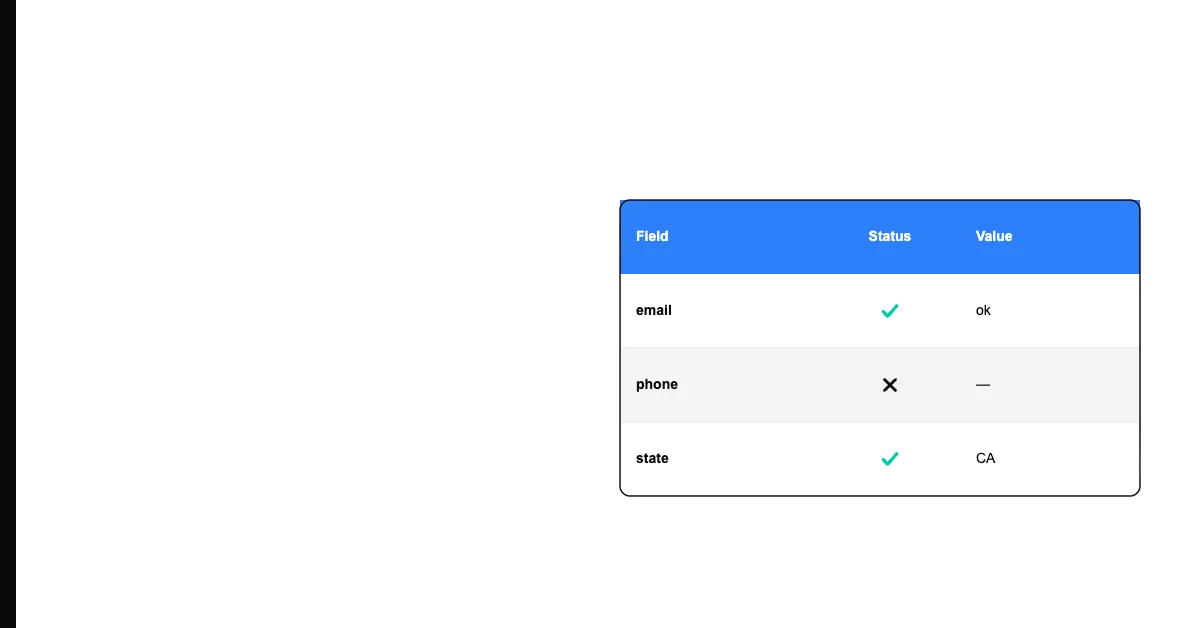
A tool like Sohovi lets you upload your lead export and get an instant completeness and validity report across every field — no code, no setup, no data leaving your browser.
What Good Marketing Data Quality Looks Like
Good marketing data quality is a known, acceptable error rate per field with a process for catching exceptions before they affect campaigns:
- Email validity rate above 97% before any major send
- Duplicate rate below 1% in your active contact database
- Completeness above 90% on every field your lead scoring model uses
- Attribution data with consistent naming across all active campaigns
Frequently Asked Questions
Q: How does bad data affect email marketing campaign performance? Invalid email addresses increase hard bounce rates, which damages your sender reputation with inbox providers. Once your sender score drops, even valid emails land in spam. Industry estimates suggest a 2% hard bounce rate is the threshold beyond which deliverability begins to degrade noticeably.
Q: What causes duplicate leads in a CRM? Duplicates most commonly enter through multiple form submissions from the same person on different campaigns, ad platform lead syncs that don't deduplicate against existing records, manual sales entry, and event registrations imported without a merge check.
Q: How often should marketing operations run a data quality audit? A light audit — completeness check on critical fields, email validation before major sends, duplicate check — should happen monthly. A full audit of your entire active contact database should happen quarterly at minimum.
Q: What is UTM naming convention and why does it matter for data quality? UTM parameters tag URLs with campaign, source, and medium information. Inconsistent naming (capitalizing some values but not others, using dashes in some entries and underscores in others) fragments your attribution data and makes campaign performance reporting unreliable.
Q: Can data quality problems affect lead scoring accuracy? Directly. Lead scoring models assign scores based on field values — job title, company size, behavior data. If those fields are blank or inconsistent, the model either scores incorrectly or can't score at all. Leads that should reach sales get stuck in the wrong stage.
Q: What fields should marketing ops prioritize for data quality? Email address, lead source, campaign attribution fields, job title, company size, and any field used in segmentation or lead scoring logic. Prioritize the fields your business logic depends on most.
Q: How do I clean up a list of contacts inherited from another system? Start with an email validation pass to flag invalids. Then run a deduplication check. Then audit your critical segmentation fields for completeness. Handle in that order — you don't need to clean fields on leads with invalid emails.
Q: What is data decay in a marketing database? Data decay is the natural degradation of contact accuracy over time. Industry estimates suggest marketing databases decay at 20–30% per year. Even a database that was clean when built becomes unreliable within 12–18 months without active maintenance.
Q: How should I handle opt-out and consent data quality? Ensure your unsubscribe and GDPR/CCPA consent flags are propagated accurately and immediately across every system that touches your contact database. A contact who unsubscribed must not receive another campaign from any channel.
Q: What's the difference between data quality for demand gen vs. marketing ops? Demand gen focuses on acquiring leads. Marketing ops is responsible for ensuring the data those leads generate is accurate, structured, and usable across the business. They're complementary — demand gen drives volume, marketing ops ensures quality.
If your marketing team is spending hours cleaning data before every campaign instead of launching them, that's a process signal. The right data quality habit, applied at capture and maintained on a schedule, removes that friction permanently.
If you're ready to see exactly where your marketing data breaks, Sohovi gives you a complete field-by-field quality report on any contact export — free, private, and instant. Upload your first file and get your quality score in under 60 seconds.