The forecast says $2.4M for the quarter. Your team closes $1.6M. When the post-mortem happens, the culprit isn't usually the sales team — it's the pipeline data those projections were built on.
Revenue operations sits at the intersection of sales, marketing, and customer success data. When any of those inputs are wrong, the forecasts that leadership depends on are built on a foundation that was never stable. The fix isn't a better forecasting model. It's cleaner data.
Why RevOps Data Is Structurally Prone to Quality Problems
CRM Data Entered by Sales Reps
Sales reps enter data under time pressure, after calls, often on mobile. They enter the same company under "Acme Corp," "ACME Corporation," and "Acme Inc." — three records in your CRM for one prospect. They forget to update deal stage. They leave close date as the default.
Sohovi finds gaps, duplicates, and format errors in your CRM data — so your team is working from records they can trust.
Industry estimates suggest that CRM databases lose 20–30% of their accuracy every year through natural decay alone — before you factor in bad inputs.
Multi-System Fragmentation
Revenue operations typically touches four to six systems: CRM, marketing automation, customer success platform, billing system, data warehouse, and reporting layer. Every handoff between systems is a potential quality failure. A lead that enters as "Jennifer Smith" in your marketing platform may arrive in the CRM as "Jen Smith" after an integration sync.
Historical Data Debt
Most RevOps teams inherit data accumulated over years. Old deals with wrong close dates that skew sales cycle calculations. Contacts at churned accounts still marked active. Opportunities sitting in pipeline stages from 18 months ago.
The Data Quality Problems That Break Revenue Forecasting Most
- Open opportunities without updated close dates: Pipeline that doesn't reflect real sales activity makes stage-based forecasting unreliable
- Duplicate accounts and contacts: The same prospect counted multiple times inflates pipeline totals
- Missing deal stage history: Without stage-change timestamps, velocity metrics are guesswork
- Unattributed revenue: Closed deals without a lead source break attribution models
- Stale contact data: Contacts at churned or acquired companies still active in your CRM
Sohovi automatically finds every duplicate in your dataset — including near-matches — and shows you exactly which rows are affected.
Practical Data Quality Steps for Revenue Operations
1. Enforce required fields at deal creation. Close date, deal amount, primary contact, and lead source should be non-negotiable. Use CRM validation rules to prevent saving a deal without them.
2. Run a monthly pipeline audit. Flag deals that haven't had a stage change in 30+ days. Close-lose deals with no activity in 60+ days. Stale pipeline is misleading pipeline.
3. Deduplicate accounts and contacts on a schedule. Use your CRM's native dedup tool or export your account list and run a matching check. Duplicate accounts inflate pipeline totals and create confusion in customer success handoffs.
4. Standardize company name formats. Establish a naming convention and run a normalization pass on your account names. "Acme Corp," "ACME Corporation," and "Acme Inc." should resolve to a single canonical record.
5. Audit lead source completeness. Check what percentage of closed deals have a populated lead source field. Below 80% means your marketing attribution reporting is structurally unreliable.
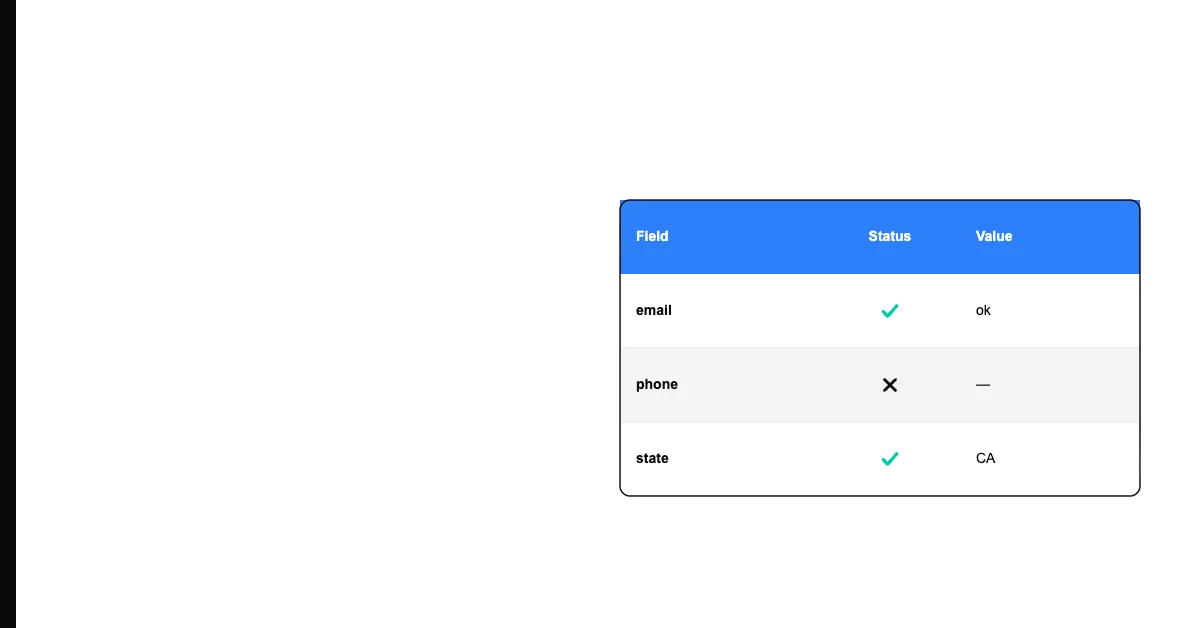
Sohovi lets you upload a CRM export and see a completeness and consistency report across every field — with your data processed entirely in your browser, never sent to an external server.
What Clean RevOps Data Actually Enables
- Forecast accuracy improves because pipeline stage data reflects real deal progress
- Territory planning becomes defensible because account data doesn't have duplicates
- Marketing attribution becomes honest because closed deals are linked to their lead sources
- Commission calculation has fewer disputes because deal data is complete and consistent
- Customer success handoffs are cleaner because account data in the CRM matches the CS platform
Frequently Asked Questions
Q: Why is CRM data quality so hard to maintain in revenue operations? CRM data is entered by many people under time pressure, without immediate accountability for quality. Unlike a database with enforced validation rules, most CRMs allow incomplete or inconsistent records to be saved. The result is systematic accumulation of errors that compounds over time.
Q: How much does bad CRM data affect sales forecasting accuracy? Directly and significantly. Stage-based forecasting assumes that deal stage reflects real probability. When reps don't update stages, deals sit in the wrong stage and distort probability-weighted pipeline. Industry estimates suggest poor CRM data hygiene is one of the top three causes of forecast miss in B2B sales organizations.
Q: What is pipeline hygiene and how does it relate to data quality? Pipeline hygiene refers to keeping open opportunities accurate and current — updated stages, realistic close dates, active contacts. It's a subset of CRM data quality, specifically focused on the records that drive forecasting.
Q: How do duplicate accounts affect revenue operations? Duplicate accounts mean the same company exists multiple times in your CRM. This inflates pipeline totals when deals are attached to different duplicates of the same account, creates confusion in territory assignments, and makes account-based reporting unreliable.
Q: What fields should RevOps enforce as required in a CRM? At minimum: close date, deal amount, deal stage, primary contact, lead source, and account name. These six cover the most critical gaps for forecasting and attribution.
Q: How often should a RevOps team run a data quality audit? A light pipeline audit should happen weekly or biweekly. A full data quality review — accounts, contacts, closed deals, lead source coverage — should happen quarterly.
Q: What's the impact of bad lead source data on marketing and RevOps alignment? If lead source is missing on closed deals, marketing can't demonstrate pipeline contribution. This creates structural friction between marketing and sales — marketing believes they're generating pipeline, but the data doesn't support it.
Q: How can RevOps improve data quality without relying on sales reps to change behavior? Enforce validation rules in the CRM so required fields can't be skipped. Use automation to populate fields where possible. Run regular audits and route exception reports to sales managers, not directly to reps.
Q: What is data decay in a sales CRM and how fast does it happen? Industry estimates suggest 20–30% of B2B contact data becomes inaccurate within a year. Job titles, phone numbers, and company affiliations for a significant portion of your database are wrong within 18 months of capture.
Q: How does RevOps data quality affect customer success handoffs? When a deal closes, customer success inherits the account record. If that record has wrong stakeholders or data that doesn't match the billing system, the CS team starts the relationship with incorrect information. Handoff quality directly affects customer onboarding experience.
Revenue forecasting doesn't have a model problem. It has a data problem. Fix the underlying inputs and the forecast accuracy improves — without changing the model at all.
If your RevOps team is ready to see exactly where your CRM data breaks down, Sohovi gives you a field-by-field quality report on any export — free to start, no IT team, no code required.