You're heading into a renewal conversation with an account your data shows as healthy. Medium NPS score. No open support tickets. Usage trending up. You walk in confident — and the customer tells you they've been planning to churn for three months because of a billing issue you never knew about.
This isn't a CS failure. It's a data failure. The account health picture your team is working from has gaps.
What Customer Success Data Actually Looks Like in Practice
Customer success data is pulled from more sources than almost any other function: CRM for account and contact data, product for usage data, billing for subscription and payment history, support platforms for ticket volume and sentiment, and NPS tools for survey responses.
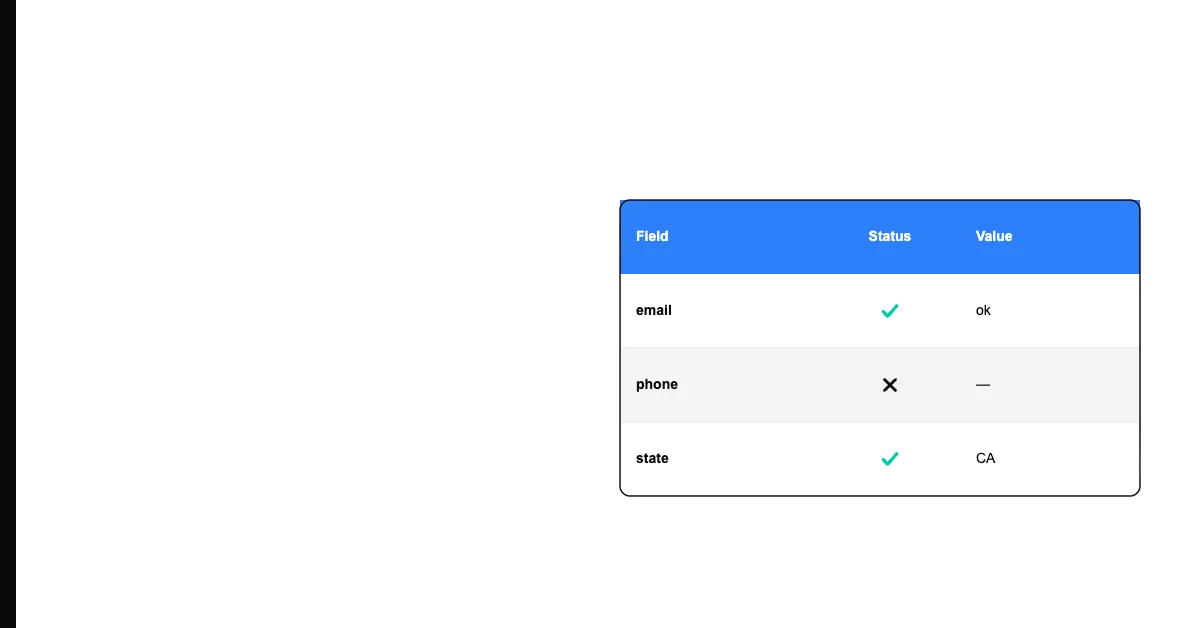
Sohovi finds gaps, duplicates, and format errors in your CRM data — so your team is working from records they can trust.
Every source introduces its own quality problems. Because CS decisions — who to escalate, who to expand, who is at churn risk — are made against a composite picture assembled from all these sources, a problem in any one of them degrades the whole picture.
The Data Quality Problems That Break Customer Success Most
Stale Contact Data
People leave companies. Decision-makers get replaced. New stakeholders join the account without being added to the CRM. The contact data that was accurate at onboarding may be 18 months out of date by the time renewal comes up.
A CS team that hasn't validated its primary contact and economic buyer fields for active accounts is flying blind on renewal conversations. They may be nurturing a champion who left six months ago.
Sohovi lets you set up validation rules for any column and instantly see which rows fall outside them — no code or SQL required.
Incomplete Usage Data
Usage data is often incomplete in ways that are hard to detect. Events that aren't tracked. Sessions that fail to log. Features that were added after the initial tracking implementation and are never instrumented. The result is a usage profile that appears complete but underrepresents actual product engagement.
Mismatched Account Data Across Systems
The CRM record says "Enterprise." The billing system shows a Mid-Market plan. The CS platform has a different MRR than the billing system. These mismatches are common when account data is managed independently in each system. They make account-level reporting unreliable and create confusion in escalation and renewal workflows.
Support Ticket Quality
Support data affects CS health scoring when CSAT, ticket volume, or unresolved issue counts are incorporated into health models. If tickets are miscategorized, closed prematurely, or attributed to the wrong account, the health signal is wrong.
Practical Steps for CS Teams to Improve Their Data Quality
1. Audit primary contact accuracy quarterly. For every account in renewal stage in the next 90 days, verify that the primary contact and economic buyer fields reflect current stakeholders.
Sohovi scores your dataset against your own accuracy standards and highlights the columns and rows where values fall outside expected ranges.
2. Validate ARR and MRR against the billing system. Reconcile the ARR values in your CS platform against the billing system at least monthly. Discrepancies are common and they affect expansion targeting.
3. Track usage data coverage. Know what percentage of your active accounts have usage data in your health model. If a significant portion have no usage signal at all, your model is misrepresenting their health.
4. Standardize account tier definitions. Establish one canonical definition and enforce it across systems. Inconsistent tier definitions make every segment-level analysis produce wrong results.
5. Create a data quality checklist for onboarding. The best time to capture accurate account data is during onboarding, when the relationship is active and contacts are engaged.
Sohovi lets you upload an account export and see exactly which fields are incomplete, which have inconsistent formats, and which accounts have data gaps — without sending your customer data to an external server.
Frequently Asked Questions
Q: Why is account data quality especially important for customer success? CS decisions — who to call, when to escalate, where to invest retention effort — are all made against account data. A renewal conversation based on wrong data doesn't just miss. It actively misleads the team and damages the customer relationship when the CS rep doesn't know something the customer assumed they knew.
Q: What is customer data decay and how does it affect CS teams? Customer data decay is the process by which account and contact information becomes inaccurate over time. Contacts leave. Companies get acquired. For CS teams managing 100+ accounts, even a 20% annual decay rate means 20 accounts per 100 have materially wrong contact data within a year.
Q: How often should a CS team audit their account data? For accounts in active renewal or expansion stages, contact accuracy should be validated at least 60 days before the renewal date. For the full account base, a quarterly completeness audit of critical fields is a reasonable cadence.
Q: What fields matter most for customer success data quality? Primary contact, economic buyer, account tier, ARR or MRR (reconciled to billing), product plan, contract renewal date, and the key usage metrics feeding your health score.
Q: How do mismatched records across CRM and billing systems affect CS? When the CRM shows one ARR and billing shows another, CS doesn't know which number to trust. This creates confusion in renewal pricing conversations and inaccurate churn risk calculations.
Q: Can a health score be reliable if it's built on incomplete data? Not reliably. A health score is only as trustworthy as the completeness and accuracy of its inputs. If usage data is missing for a significant percentage of accounts, the score produces false signals — both false positives and false negatives.
Q: How should CS teams handle accounts with missing usage data? Mark them explicitly as "no usage signal" rather than treating them as neutral. An account with confirmed low usage is different from an account with no usage data. The latter requires outreach to verify engagement.
Q: What role does data quality play in CS-to-sales handoffs for expansion? CS-sourced expansion opportunities depend on accurate account data — the right contact, the right product usage signals, the right account context. If that data is stale when the opportunity is passed to sales, the conversation starts with a disadvantage.
Q: How can CS teams improve data quality without a data engineering team? Focus on completeness audits of the fields that matter most, enforce data entry requirements in your CS platform, and reconcile your key metrics against source systems on a regular schedule. These are operational habits, not technical projects.
Q: What's the connection between data quality and customer churn? At the most direct level, missed escalations and incorrectly scored at-risk accounts produce preventable churn. A customer who notices that your team doesn't know their current stakeholders or billing history experiences lower confidence in your team — which is itself a churn signal.
The accounts your CS team is most likely to lose are the ones where the data was never maintained well enough to see the warning signs. That's fixable — and it starts with knowing which fields are broken.
If you want to see the exact data quality gaps in your account export before they cost you a renewal, Sohovi gives you a field-by-field completeness and consistency report — free, instant, and private. No data ever leaves your browser.