Your accounts payable team just flagged a duplicate payment to a supplier — $47,000 paid twice because the vendor appeared in your system under two different names with two different IDs, and both records had an open invoice. No one's fault. Just a data quality problem that got expensive.
Procurement data quality problems have a direct path to cash. Duplicate vendor records create duplicate payment risk. Incomplete supplier data creates contract compliance gaps. Stale contact information creates failed delivery confirmations and delayed disputes.
The Unique Data Quality Challenge in Procurement
Procurement data lives at the intersection of internal systems (ERP, AP, procurement platform) and external data (supplier-provided information your team didn't create). Every supplier onboarding creates a new record. Every contract creates structured data that needs to match the supplier record. Every invoice creates a transaction that needs to match both.
The data quality problem compounds at each stage. A supplier name entered inconsistently at onboarding propagates to every downstream record.
Vendor Master Data: The Root of Most Procurement Data Problems
The vendor master file is the central reference dataset for all procurement and AP activity. When it has quality problems — duplicates, stale contact information, missing tax identifiers, inconsistent naming — every process that references it inherits those problems.
Sohovi automatically finds every duplicate in your dataset — including near-matches — and shows you exactly which rows are affected.
Industry estimates suggest that in organizations with manual vendor onboarding processes, vendor master duplicate rates of 2–5% are common. In organizations with multiple business units using separate ERP instances that were later merged, duplicate rates can be significantly higher.
The Data Quality Problems That Cost Procurement Teams Most
- Duplicate vendor records: Same supplier as two or more records — different IDs, possibly different payment terms, both with open invoices
- Stale supplier contact data: Primary contacts who have left, outdated banking details that cause payment failures
- Inconsistent vendor naming: "IBM," "IBM Corp," "International Business Machines" — three records for one supplier, each with some transactions and none with a complete history
- Missing or wrong tax identifiers: TIN, VAT number, or EIN fields that are blank — compliance and 1099 reporting problems
- Contract term mismatches: Payment terms in the vendor master that don't match the executed contract
- Supplier categorization errors: Vendors coded to wrong spend categories or risk tiers
Practical Steps for Procurement Teams to Improve Supplier Data Quality
1. Deduplicate your vendor master before the next AP cycle. Export your vendor list and run a matching check for name variations, address matches, and tax identifier overlaps. Merge duplicates and establish one canonical record per supplier.
2. Validate tax identifiers on all active vendors. For US vendors subject to 1099 reporting, validate that TIN fields are populated and formatted correctly for all vendors above the reporting threshold.
3. Run a payment terms audit. Check that the payment terms in your vendor master match your executed contracts. Discrepancies create exposure — either you're paying earlier than required or later than agreed.
4. Establish a vendor onboarding data standard. Define required fields and formats for new vendor records. Enforce this standard in your onboarding workflow. Incomplete records should not be activatable for purchasing.
5. Audit stale vendor contacts annually. For every active vendor, verify that the primary contact, email address, and banking details are current.
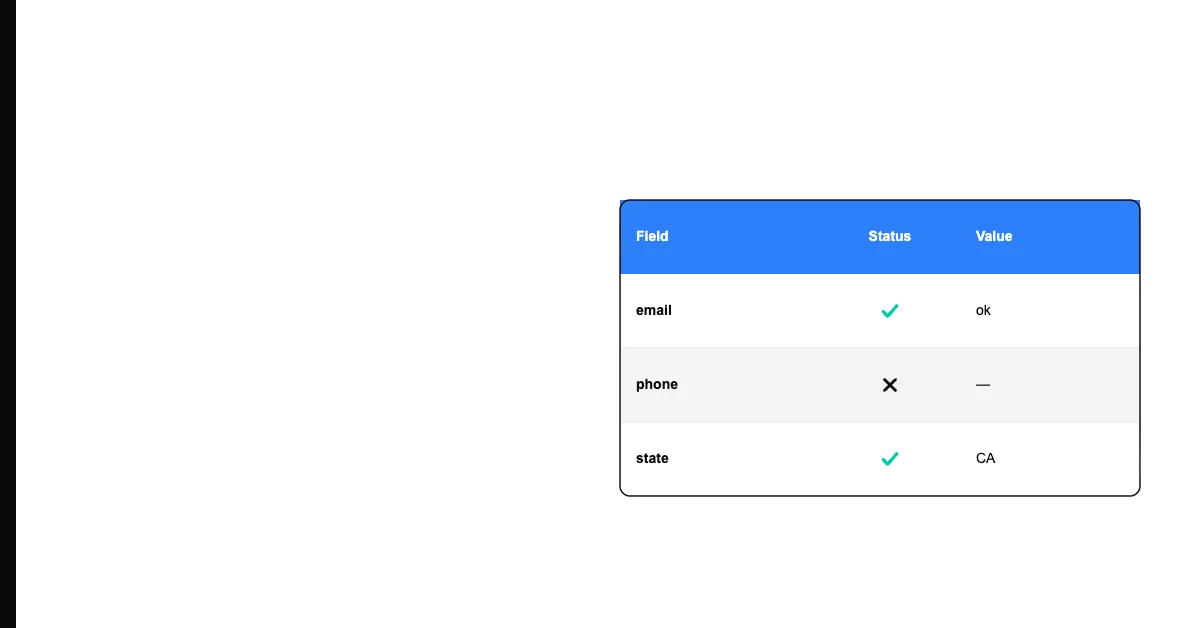
A tool like Sohovi lets you upload your vendor master export and immediately see duplicate records, completeness gaps in critical fields, and formatting inconsistencies — with your supplier data processed entirely in your browser, never shared externally.
Frequently Asked Questions
Q: What is a vendor master file and why is data quality critical for it? A vendor master file is the central record of all approved suppliers — their names, addresses, tax identifiers, payment terms, contact information, and banking details. Every PO, invoice, and payment references the vendor master. When it has quality problems, those problems propagate into every downstream process.
Q: How do duplicate vendor records cause duplicate payments? When the same supplier exists as two separate records, AP staff can match an invoice against either record. If both records have an open invoice for the same amount, there's risk of both being paid — particularly in high-volume AP environments where individual transaction review is limited.
Q: How often should procurement teams audit their vendor master? A duplicate and completeness audit should happen at least annually, ideally before year-end close when tax data validation is also required. A lighter contact accuracy review should happen semi-annually.
Q: What is vendor name normalization and why does it matter? Vendor name normalization establishes one canonical form for each supplier and ensures all records use that form. Without it, "IBM," "IBM Corp," and "International Business Machines" appear as three separate vendors in spend analysis.
Q: How does stale supplier banking data affect operations? When banking details for a vendor are outdated, ACH and wire payments fail. This requires emergency correction and potential late payment fees.
Q: What fields should be required for vendor onboarding? At minimum: legal entity name, address, primary contact name and email, tax identifier, payment terms, banking details, and spend category.
Q: How should procurement handle supplier data that can't be verified? Hold activation until information is confirmed. For existing suppliers with stale data, flag the record and pause new POs until data is refreshed.
Q: What is spend category data quality and why does it affect sourcing decisions? Spend category data tells you how much your organization spends with which types of suppliers. If vendors are coded to wrong categories, your spend analysis is wrong and sourcing strategy is based on incorrect baselines.
Q: How does procurement data quality affect supplier relationship management? When supplier contact data is stale, outreach goes to people who have left, and disputes take longer to resolve because the right contact can't be reached.
Q: What's the connection between procurement data quality and financial audit? Auditors reviewing procurement activity look at the reliability of controls, including the vendor master. A vendor master with a high duplicate rate or missing tax identifiers is a control weakness that increases audit findings.
Duplicate vendor records, stale contacts, and wrong payment terms aren't administrative annoyances — they're financial and compliance risks. The cost of a clean vendor master is a few hours of quarterly maintenance. The cost of a duplicate payment is orders of magnitude higher.
When your procurement team is ready to see exactly where your vendor master has quality gaps, Sohovi gives you a complete field-by-field quality report on any supplier data export — free, instant, and your data never leaves your browser.