A litigation hold arrives. Your team needs to produce all communications with a specific counterparty between two dates. Your records system returns 847 documents. But because email addresses were inconsistently recorded across three systems, 214 documents that should have been captured weren't matched by the query. You produced an incomplete response.
That's not a legal strategy failure. It's a data quality failure with legal consequence.
Legal and compliance teams work with records that are required to be accurate, complete, and accessible — not for operational reasons, but for regulatory and litigation reasons. When those records have data quality problems, the consequences aren't a missed KPI. They're regulatory findings, discovery sanctions, and enforcement actions.
Why Legal and Compliance Data Quality Is Different
In most functions, a data quality problem creates an operational inefficiency. In legal and compliance, the same data quality problem may create evidence of non-compliance, impair the ability to produce records in litigation, or undermine the credibility of compliance attestations.
The Retention and Disposal Problem
Data quality intersects with legal hold and records retention in a specific way: you can only hold what you can find, and you can only defensibly dispose of what you've correctly identified. Poor data quality — wrong dates, missing matter IDs, inconsistent record categorization — creates situations where records that should have been retained weren't.
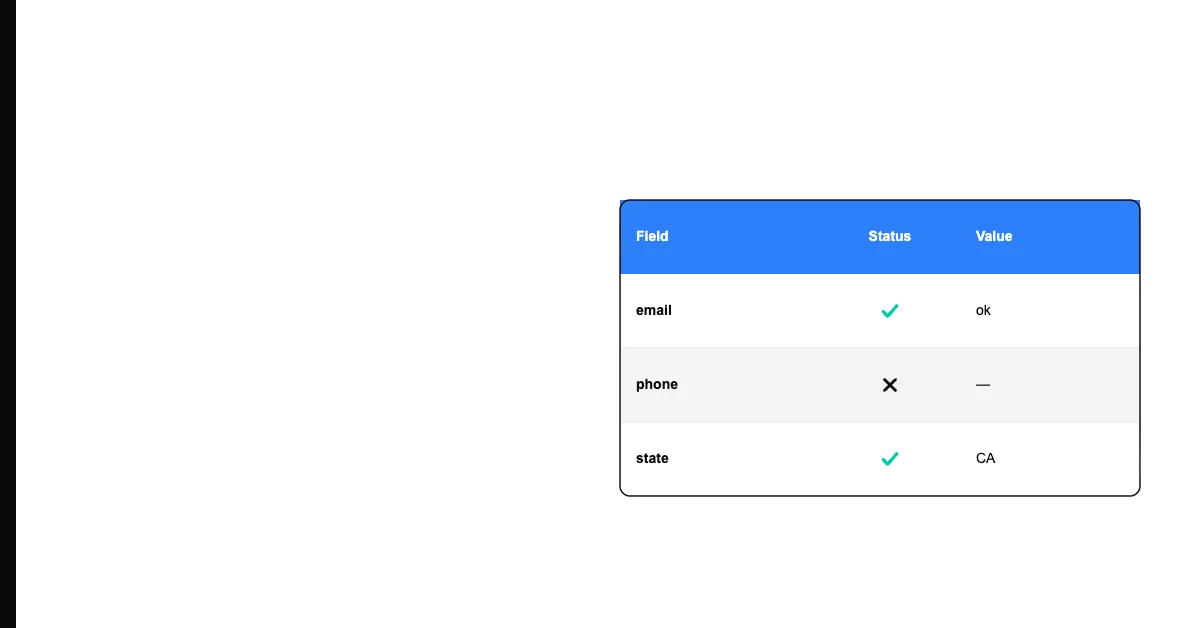
Sohovi shows you exactly what is wrong with your data — completeness gaps, type mismatches, duplicates — in one clear report.
The Data Quality Problems Legal and Compliance Teams Face Most
Inconsistent Counterparty and Entity Names
The same entity recorded as "Apex Technologies," "Apex Tech," "Apex Technologies Inc.," and "Apex" across different systems. When you need to search for all activity involving this counterparty — for a litigation hold or compliance review — each variation may or may not be captured.
Incomplete Obligation and Deadline Records
Contracts have dates — effective dates, expiration dates, notice periods. When those dates are incomplete, wrong, or stored inconsistently, your obligation tracking is unreliable. Missed renewal windows and overlooked compliance deadlines are often traceable to a record with a wrong or missing date.
Unstructured Records in Systems Without Quality Controls
Legal records often include unstructured content — emails, documents, communications — in systems that weren't designed for legal compliance. When structured metadata (sender, recipient, date, matter ID) is wrong or missing, discovery and hold processes can't reliably capture the full record set.
Conflicting Records Across Systems
The HR system and the contract management system may both have a record for the same vendor relationship — with different effective dates, different signatories, and different payment terms. In a dispute, which is authoritative matters.
Practical Steps for Legal and Compliance Teams
1. Establish a canonical record standard for counterparty names. Define how counterparty entities will be named in all systems your team maintains. Create a lookup table of all variations of each entity name and ensure your search processes capture all variants.
2. Audit contract database completeness on critical date fields. For every active contract, verify that effective date, expiration date, and governing law fields are populated and in consistent formats.
Sohovi profiles every column in your dataset for completeness and flags the exact rows where values are missing — free to try.
3. Run a retention schedule audit against your records inventory. For each record type, verify that records are classified correctly against your retention schedule categories.
4. Document your data quality baseline before any regulatory review. Before a scheduled audit, self-audit your records for completeness and consistency. Regulators evaluate the quality of your recordkeeping.
5. Validate that legal hold processes capture all record variants. Before certifying a hold response as complete, verify your search covered all known variations of counterparty names, matter identifiers, and date ranges.
Sohovi lets you set up validation rules for any column and instantly see which rows fall outside them — no code or SQL required.
GDPR, CCPA, and the Data Quality Obligation
GDPR Article 5(1)(d) requires that personal data be accurate and, where necessary, kept up to date. CCPA requires businesses to respond accurately to consumer data requests, which depends on records being complete and correctly attributed.
A records system with duplicate customer records, inconsistent email addresses, or stale contact information creates specific regulatory exposure under data protection law. A consumer data deletion request that misses records because of entity resolution problems is a GDPR compliance failure.
Frequently Asked Questions
Q: Why is data quality a legal and compliance concern, not just an IT concern? Legal and compliance teams are accountable for the accuracy of records under regulatory requirements and litigation obligations. When records are wrong or incomplete because of data quality problems, the legal and compliance team bears the consequence — regulatory findings, sanctions for incomplete discovery responses, and credibility challenges.
Q: What is entity resolution and why does it matter for legal record management? Entity resolution is the process of identifying that different records — with different name formats — refer to the same real-world entity. Poor entity resolution means searches for records about a specific counterparty may miss documents filed under name variants. Completeness of record production in litigation depends on entity resolution quality.
Q: How does poor records data quality affect e-discovery? E-discovery requires producing all responsive documents within a defined scope. When records have inconsistent metadata — wrong dates, missing matter IDs — search queries may miss records that should have been included. Incomplete production due to data quality failures is treated the same as other discovery failures.
Q: What are the GDPR data quality requirements? GDPR Article 5(1)(d) establishes data accuracy as a core data protection principle. Personal data must be accurate and kept up to date, with inaccurate data corrected or erased without delay. Article 16 gives data subjects the right to rectification of inaccurate personal data.
Q: How should legal teams handle conflicting records across systems? Establish a system of record — one authoritative source for each record type — and document it. When two systems have conflicting information, the system of record governs. Unresolved conflicts create the kind of ambiguity that becomes evidence in a dispute.
Q: What is a records retention schedule and how does data quality affect its enforcement? A retention schedule defines how long each record type must be kept and when it can be destroyed. Enforcing it requires correctly categorizing every record against the schedule categories. Records with wrong or missing classification data can't be enforced against.
Q: What data quality checks should be part of a pre-audit preparation process? Completeness checks on all required fields in records systems, verification that counterparty names are standardized and searchable, date field completeness and format consistency audit, and a check for duplicate records that might produce double-counting in audit-facing reports.
Q: How should compliance teams manage data quality in systems they don't control? Establish data quality requirements for any system whose records feed compliance reporting, and include those requirements in vendor agreements and internal data governance policies. Build validation checks at the point where data enters compliance processes.
Q: What is the connection between data quality and SOX compliance? SOX Section 302 requires certifying officers to affirm that disclosure controls ensure material information is recorded and reported accurately. Data quality problems in records material to financial reporting create SOX compliance exposure.
Q: Can a compliance team use a data quality tool without creating additional privacy risk? This depends on the tool's architecture. Tools that process data on their servers create data residency and access control considerations under GDPR and other privacy regulations. Sohovi processes data entirely in the browser — raw records never leave the user's environment — which makes it usable for compliance records without triggering additional data transfer compliance requirements.
Legal and compliance records need to be accurate not because accuracy is convenient, but because it's required. The organizations that respond to audits and litigation confidently are the ones that know their records are right — not because they believe it, but because they checked.
When your legal or compliance team needs to verify the quality of any records export before it goes to regulators or counsel, Sohovi gives you a complete field-level quality report — privately, instantly, and without your data ever leaving your browser.