You spent three days building an analysis that led to a major decision. A week later, someone found a duplicate in the source data that inflated the key metric by 18%. The decision was made on a number that was wrong. Your credibility takes the hit, even though the analysis itself was sound.
This is the business analyst's version of a data quality problem: not a broken pipeline, not a failed system — just a bad dataset that produced a misleading insight.
Why Business Analysts Have a Unique Data Quality Challenge
Business analysts typically don't own the systems that produce the data they analyze. They receive data from other teams, pull exports from tools they don't administer, and work with files that have been through multiple hands.
This means the analyst's data quality challenge is primarily about what to check before trusting data they didn't produce — not about fixing the systems that generate it.
The Trust Problem
When an analyst presents findings to leadership, the implicit assumption is that the underlying data is reliable. But in most organizations, no one explicitly verified that assumption before the analysis was built. Industry estimates suggest that data analysts spend 30–40% of their working time on data cleaning and preparation tasks — much of it discovering quality problems that could have been identified upfront with a structured check.
Sohovi profiles your datasets for quality issues in minutes — see what's broken before it breaks your pipeline — try Sohovi free.
The Data Quality Issues Business Analysts Encounter Most
Duplicate Records
Duplicates are the analyst's most common data enemy. A customer who appears twice produces double-counted revenue. A campaign response in two cohorts inflates both conversion rates. Duplicates are often subtle — same company with different formats, same customer with two email addresses.
Inconsistent Field Values
A "status" field that uses "Active," "active," "ACTIVE," and "1" to mean the same thing. A date field where some records use MM/DD/YYYY and others use YYYY-MM-DD. These inconsistencies silently fragment your analysis into subgroups that should be one group.
Missing Values in Key Dimensions
An analysis of revenue by customer segment breaks when 22% of customers have no segment assigned. The analyst often doesn't discover this gap until the numbers don't add up — late in the analysis process.
Wrong Date Ranges
An export that was supposed to cover Q3 but includes some Q4 records due to a timezone issue. Date range errors are some of the hardest quality problems to catch because the data looks complete — it just covers the wrong period.
A Practical Data Quality Checklist for Analysts
Use this before beginning any analysis on new data:
- Row count sanity check: Does the number of rows match expectations?
- Duplicate check on primary key: Are there any duplicate values in the field that should uniquely identify each record?
- Null rate by column: What percentage of each critical column is empty?
- Value distribution check: For categorical fields, what are all the distinct values present?
- Date range validation: Do the dates cover the expected period? Are there outlier dates?
- Join key validation: If you're joining this dataset to another, how many records in each have no match?
Sohovi automatically finds every duplicate in your dataset — including near-matches — and shows you exactly which rows are affected.
How to Make Data Quality Checks Part of Your Workflow
The most effective analysts treat data quality checks as the first step of every project, not a remediation step when something looks wrong. Fifteen minutes at the start of a project reviewing source data quality saves hours of downstream confusion.
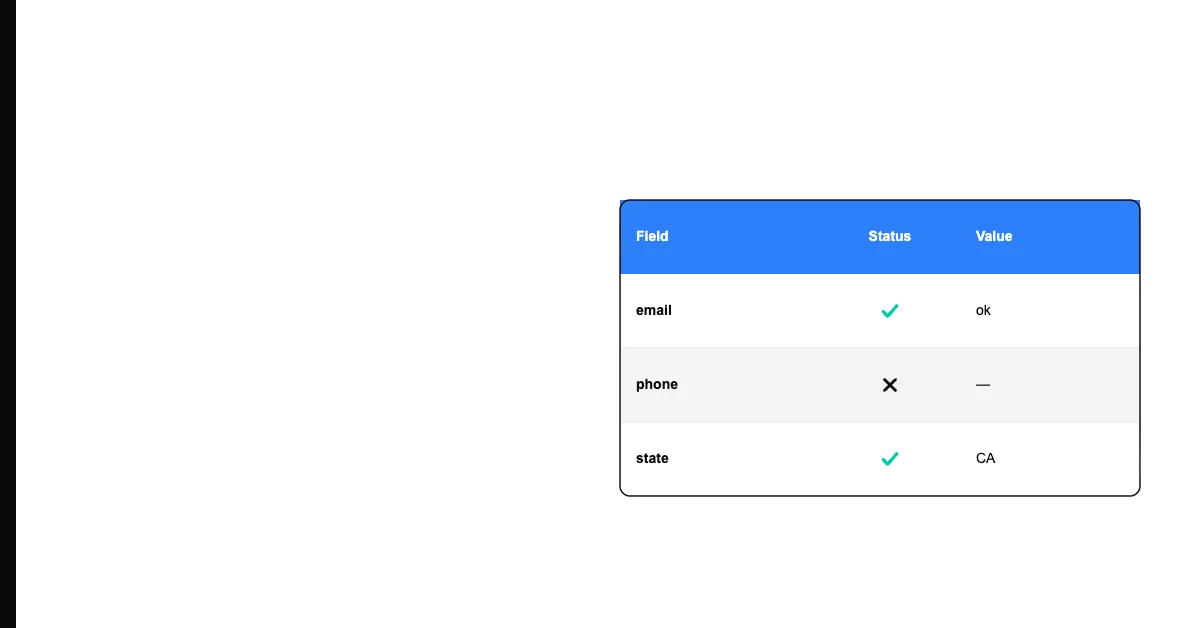
Sohovi lets you upload any CSV or Excel export and get an instant quality report — duplicate count, null rates by column, format inconsistencies, and value distribution — before you open it in your BI tool or spreadsheet.
Frequently Asked Questions
Q: Why do business analysts spend so much time on data cleaning? Because quality problems are usually invisible until you're deep in an analysis. Analysts discover quality problems when a number looks wrong and start tracing backward. Upfront quality checks compress this discovery time from hours to minutes.
Q: What is the most dangerous data quality problem for a business analyst? Duplicates, because they silently inflate any aggregate metric without producing an obvious error. A sum of revenue with duplicates just looks like a higher number. There's no error signal — only a wrong answer.
Q: How should an analyst handle a dataset with a 20% null rate on a critical field? Determine whether the null rate is random or systematic. Random nulls allow you to proceed with caveats. Systematic nulls — concentrated in a specific time period, segment, or source — require investigation before the data is used.
Q: What is the difference between data cleaning and data quality checking? Data quality checking is understanding what quality problems exist. Data cleaning is fixing them. The check should always come before the clean — you need to know what the problems are before you can fix them appropriately.
Q: How can a business analyst verify the accuracy of a number in a data export? Cross-validate against at least one other source. If your export shows 12,000 monthly active users, does the billing system show approximately the same number of active paid accounts? Cross-validation catches large discrepancies.
Q: What is a join quality check and why does it matter? A join quality check verifies that when you join two datasets, the join key produces the expected match rate. If 30% of transactions have no matching customer, that's either a data quality problem or a business reality — you need to know which before proceeding.
Q: How should a business analyst communicate data quality caveats in a presentation? Explicitly. Note the null rate on any field critical to the analysis. Mention the duplicate check you ran. If the analysis excluded records with missing values, state what was excluded. This doesn't weaken the analysis — it makes it more credible.
Q: What is an analyst's responsibility for data quality vs. the data engineering team? The data engineering team is responsible for the quality of data in the systems they maintain. The analyst is responsible for verifying the quality before building analysis on it — even if they don't own the source system.
Q: How do value distribution anomalies affect business analysis? An unexpected value in a categorical field or a numeric outlier can distort aggregates and statistical measures. An unexpected value in a segment field can create a "segment" that represents data errors rather than a real customer category.
Q: What tools do business analysts use for data quality checks? SQL for database-based checks, Python or Excel for file-based checks, and specialized data profiling tools. The most important attribute of a tool for analysts is speed — the check needs to be fast enough that it becomes a routine first step rather than a project.
An analyst who builds on bad data produces bad insights with excellent methodology. The quality check at the start of a project isn't optional — it's what separates insight you can defend from insight that gets walked back in the meeting.
Sohovi shows you exactly what is wrong with your data — completeness gaps, type mismatches, duplicates — in one clear report.
If you're ready to make data quality checking a fast, consistent first step in every analysis, Sohovi gives you a complete field-by-field quality report on any data export — free, instant, and private.