Customer data quality is the foundation of every customer-facing operation — marketing, sales, support, billing, and retention all depend on having accurate, complete, current customer records. When that foundation is wrong, every operation built on it underperforms.
What Makes Customer Data Decay So Fast
B2B contact data decays at roughly 30% per year (industry estimates). People change jobs, get promotions, update email addresses, and move companies. Consumer contact data decays more slowly but still significantly — people move, change phone carriers, abandon old email addresses.
A CRM that hasn't been actively maintained for 18 months may have 40-50% of its contact records partially or fully stale. The records look complete — they have all the fields filled in. They're just wrong.
Sohovi finds gaps, duplicates, and format errors in your CRM data — so your team is working from records they can trust.
The Core Dimensions of Customer Data Quality
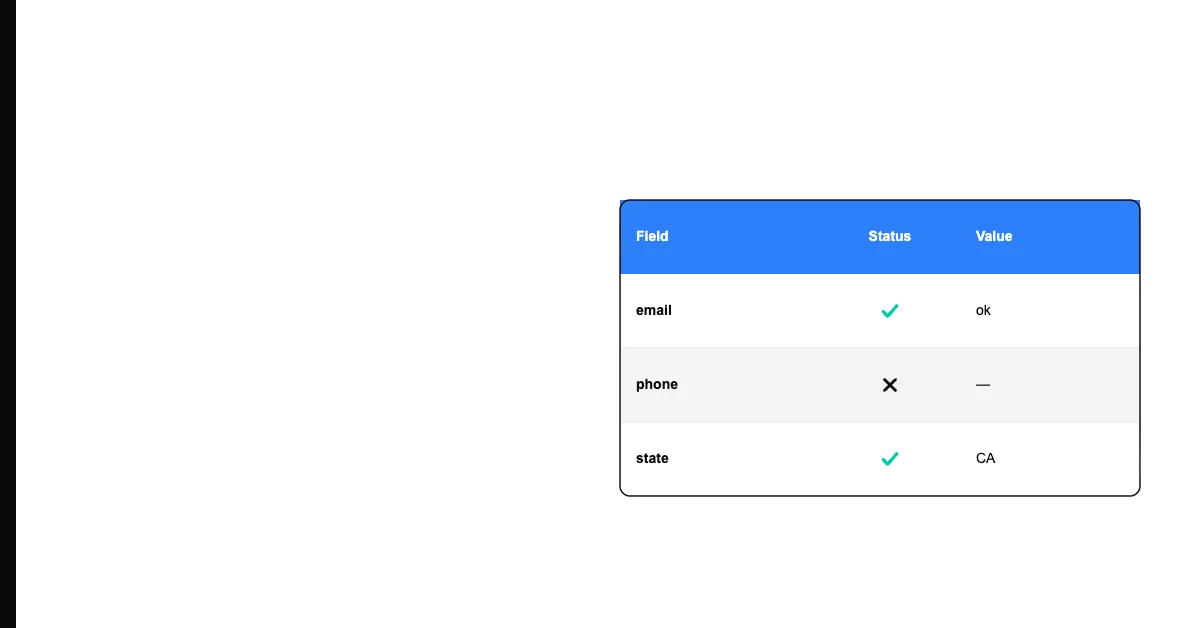
Completeness: Are all required fields populated? At minimum, every customer record should have: primary email, primary phone, company (for B2B), and one address. Missing these limits what you can do with the record.
Accuracy: Does the data reflect reality? An email that was accurate at signup may no longer reach the customer if they changed jobs. A phone number for a company's main line may no longer be the right contact. Accuracy is the hardest dimension to maintain at scale.
Uniqueness: Is each customer represented once? Duplicate customer records split interaction history, create double-outreach, and inflate your customer count. Deduplication on email is the primary key for most contact databases.
Sohovi automatically finds every duplicate in your dataset — including near-matches — and shows you exactly which rows are affected.
Timeliness: When was the record last verified? A "last verified" timestamp lets you identify records that need refreshing.
Practical Maintenance Strategies
Verification through engagement: Any customer who opens an email, logs into your platform, or interacts with your support team is implicitly confirming their email is active. Track these engagement signals to identify which records are verified-current.
Progressive enrichment: When customers interact with your brand across multiple touchpoints, capture new data at each interaction to fill gaps. A contact who fills out a webinar registration form may provide their phone number for the first time.
Periodic re-verification campaigns: For high-value segments, send a "Is your information current?" email annually. Even a 30% response rate significantly refreshes your highest-priority records.
Automated enrichment: Commercial data enrichment services (Clearbit, ZoomInfo, Apollo) can refresh job titles, company associations, and contact details automatically. Quality varies — always validate enriched data before relying on it.
Sohovi lets you set up validation rules for any column and instantly see which rows fall outside them — no code or SQL required.
A tool like Sohovi lets you upload your customer contact export and immediately see completeness rates, duplicate counts, and format validity across every field — so you know exactly where your contact data quality stands before your next campaign.
Frequently Asked Questions
Q: How often should customer contact records be verified? For active marketing contacts, annual verification is a minimum — quarterly is better. B2B contact data decays the fastest, so higher verification frequency is warranted for B2B customer lists. Verification through engagement signals (opens, logins) can complement scheduled verification campaigns.
Q: What is the most important field to maintain for customer contact quality? Email address is the most critical — it's used for virtually every customer communication. After email, primary phone and company name (for B2B) are next in importance. Maintaining these three fields at high quality covers most use cases.
Q: How do I identify stale customer records without contacting every customer? Use engagement signals to identify records that are likely current (email opens in the last 6 months, recent logins, recent purchases) and flag records with no engagement signals as potentially stale. Focus re-verification effort on the flagged records.
Q: What is the cost of maintaining customer data quality vs. the cost of not doing it? The cost of maintenance (periodic validation, enrichment subscription, re-verification campaigns) is typically much lower than the cost of bad customer data (wasted campaign spend, damaged deliverability, missed opportunities, customer experience failures).
Q: Should I delete customer records that I can't verify? It depends on the context. For active marketing purposes, unverifiable records should be suppressed until verified. For customer relationship management, flagging as "needs verification" is more appropriate than deletion — you may still need the record for historical context.
Q: What is the difference between customer data quality and CRM data quality? CRM data quality is the broader category — it includes all data in your CRM: leads, contacts, accounts, opportunities, activities. Customer data quality refers specifically to the records of confirmed customers. The quality management practices are similar, but customer records may warrant higher quality thresholds because the relationship is already established.
Q: How does data enrichment help customer data quality? Enrichment adds missing fields and updates stale ones using external data sources. For B2B contacts, it can update job titles, company names, and phone numbers when people change jobs. The limitation: enriched data is only as current as the provider's database, which may itself have some staleness.
Q: What is a "data health score" for a customer record? A data health score aggregates multiple quality indicators — completeness, freshness, engagement signals — into a single score per record. Records below a threshold score are prioritized for re-verification. It's a useful tool for managing large contact databases at scale.
Q: How does customer data quality affect customer lifetime value calculations? Directly. If your customer database has significant duplicate records, your customer count is inflated, making average LTV calculations understated. If records are missing purchase history (split across duplicate records), per-customer revenue is understated. Clean, deduplicated records are the prerequisite for reliable LTV metrics.
Q: What fields should be required for a new customer contact record? At minimum: email (primary identifier), first name and last name, and company (for B2B). For customer records specifically: date of first purchase and customer ID. Everything else is valuable but optional if it prevents the required fields from being completed.
Customer data quality is an ongoing operational discipline, not a one-time project. Verify through engagement, enrich where practical, monitor completeness rates, and remediate before every major campaign.