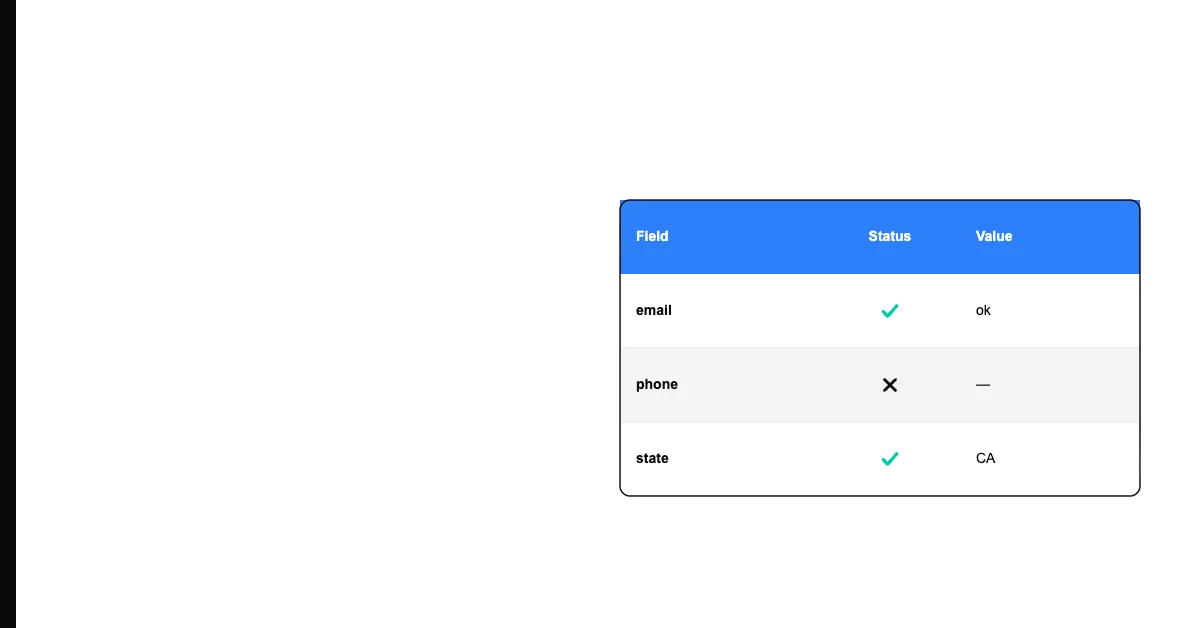
Phone number data quality problems are ubiquitous and expensive. A sales team dialing through a territory list where 30% of numbers are wrong wastes hours per rep per week. A fulfillment system that can't send delivery notifications because phone fields are empty or invalid creates customer experience failures. An SMS campaign with 15% invalid numbers triggers carrier filtering.
Why Phone Number Data Is So Problematic
Phone numbers have more format variety than almost any other field:
- (555) 123-4567
- 555-123-4567
- 555.123.4567
- 5551234567
- +1 555 123 4567
- +15551234567
All of these represent the same number. To a system doing exact string matching, they're six different values. Without standardization, deduplication on phone fails, and any lookup against a reference list fails.
Sohovi automatically finds every duplicate in your dataset — including near-matches — and shows you exactly which rows are affected.
Beyond format, phone data decays through:
- People changing phone numbers when they change carriers
- Business numbers that become invalid when companies relocate or close
- Personal numbers that are abandoned
- Extensions that change without the main number changing
Validation Approaches for Phone Numbers
Syntax validation: Check that the number contains only digits and allowed formatting characters, has an appropriate digit count (7-15 digits internationally, per ITU standard), and follows the expected format for its region. This is the minimum viable validation and catches obvious errors.
Format standardization: Convert all phone numbers to a canonical form — E.164 (+15551234567) is the international standard. Once standardized, deduplication and matching work reliably.
Carrier lookup: APIs from providers like Twilio or Telnyx can validate whether a phone number is currently assigned to an active subscriber. More thorough than syntax checking but adds latency and cost.
Type classification: Distinguishing mobile from landline matters for SMS campaigns — SMS sent to landlines is wasted spend. Carrier lookup APIs typically return line type along with validation results.
Frequently Asked Questions
Q: What is the best format to store phone numbers in a database? E.164 format: "+" followed by country code followed by subscriber number, no formatting characters. "+15551234567" for a US number. This format is unambiguous, accepted by telephony APIs, and doesn't get distorted when stored as text.
Q: How do I standardize phone numbers in bulk? Strip all non-numeric characters, validate the digit count for the expected region, prepend the country code if missing, and format as E.164. In Python, the phonenumbers library handles this for international numbers. For spreadsheets, a combination of SUBSTITUTE and LEN formulas handles US number standardization.
Q: What phone number data quality checks should run before an outreach campaign? Check: (1) field is not null, (2) contains only valid characters, (3) digit count is appropriate for the region, (4) if SMS campaign, line type is mobile. Remove or flag records that fail any check.
Q: How quickly does phone number data decay? B2B direct-dial numbers decay fastest — people change companies and phone numbers change. Consumer mobile numbers are more persistent but still change with carrier switches. Industry estimates suggest 15-20% of B2B phone records are inaccurate within 18 months of collection.
Q: What is a phone number lookup service and when should I use it? A phone number lookup service validates whether a number is currently assigned to an active subscriber and classifies it (mobile, landline, VOIP). Use it when you're about to run an outreach campaign and want to maximize connection rates, or when you're building an SMS program and need to distinguish mobile numbers.
Q: How should I handle phone numbers with extensions? Store extensions in a separate field from the main phone number. The main number should be in E.164 format; the extension in a separate "extension" field. Never combine them in a single field — it makes standardization impossible and breaks most telephony systems.
Q: What is a VoIP number and how should it be treated differently? VoIP numbers are not tied to a physical location or specific carrier — they're internet-based. They can be reassigned or abandoned easily, making them somewhat less reliable as contact information. Carrier lookup APIs can identify VoIP numbers if this distinction matters for your use case.
Q: How do international phone numbers complicate data quality? Different countries have different digit counts, different country code formats, and different conventions for local vs. full number representation. A system that assumes US-only numbers will misparse international numbers. For global datasets, always store numbers in E.164 format and use a library that understands international formats.
Q: Can phone numbers be validated with a regex? For basic US format validation, yes. But phone numbers are complex enough internationally that a regex-only approach misses many valid formats and incorrectly flags others. The phonenumbers Python library or a carrier lookup API handles the full complexity more reliably.
Q: What percentage of phone numbers are typically invalid in a B2B database? For databases that aren't actively maintained, 15-30% invalid rates are common, depending on database age. Regular verification (carrier lookups, active outreach confirmation) keeps invalid rates below 5% for high-quality databases.
Phone number quality is directly connected to sales efficiency and SMS program ROI. Standardize to E.164, validate format at capture, and run carrier lookups before high-volume outreach campaigns.
Sohovi lets you set up validation rules for any column and instantly see which rows fall outside them — no code or SQL required.