Your email list is only as good as its deliverability. A list of 100,000 contacts that reaches 70% of inboxes outperforms a list of 150,000 that reaches 40%. Email list quality — not list size — determines your email program's effectiveness.
The Components of Email List Quality
Deliverability: The percentage of emails that reach inboxes rather than bouncing or landing in spam. Determined primarily by list hygiene (removing invalid addresses) and sender reputation (which is itself determined by engagement rates and bounce history).
Engagement: The percentage of delivered emails that are opened, clicked, and acted upon. Low engagement signals to inbox providers that your content isn't relevant, which degrades future deliverability even for valid addresses.
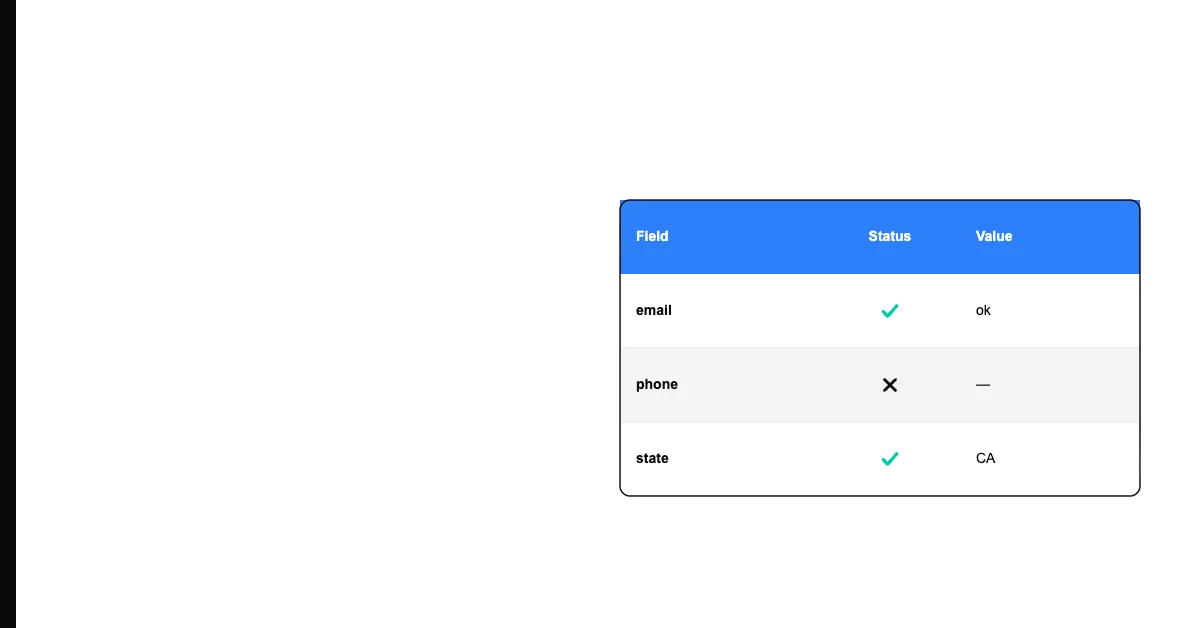
Sohovi validates your email list for invalid formats, duplicates, and missing fields before you send — protecting your sender reputation.
Accuracy: The emails belong to people who actually opted in and are still associated with the individuals you expect to reach. A valid email that was collected without consent or belongs to someone who has moved on is technically deliverable but functionally useless.
What Degrades Email List Quality
Natural decay: ZeroBounce's research puts email list decay at 22-25% per year. People change jobs and abandon old addresses, switch email providers, and stop using older secondary email accounts.
Invalid formats at collection: Forms that don't validate email syntax allow "user@" or "user.com" to enter your list. These produce instant hard bounces on every send.
Sohovi lets you set up validation rules for any column and instantly see which rows fall outside them — no code or SQL required.
Role-based addresses: info@, support@, sales@, noreply@ — shared inboxes that don't belong to individuals and typically produce low engagement and higher rejection rates.
Purchased or scraped lists: Addresses obtained through purchase, scraping, or harvesting rather than opt-in consent. These typically have 10-20% invalid rates and significant spam trap exposure.
Inactive subscribers: Contacts who haven't engaged in 12+ months. While technically deliverable, they reduce engagement rates and signal low relevance to inbox providers.
Maintaining Email List Quality Over Time
Validate before major sends. Before any high-stakes campaign, run your list through email format validation. Remove hard bounces from previous campaigns. Flag role-based addresses for review.
Monitor engagement signals. Track opens and clicks per contact. Contacts with no engagement in 12+ months should be moved to a re-engagement segment before being suppressed.
Implement a re-engagement sequence. For disengaged subscribers, send 2-3 re-engagement emails asking them to confirm interest. Remove those who don't respond.
Enforce double opt-in for new subscribers. Requiring email address confirmation at signup eliminates invalid formats, fake addresses, and mistyped emails at the source.
Frequently Asked Questions
Q: What is a good email deliverability rate? Industry benchmarks suggest that a deliverability rate above 95% is healthy. Hard bounce rates should be below 0.5%. If your hard bounce rate exceeds 2%, your sender reputation is actively degrading and list hygiene should be your immediate priority.
Q: What is the difference between email validation and email verification? Email validation checks format and domain existence — fast and local. Email verification goes further, attempting to confirm the mailbox exists through SMTP probing, though major providers like Gmail and Outlook block this technique. For most use cases, validation plus regular bounce monitoring provides sufficient quality information.
Q: What is a spam trap and how does it get into my list? Spam traps are email addresses maintained by inbox providers to identify senders with poor list hygiene. They include recycled addresses (previously valid addresses reassigned to trap use) and pristine addresses (never published, existing only to catch scrapers). Spam trap exposure comes from purchased lists, scraped addresses, and very old list segments.
Q: Should I use double opt-in for all email signups? For email marketing programs where deliverability is critical, yes. Double opt-in eliminates invalid formats, typos, and addresses entered by third parties, producing a cleaner list from the start. The tradeoff is lower list growth rate (some valid users don't confirm). For transactional or account-based email, single opt-in with format validation is typically sufficient.
Q: How do I handle hard bounces? Remove them immediately and permanently from your sending list. Never retry a hard bounce — the address is permanently undeliverable. Hard bounces that are retried contribute to sender reputation damage without any chance of delivery.
Q: What is a re-engagement sequence and when should I use it? A re-engagement sequence is a short series of emails (typically 2-3) sent to subscribers who haven't engaged in 12+ months, asking them to confirm continued interest. Those who don't engage after the sequence should be suppressed. Running this sequence before major campaigns maintains engagement rate quality.
Q: What is a sunset policy for email lists? A sunset policy defines when inactive subscribers are permanently removed from your list. A typical policy: suppress after 12 months of no engagement, run a re-engagement sequence, permanently remove those who don't respond. This maintains overall engagement quality at the cost of list size.
Q: How does list quality affect email deliverability over time? Poor list quality damages sender reputation cumulatively. Each high-bounce send further degrades reputation. Each low-engagement send signals irrelevance to inbox providers. The damage compounds — a list that had 3% bounce rates for 6 months will have a significantly harder time recovering deliverability than one that maintained below 0.5%.
Q: What is a preference center and how does it improve list quality? A preference center lets subscribers control which types of emails they receive and how frequently. By allowing subscribers to opt down (receive fewer emails) rather than only opt out (unsubscribe entirely), preference centers reduce unsubscribes and spam complaints from contacts who want less, not nothing.
Q: What's the most important action to take before a large email campaign? Run an email validation check on your send list. Remove any hard bounces from previous campaigns (if your platform doesn't do this automatically). Confirm that your list hasn't been imported with role-based addresses or invalid formats. Verify your bounce rate from the last 3 campaigns is below 2%.
Email list quality is a competitive advantage. A smaller, higher-quality list consistently outperforms a larger, degraded one. Maintain quality through regular validation, engagement monitoring, and source controls.