If you've looked at any business intelligence or analytics tooling, you've seen the term "data warehouse" come up constantly. Snowflake, BigQuery, Amazon Redshift, and Databricks have collectively spent billions of dollars making sure you know this term. But most small business owners and non-technical managers have a vague sense of what it means at best.
Let's be direct about what a data warehouse is, when it's useful, and when it's overkill.
What Is a Data Warehouse?
A data warehouse is a centralized database system designed specifically for analytics and reporting — as opposed to transactional systems, which are designed for day-to-day operations like processing orders or recording customer actions.
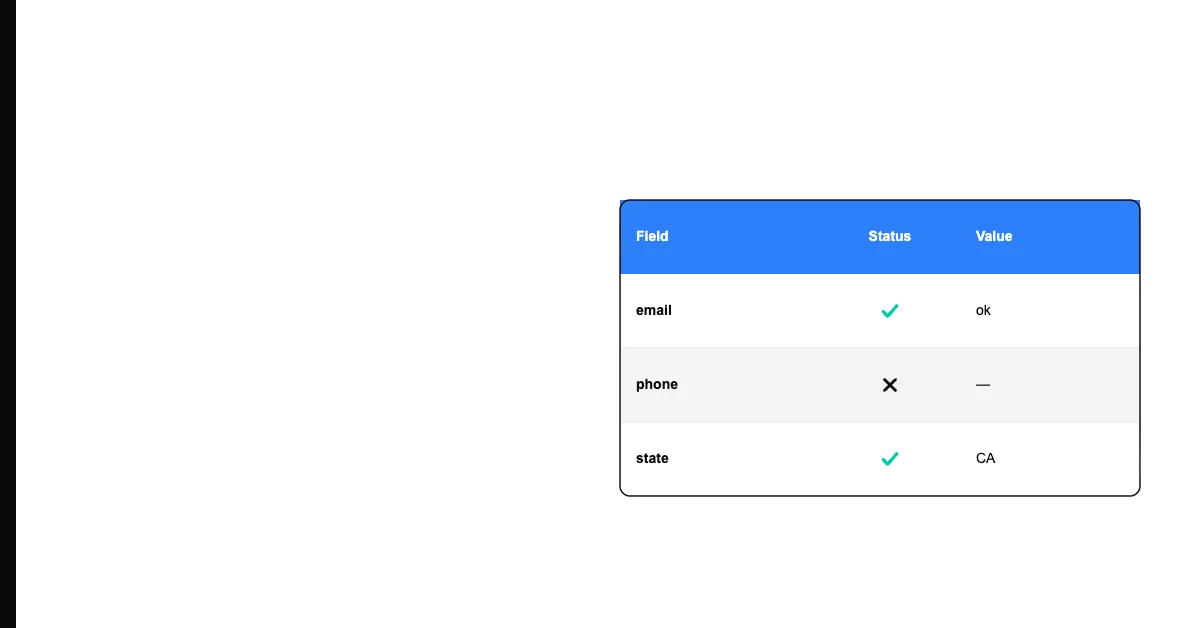
Sohovi validates your dataset before it enters the warehouse — catching format errors, nulls, and duplicates at the source.
The key characteristics:
1. Integrated data from multiple sources. Your CRM exports go in. Your e-commerce orders go in. Your accounting exports go in. Everything is transformed into a common format and stored together so you can ask cross-system questions.
2. Historical and current data. Unlike operational systems that often only show current state, a data warehouse keeps history. You can ask: what were my monthly sales numbers for the last 3 years?
3. Optimized for reading and querying, not writing. Data warehouses are built for running complex queries against large datasets — not for inserting individual transactions at high speed.
4. Structured and cleaned before storage (ETL/ELT). Data is extracted from source systems, transformed into a consistent format, and loaded into the warehouse. This transformation step is where data quality is enforced.
How Data Quality Connects to a Data Warehouse
A data warehouse is only as useful as the data inside it. If your CRM exports contain duplicate contacts, if your order data has inconsistent formats, or if your accounting exports have null values in critical fields — those problems go into the warehouse and corrupt every report you run.
Sohovi automatically finds every duplicate in your dataset — including near-matches — and shows you exactly which rows are affected.
This is why data quality processes are typically built into the transformation step of a data warehouse pipeline. Before data is loaded, it's validated, deduplicated, and standardized. The quality of your warehouse is a direct function of the rigor of that transformation step.
The Most Common Data Warehouse Mistakes
Skipping data quality in the transformation step. It's tempting to just load the data and clean it later. Later never comes, and your reports become unreliable.
Building a warehouse before you need one. If your team can answer its most important questions with a well-maintained spreadsheet or a basic SQL database, a full data warehouse is likely premature.
Treating the warehouse as the source of truth without auditing it. Data warehouses require ongoing maintenance. Source systems change, formats evolve, new data sources are added. Without continuous monitoring, quality degrades.
When Does Your Business Actually Need a Data Warehouse?
You probably need a data warehouse when:
- You have data in multiple source systems that you can't easily combine in a spreadsheet
- Your analytical queries take too long to run against your operational databases
- You need to track historical trends across years, not just the current state
- You have a team that needs to run reports independently without depending on an engineer
You probably don't need one yet when:
- One or two well-maintained spreadsheets or CSVs can answer your key business questions
- You don't have a dedicated person to maintain the data pipeline
- Your data volumes are small enough to fit comfortably in Excel or Google Sheets
The Bottom Line
A data warehouse is a powerful tool for centralizing and analyzing business data at scale. But it multiplies the impact of whatever data quality you bring in. Invest in clean, validated data before you invest in warehouse infrastructure — the warehouse won't fix your data quality problems, it will just surface them more visibly.
If you're not yet at warehouse scale, running a quick quality check on your most important CSV files gives you most of the analytical confidence a warehouse provides, at a fraction of the complexity.