Data governance sounds like something large corporations worry about. The reality is that any business collecting customer information, running reports, or storing records in spreadsheets is already doing some form of data governance — they're just usually doing it badly by accident.
Data governance is the set of rules, roles, and processes that define how data is collected, stored, maintained, and used within an organization. It answers questions like: Who is allowed to edit this customer record? What format should phone numbers be stored in? How long do we keep purchase history? Who is responsible when data quality degrades?
Without answers to those questions, every person on your team makes their own decisions — and the result is inconsistent, untrustworthy data.
Why Data Governance Matters for Small Businesses
The classic argument against data governance at small companies is: "We don't have enough data to need governance." That argument has it backwards. Small businesses are precisely the companies that can't afford to ignore data quality problems — they lack the large teams, expensive tools, and redundant checks that enterprises use to catch errors downstream.
Sohovi gives you the data quality picture you need to make the case for fixing it — and to track improvement over time.
When a 500-person company has bad data, the finance team catches the discrepancy and fixes it. When a 5-person company has bad data, it often goes into the quarterly report and informs a decision that shapes the next six months.
According to DAMA International, poor data governance is cited as the root cause of most data quality failures — not data entry errors, not system bugs, but the absence of clear rules about who owns and maintains the data.
The Core Components of Data Governance
You don't need a formal governance team. You need answers to five questions:
1. Data ownership — Who is responsible for each type of data? Assign a person, not a department.
2. Data standards — What format does each field use? Dates as YYYY-MM-DD. Phone numbers as +1XXXXXXXXXX. States as two-letter codes.
3. Access controls — Who can view or edit each dataset? Not everyone needs access to everything.
4. Data quality rules — What makes a record "good enough" to use? Define it explicitly: an email address must be present and validated; a customer record must have at least a first name.
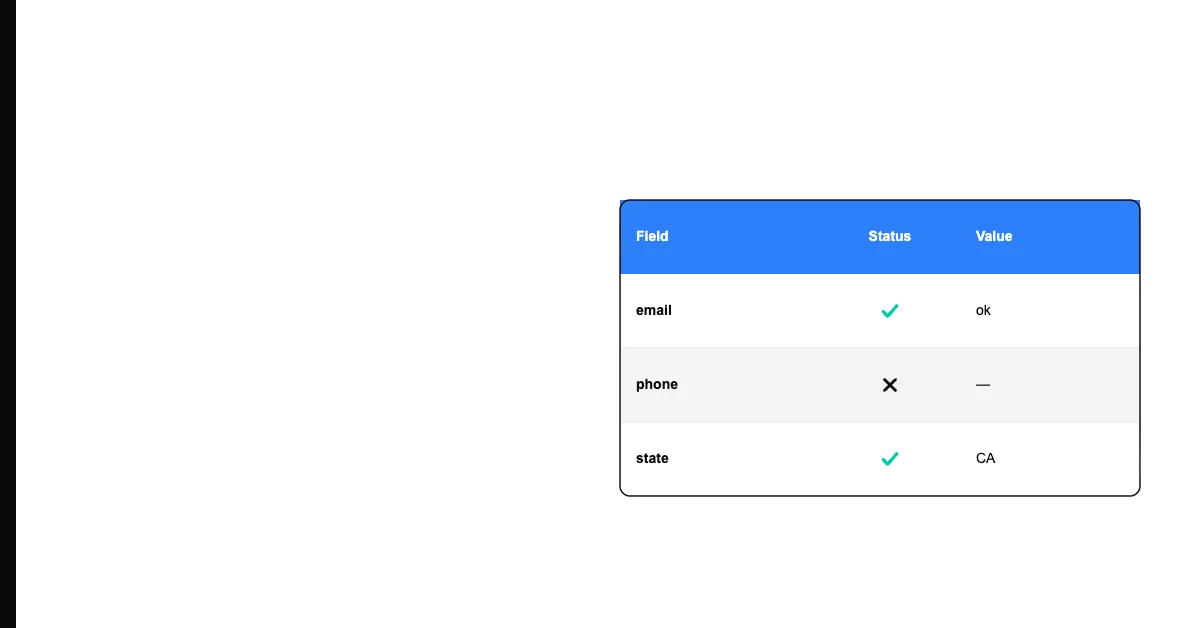
Sohovi lets you set up validation rules for any column and instantly see which rows fall outside them — no code or SQL required.
5. Audit trail — When data changes, can you see who changed it and why?
The Difference Between Data Governance and Data Quality
Data governance is the policy layer — the rules and responsibilities. Data quality is the execution layer — measuring and enforcing those rules. You can have governance without quality (rules that no one enforces), or you can have quality checks without governance (tools that flag problems but no one who owns the fix). You need both.
How to Start a Lightweight Governance Practice
Step 1: Document your critical datasets. List the three to five datasets your business actually relies on — customer contacts, orders, supplier list, whatever matters most.
Step 2: Assign an owner to each. This is one person with the authority to define standards and the responsibility to maintain quality.
Step 3: Write down your field standards. Create a single page (or spreadsheet row) for each field that says: what format is required, what values are allowed, and what "empty" means.
Sohovi gives you a full quality report on any spreadsheet in seconds — upload your file and see exactly what needs fixing.
Step 4: Build a light quality check into your workflow. Before importing data or using it in a report, run a basic quality check. Even checking for blanks in required fields takes two minutes and catches major issues.
A tool like Sohovi can automate the quality check step — upload any CSV and get a completeness and validity report by column in seconds, without sending your data to a server.
The Bottom Line
Data governance isn't a big-company luxury. It's the difference between a business that makes decisions on reliable data and one that's always patching last-minute errors before the board meeting. Start with the five questions above, assign ownership, and write your standards down. The rest follows.
If you want to stop fixing data problems after the fact and start preventing them at the source, a governance practice — even a simple one — is where that journey starts.