The data industry has a habit of inventing new terms by combining existing ones. "Data lakehouse" sounds like it might just be another buzzword, but it actually describes a meaningful architectural shift — and it has real implications for how data quality works in modern organizations.
Let's break it down from first principles.
What Is a Data Lake?
A data lake is a large, centralized storage repository that holds raw data in its native format — structured tables, unstructured text, images, logs, whatever you have — until it's needed. The defining feature of a data lake is that you don't transform or organize the data before storing it. You dump it in, and you figure out the schema later.
This is useful because it means you never lose data. Every event log, every API payload, every file export goes into the lake. The downside: without structure or governance, data lakes can quickly become "data swamps" — full of data that no one knows how to use, with no clear ownership, no quality standards, and no documentation.
What Is a Data Warehouse?
A data warehouse is a structured, organized storage system designed specifically for analytics and reporting. Data is transformed, cleaned, and loaded into a predefined schema before being stored. Queries are fast. Reports are reliable. But you can only store what you've planned for — adding new data types requires schema changes.
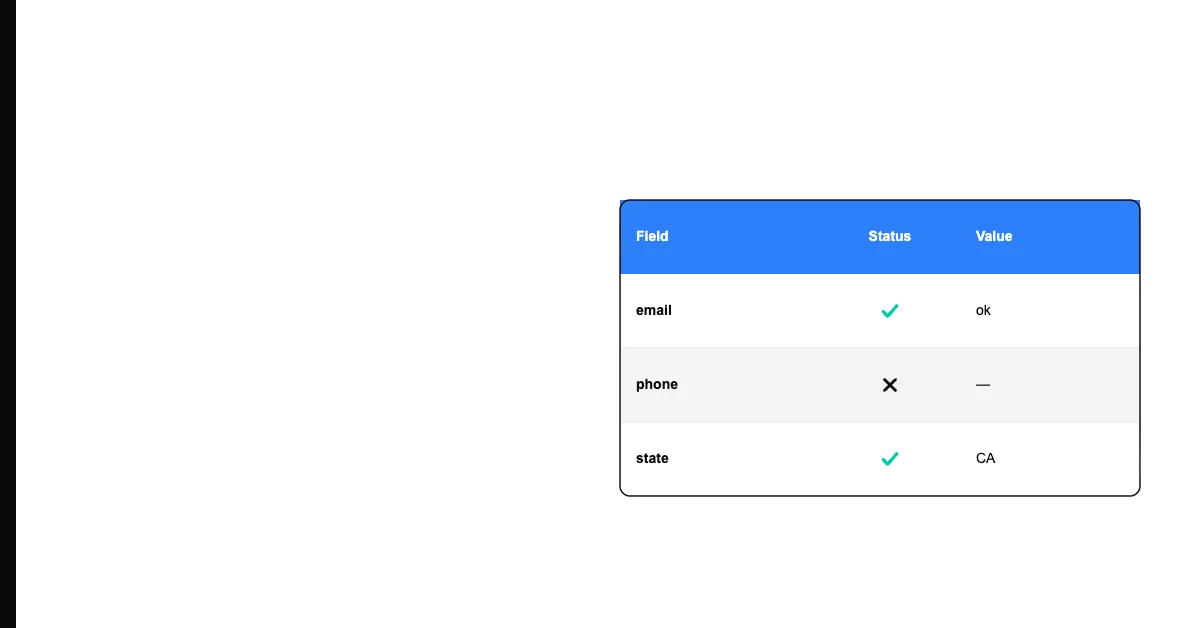
Sohovi validates your dataset before it enters the warehouse — catching format errors, nulls, and duplicates at the source.
What Is a Data Lakehouse?
A data lakehouse attempts to give you both: the low-cost, flexible storage of a data lake with the structure, governance, and query performance of a data warehouse. It does this by adding a metadata and governance layer on top of raw storage — so you can apply schemas, enforce quality checks, and run analytics without first moving data to a separate warehouse.
The major platforms driving the lakehouse concept include Databricks (which coined the term) and Apache Iceberg/Delta Lake as the underlying table formats.
The Data Quality Challenge in a Lakehouse
This is where it gets practically relevant. In a traditional data warehouse, data quality is enforced at load time — if the data doesn't meet the schema requirements, the load fails. This forces upstream quality standards.
In a data lake (and in the raw storage layer of a lakehouse), data arrives without those checks. Bad data, inconsistent formats, and duplicate records accumulate silently. The lakehouse architecture adds governance tooling to address this — but those tools only work if someone is actively using them.
The common failure mode: teams build a lakehouse for the storage flexibility and then skip the governance layer because it requires more setup. They end up with the same swamp problems as a bare data lake.
Does Your Business Need a Lakehouse?
Almost certainly not — at least not yet. A lakehouse is designed for organizations with:
- Multiple data sources generating large volumes of raw data
- Both real-time analytics and historical reporting needs
- A dedicated data engineering team to manage the infrastructure
If you're working with CSV files and spreadsheets, or even with a modern SaaS data stack, a lakehouse is architectural overkill. You're solving problems you don't have.
Sohovi gives you a full quality report on any spreadsheet in seconds — upload your file and see exactly what needs fixing.
What is relevant is the underlying principle: data quality needs to be enforced at the point of ingestion, not cleaned up after the fact. Whether you're working with a lakehouse, a small database, or a shared Google Drive folder, the same rule applies: garbage in, garbage out.
A tool like Sohovi lets any team member run a quality check on incoming data before it enters any system — no engineering required.
The Key Takeaway
The data lakehouse is a modern architecture that merges flexibility with structure. Its relevance to you depends entirely on your data scale. But the data quality lesson embedded in its design — that quality governance must be built in, not bolted on — applies to every business, regardless of size.