Every business that uses more than one software tool has a data integration problem. Your CRM has customer records. Your accounting software has invoices. Your e-commerce platform has orders. Your email marketing tool has engagement data. None of these systems talk to each other natively — and getting a unified view of your business requires connecting them.
That's what data integration is. Here's how it works and why it's harder than it sounds.
What Is Data Integration?
Data integration is the process of combining data from multiple source systems into a unified, consistent view that can be used for analysis, reporting, or operational purposes.
This can range from simple (exporting a CSV from one system and importing it into another) to complex (building a real-time data pipeline that syncs thousands of records per second between a CRM, a data warehouse, and a marketing platform).
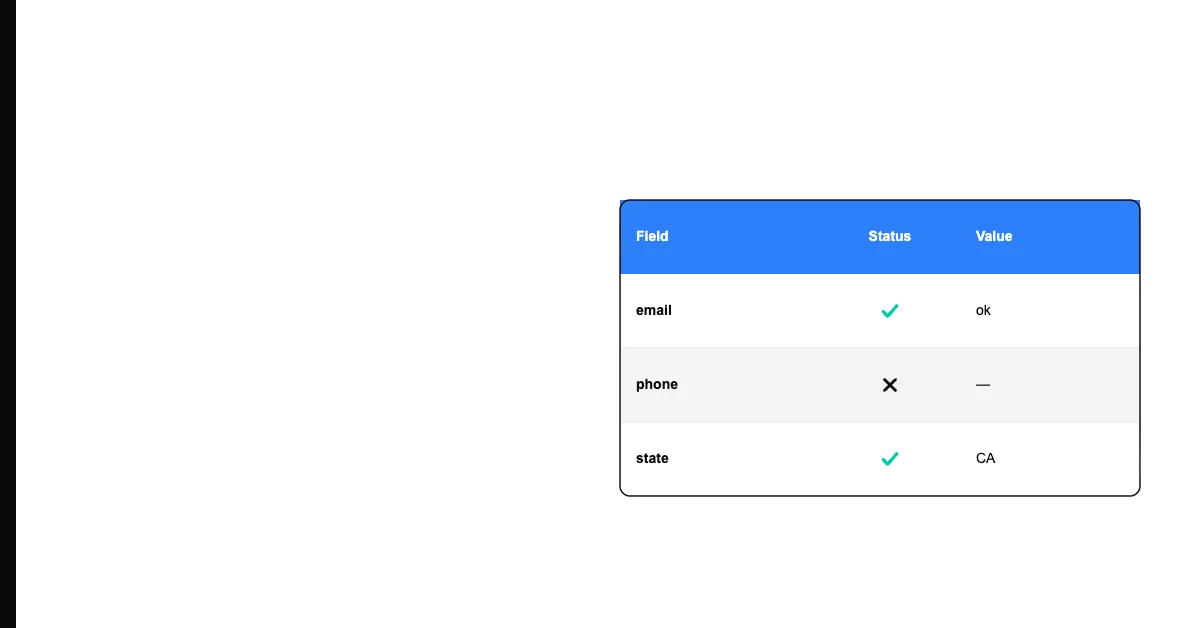
Sohovi validates your dataset before it enters the warehouse — catching format errors, nulls, and duplicates at the source.
The core challenge of data integration isn't technical — most integration tools have solved the connection problem. The core challenge is data quality: when you bring data together from systems that were built independently, the formats don't match, the values are inconsistent, and the duplicates multiply.
The Three Main Approaches to Data Integration
Manual integration — Export from one system, transform in a spreadsheet, import to another. This is slow, error-prone, and doesn't scale, but it's where many small businesses start.
ETL (Extract, Transform, Load) — An automated pipeline that pulls data from sources, transforms it into a consistent format, and loads it into a destination (usually a data warehouse). The transformation step is where quality checks happen.
Sohovi applies your data quality rules automatically across the whole dataset and highlights every violation — so nothing slips through.
ELT (Extract, Load, Transform) — A newer approach where data is loaded raw into the destination first, then transformed in place. Popular with cloud data warehouses because storage is cheap and transformation can be done using SQL.
API-based integration / iPaaS — Tools like Zapier, Make, and Boomi connect systems directly through their APIs, syncing records in near real-time. Great for operational integration (keeping a CRM and marketing tool in sync), less suited for complex analytical integration.
The Data Quality Challenges in Integration
This is where integration projects most commonly fail — not technically, but in data quality terms.
Schema mismatches — System A stores dates as MM/DD/YYYY. System B expects YYYY-MM-DD. If you don't handle this in the transformation, every date value either fails to load or loads incorrectly.
Different representations of the same entity — Your CRM has "United States." Your accounting software has "US." Your e-commerce platform has "USA." When you join these datasets, the same country appears three times as three different values.
Sohovi finds gaps, duplicates, and format errors in your CRM data — so your team is working from records they can trust.
Duplicate records across systems — The same customer exists in your CRM as "Jane Smith" and in your support tool as "J. Smith." After integration, you have two customer records that should be one.
Missing fields that one system requires — System A doesn't collect phone numbers. System B requires them. Every record from System A will fail System B's validation.
Conflicting values for the same field — The same customer's email address is updated in one system but not another. After integration, which version is correct?
The Rule of Integration and Quality
Data integration amplifies whatever quality level you start with. If your source systems have 10% null rates and 5% duplicate rates, your integrated dataset will have at least those rates — usually worse, because integration introduces new types of errors that didn't exist in the source systems.
This is why data quality checks at the source — before integration — matter far more than fixes attempted after data has been combined.
Practical Steps Before Any Integration Project
-
Profile each source dataset independently. What does completeness look like? What are the value distributions? Where are the nulls?
-
Identify your entity matching strategy. What field uniquely identifies a customer, product, or transaction across all systems? Email address? Order ID? Phone number?
-
Define a canonical format for each field. Pick one date format, one phone number format, one country name standard — before integration, not after.
-
Build quality checks into the transformation. Don't just move data. Validate it at each step.
A tool like Sohovi helps you assess the quality of any source dataset before you start an integration project — showing you exactly which fields are incomplete, inconsistent, or duplicated so you can fix them before they compound in the destination.
The Bottom Line
Data integration is the practical challenge every growing business faces. As you add more tools, connecting them becomes both more valuable and more complex. The businesses that do it well treat data quality as a prerequisite to integration, not a cleanup task afterward.