Every time data moves from one place to another — from your CRM to your analytics tool, from an API to your database, from a form submission to a spreadsheet — it travels through a data pipeline. Most people use pipelines without knowing they have them.
Understanding what a data pipeline is, and more importantly where pipelines break, is one of the most practical things you can do to protect your data quality.
What Is a Data Pipeline?
A data pipeline is a series of steps that move data from a source system to a destination system, often transforming the data along the way. The source might be a REST API, a database, a CSV file, or a streaming event. The destination might be a data warehouse, a dashboard, an email marketing tool, or another database.
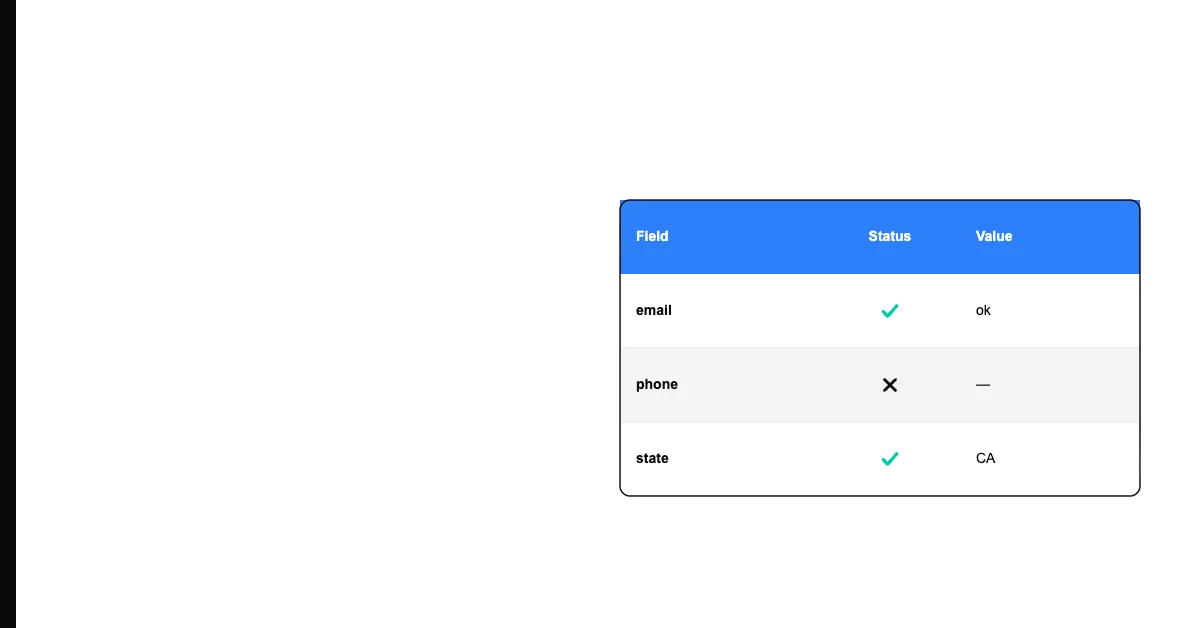
Sohovi validates your dataset before it enters the warehouse — catching format errors, nulls, and duplicates at the source.
The "pipeline" metaphor is apt: water flows through a pipe, picking up pressure changes and sometimes impurities. Data flows through a pipeline, picking up transformations and sometimes errors.
A simple data pipeline might look like:
- Export customer records from CRM every night at 2am
- Deduplicate the records and standardize field formats
- Load the cleaned records into the marketing analytics dashboard
A more complex pipeline might involve dozens of sources, real-time streaming, multiple transformation layers, and outputs to several systems simultaneously.
The Three Phases of Most Pipelines
Extract — Pull data from the source. This can be a direct database connection, an API call, a file download, or a webhook. Problems here: authentication failures, rate limits, source data format changes, partial extracts.
Transform — Clean, reshape, and enrich the data. This is where quality rules are typically applied: deduplication, format standardization, null handling, validation. Problems here: schema mismatches between source and destination, business logic errors, unexpected null values crashing the transformation.
Sohovi automatically finds every duplicate in your dataset — including near-matches — and shows you exactly which rows are affected.
Load — Write the transformed data to the destination. Problems here: duplicate loads, schema evolution breaking existing queries, load failures that aren't caught.
Where Pipelines Break — and How It Affects Data Quality
Most pipeline failures are silent. The pipeline runs, reports "success," and loads subtly wrong data that no one notices until it corrupts a report or triggers a wrong business decision.
The most common failure modes:
Schema drift — The source system adds, removes, or renames a field. The pipeline transformation was written assuming the old schema. The new field is silently dropped or mapped to the wrong destination field.
Null propagation — A required field is empty in one record. Instead of failing visibly, the pipeline processes the record with a null value and loads it as-is. Downstream queries break or produce misleading results.
Sohovi profiles every column in your dataset for completeness and flags the exact rows where values are missing — free to try.
Partial loads — The pipeline loads 95% of the data before hitting an error and stopping. The destination has an incomplete dataset, but there's no clear alert. Users run reports on the partial data.
Transformation logic errors — A business rule encoded in the transformation step is wrong. For example, a date field is timezone-adjusted incorrectly, so all timestamps are off by 6 hours.
How to Protect Data Quality in a Pipeline
1. Add validation checks before the load step. Before writing data to the destination, verify that record counts are within expected ranges, required fields are populated, and formats match the destination schema.
2. Alert on failures, not just on crashes. A pipeline that runs without errors but loads wrong data is worse than one that crashes — at least a crash is visible. Add quality checks that fail loudly when data is outside expected parameters.
3. Maintain an audit log. Track what data was loaded, when, and from what source. When a downstream report is wrong, you need to be able to trace it back.
4. Test transformations against edge cases. What happens when a field is null? When a date is in an unexpected format? When a record count doubles unexpectedly? These edge cases are where most quality problems originate.
A tool like Sohovi lets you run a quality check on the output of any pipeline step — upload the extracted or transformed CSV and verify completeness, validity, and uniqueness before the load step.
The Bottom Line
A data pipeline is the connective tissue between your data sources and your business tools. When it works correctly, data flows cleanly and your reports are trustworthy. When it breaks — especially silently — quality problems accumulate downstream. Understanding the failure modes is the first step to catching them before they reach your decision-makers.