The data lake concept emerged as a response to a real limitation: traditional data warehouses are expensive to store data in and require you to know the schema before loading. What if you could store everything — raw, unprocessed, in any format — and figure out the structure later?
That's the promise of a data lake. Here's what it is, why it was built, and why data quality is its most persistent challenge.
What Is a Data Lake?
A data lake is a large, centralized storage repository that holds data in its native, raw format — structured tables, semi-structured JSON or XML, unstructured text, images, audio, video, log files — until it's needed for processing or analysis.
Unlike a data warehouse, which requires data to be cleaned and transformed before loading, a data lake accepts data as-is. This makes it fast and flexible to populate: you can dump any data source into the lake without first designing a schema.
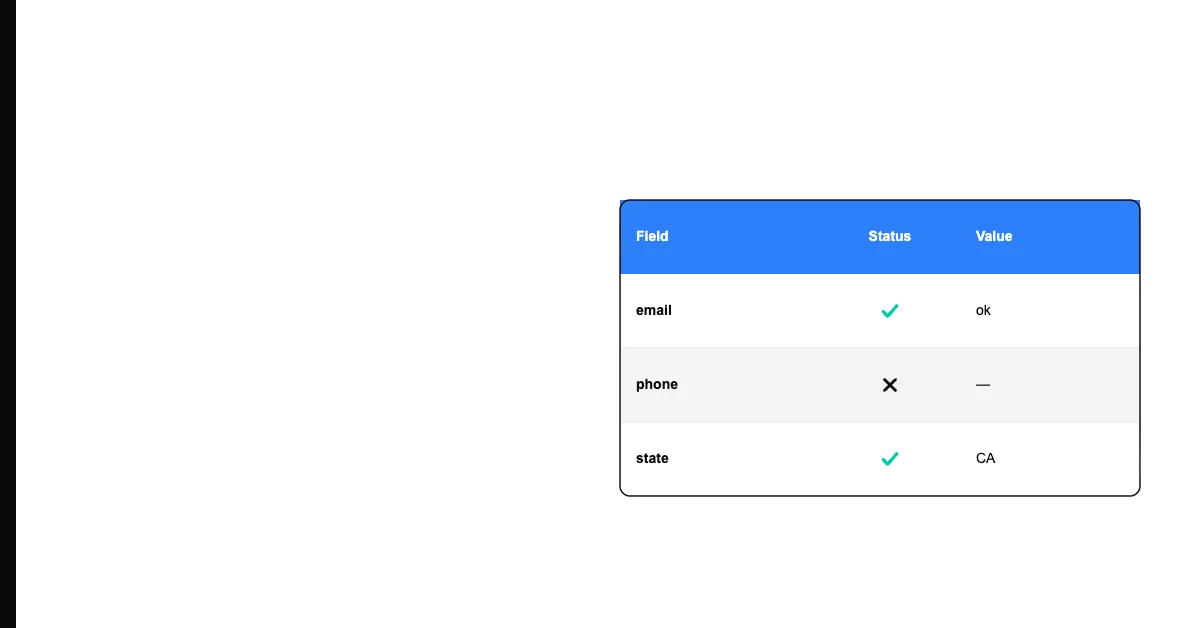
Sohovi validates your dataset before it enters the warehouse — catching format errors, nulls, and duplicates at the source.
Data lakes are typically built on cheap object storage (Amazon S3, Google Cloud Storage, Azure Data Lake Storage), making them extremely cost-effective for storing large volumes of raw data.
Common use cases:
- Storing raw event logs from web and mobile applications
- Archiving operational database backups
- Holding raw API payloads and webhook data
- Staging data before loading into a data warehouse
Why Data Quality Is the Data Lake's Biggest Problem
The same flexibility that makes data lakes powerful makes them data quality nightmares if not actively governed.
Schema-on-read means no validation at write time. In a data warehouse, data must conform to the destination schema or the load fails. In a data lake, you can write anything. This means invalid, duplicate, and malformed records accumulate silently.
Sohovi automatically finds every duplicate in your dataset — including near-matches — and shows you exactly which rows are affected.
Ownership is often unclear. Data lakes are typically shared repositories — many teams write data in, many teams read data out. Without clear ownership of each dataset, no one is responsible for quality. The result is the "data swamp" problem: a lake full of data that no one trusts or knows how to use.
Data lineage is opaque. In a lake with thousands of files from dozens of sources, tracking what came from where — and therefore tracing a quality problem back to its source — requires explicit metadata management. Without it, debugging quality issues becomes archaeology.
File proliferation. Data lakes accumulate files. Old versions, partial exports, test datasets, and duplicate uploads pile up. Without data lifecycle management, you end up with multiple versions of the same data, none of them clearly the authoritative one.
The "Data Swamp" Problem
The term "data swamp" entered the vocabulary when organizations started realizing that their data lakes — built with the best intentions — had become unusable. Too much data, too little documentation, no quality standards, no ownership. The lake was full, but no one could find trustworthy data inside it.
The fix is governance: catalog everything (know what's in the lake), assign ownership (someone is responsible for each dataset), define quality standards (what does "good" mean for each dataset), and enforce those standards at ingestion.
Data Quality Practices for Data Lakes
1. Add metadata at ingestion. Every file or dataset written to the lake should include: source system, ingestion timestamp, expected schema, data owner. This is the minimum documentation to make the data usable later.
2. Apply quality checks before writing. Run completeness, format, and uniqueness checks on incoming data before it lands in the lake. Catching problems at ingestion is far cheaper than discovering them six months later during analysis.
3. Use a data catalog. Tools like Apache Atlas, AWS Glue Data Catalog, or even a well-maintained spreadsheet serve as the index to your lake. Without a catalog, you can't find what you have.
4. Define access zones. Divide the lake into zones: raw (unvalidated, exactly as received), validated (quality-checked, documented), curated (transformed and ready for analysis). Data moves between zones as quality gates are passed.
5. Set data retention policies. Decide how long each type of data is kept and when old files are deleted. This prevents the accumulation of outdated, conflicting versions.
Do Small Businesses Need a Data Lake?
Almost certainly not. Data lakes are designed for organizations generating and storing data at scale: millions of events per day, large machine learning training datasets, multi-year log archives. If your data fits in a spreadsheet or a modest relational database, a data lake adds complexity without adding value.
The data quality principles that govern data lakes — validate at ingestion, document everything, assign ownership, apply quality checks before use — apply to any data, at any scale.
The Bottom Line
A data lake is a powerful storage architecture for large-scale, heterogeneous data. Its flexibility is its greatest strength and its greatest quality risk. The organizations that use data lakes successfully invest as much in governance and quality as they do in storage infrastructure. Raw storage without quality discipline is just an expensive swamp.