If you've attended any data conference or read any analyst report in the past few years, you've seen the phrase "data fabric" used to describe solutions to every possible data problem. Gartner has named it a top data management trend multiple years running. Vendors from IBM to Microsoft to SAP have products under this label.
But ask five data architects what a data fabric is and you'll get five different answers. Here's a clear breakdown of what the term actually means and whether it's relevant to your work.
What Is Data Fabric?
Data fabric is an architectural approach that uses automation and AI to integrate, govern, and manage data across distributed environments — regardless of where the data lives. It's designed for organizations that have data spread across on-premises systems, multiple cloud providers, SaaS applications, and edge systems, and need a unified layer to find, access, and govern all of it.
The core idea: instead of moving all your data to one place (a data warehouse or data lake), a data fabric creates a unified layer of metadata, governance, and access policies that works across all your data sources where they already are.
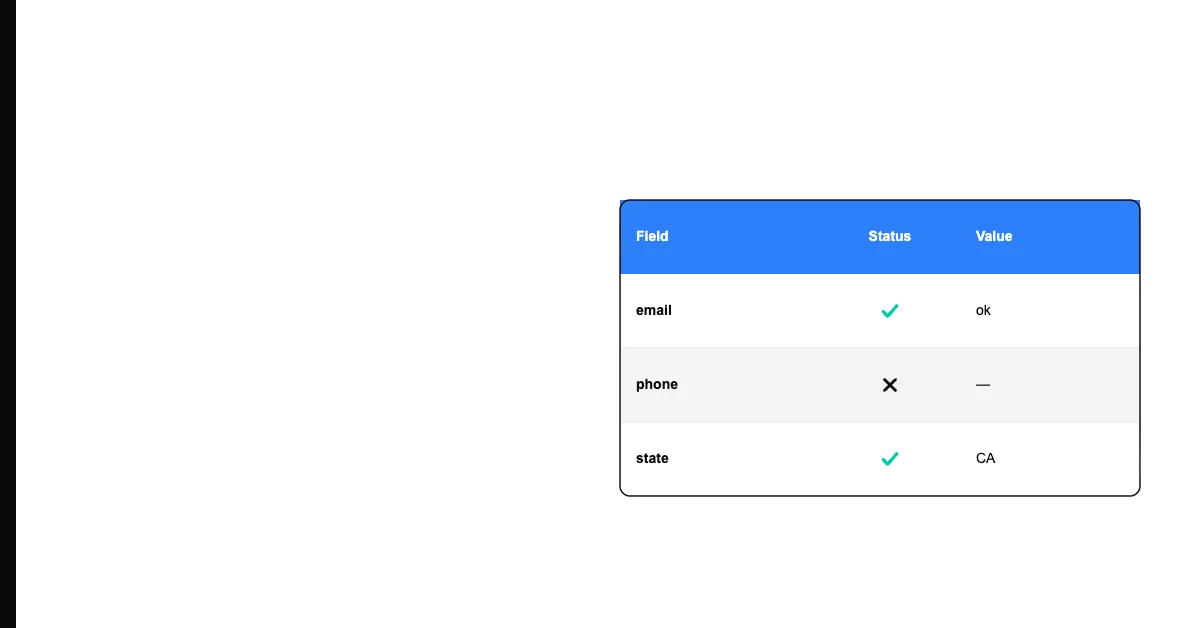
Sohovi validates your dataset before it enters the warehouse — catching format errors, nulls, and duplicates at the source.
The components typically described under "data fabric" include:
Unified data catalog — A searchable inventory of all data assets across all systems. Know what data you have, where it lives, and what it contains.
Automated metadata management — AI-driven discovery of metadata: field types, data lineage, usage patterns, relationships between datasets.
Unified governance and access control — Apply data quality rules, access policies, and compliance requirements consistently across all systems from one place.
Sohovi applies your data quality rules automatically across the whole dataset and highlights every violation — so nothing slips through.
Data virtualization — Query data across multiple systems without physically moving it, as if it were in one place.
How Data Fabric Connects to Data Quality
In a fragmented data environment — data in Salesforce, data in Snowflake, data in an on-premises Oracle database, data in an S3 data lake — enforcing consistent data quality standards is extremely difficult. Each system has its own tools, formats, and access controls.
A data fabric's value proposition for data quality is: apply quality rules once, enforce them everywhere. Define that "email" must be non-null and valid in your governance layer, and that rule propagates across every system in your environment.
In practice, the AI-assisted metadata discovery component of data fabric is also relevant to quality: automated scanning can identify where PII lives, where data quality problems are concentrated, and where datasets have drifted from their expected schemas — without requiring manual audits of each system separately.
Data Fabric vs. Data Mesh
These two concepts are often confused and occasionally positioned as competitors. The difference:
Data mesh is an organizational principle — distribute data ownership and responsibility to domain teams. It's about people and accountability.
Data fabric is a technology principle — use automation and AI to create a unified data management layer across distributed systems. It's about infrastructure.
They're not mutually exclusive. A data mesh approach can use data fabric technology as the self-serve infrastructure that domain teams operate on.
Is Data Fabric Relevant to Small Businesses?
Honestly: no, not the enterprise platforms that vendors sell under the "data fabric" label. These are designed for organizations managing petabytes of data across dozens of systems, with dedicated data engineering teams and six-figure software budgets.
The principles, however, are relevant at any scale:
- Know what data you have and where it lives (catalog)
- Define quality standards and enforce them consistently (governance)
- Track where data came from and how it's been transformed (lineage)
- Apply access controls to sensitive data (security)
These are achievable for small teams without enterprise software. A simple data dictionary, clear ownership assignments, and a quality check process before any data import covers the core principles.
The Bottom Line
Data fabric is a real architectural concept solving real problems — specifically, the problem of managing data quality and governance across highly fragmented, distributed environments. For most small businesses, those problems are still in the future. But the underlying principles — catalog, govern, track, secure — are the same ones that make any data quality practice robust, at any scale.