The single most preventable campaign failure in email marketing is sending to an unvalidated list. Here's a step-by-step process to validate your email list before every campaign — no coding required.
Why Validation Before Every Send Matters
Email addresses decay at roughly 22–25% per year (ZeroBounce, 2023 industry data). A list you built 12 months ago could have a 20%+ invalid address rate today — even if you've never had a bounce problem before.
Sending to invalid addresses drives up your hard bounce rate. A bounce rate above 2% triggers deliverability penalties from inbox providers. Once your sender reputation degrades, your open rates drop for your entire list — including the healthy addresses.
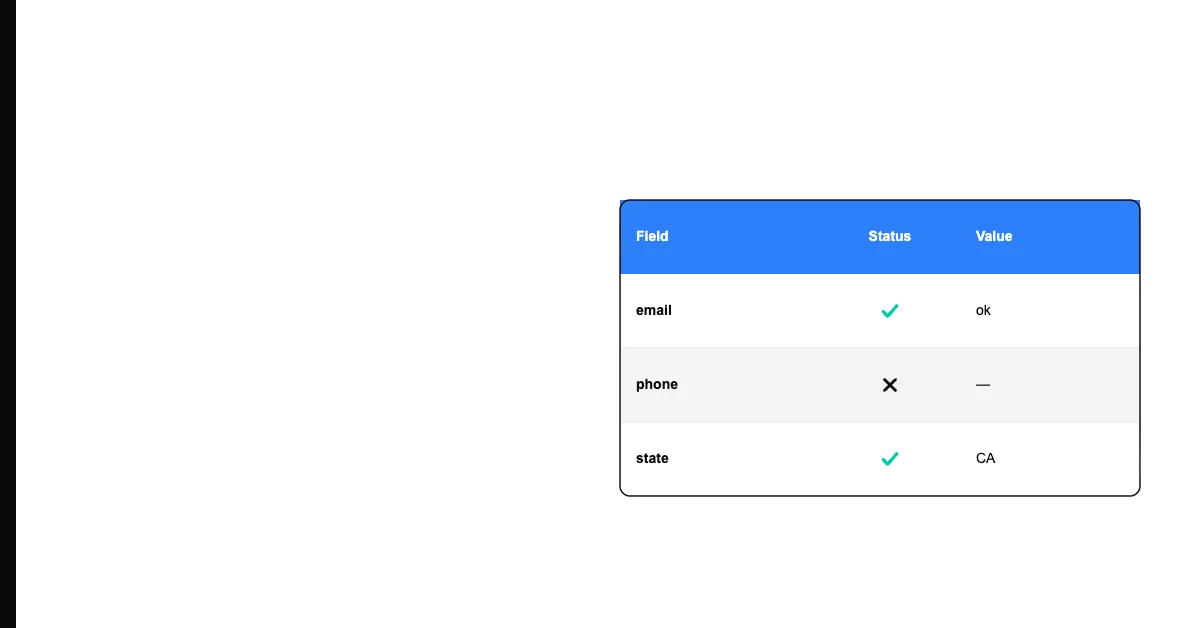
Sohovi validates your email list for invalid formats, duplicates, and missing fields before you send — protecting your sender reputation.
Validation before send is insurance. It takes 10 minutes and prevents weeks of reputation recovery.
Step 1: Export Your Segment as a CSV
Export only the contacts you're planning to send to. Don't validate your entire database every time — validate the specific segment. Narrow lists run faster and flag issues more clearly.
Step 2: Check for Syntax Errors First
Look for obvious formatting problems in the email column:
- Missing @ symbol
- Double @ symbols
- Spaces inside the address
- Domain with no TLD (.com, .org, .io, etc.)
These are almost always caught by form validation — but imports and manual data entry bypass form validation regularly. A full data profile will surface these instantly.
Sohovi runs a full data profile on any CSV or spreadsheet in under a minute — completeness rates, type distributions, outliers, and more.
Step 3: Flag Role-Based and Disposable Addresses
Role-based addresses (info@, admin@, noreply@, support@) rarely belong to an individual. They often route to shared inboxes or ticketing systems. They technically "receive" email but rarely produce engagement — and some will hard bounce.
Disposable addresses (Mailinator, Guerrilla Mail, TempMail) were created specifically to avoid real contact. Remove both categories before your send.
Step 4: Cross-Reference Your Suppression List
Your ESP maintains a suppression list of prior hard bounces, unsubscribes, and spam complaints. Before every send, confirm your segment has been checked against this list. Most ESPs do this automatically — but if you're using a third-party send tool or an imported list, double-check.
Step 5: Check Last Engagement Date
Technically valid addresses that haven't engaged in 12+ months are high-risk. Many have become spam traps (abandoned email addresses repurposed by ISPs to catch bulk senders). Segment these contacts out of your main send, or run a re-engagement campaign before including them in a standard blast.
Sohovi lets you upload your CSV and get an instant data quality report — no setup, no code required.
What to Do With Invalid Addresses
Don't just delete invalid addresses. Move them to a suppression list instead. This prevents them from re-entering your active list through future imports and gives you a record of contacts you've identified as undeliverable.
For hard bounces, some ESPs add these automatically to your suppression list. Confirm your platform does this — or do it manually after each campaign.
For role-based addresses, it's worth sending a one-time "confirm your subscription" to see if a real person manages that inbox. Some info@ and contact@ addresses are actively monitored by decision-makers at small companies. If they re-confirm, move them to your main list. If they don't, suppress them.
Sohovi tracks quality trends across runs and alerts you when a metric — null rate, duplicate count, score — moves outside its normal range.
How Often to Validate Ongoing Lists
- Before every new campaign to a new or imported list: Always.
- Quarterly validation of your full database: Every 3 months, run a full check even on your established list. Decay is gradual and invisible.
- Immediately after any bulk import: Any time you import more than 100 new contacts, run a validation pass before they enter your regular send rotation.
For e-commerce and B2B marketers, building this into a checklist before every major send takes about 15 minutes and keeps deliverability stable over years, not just months.
Building a Pre-Send Checklist That Protects Your Sender Score
Deliverability problems compound over time. A single campaign with a 5% bounce rate won't destroy your sender reputation immediately — but three campaigns in a row at that rate will. The damage accumulates, and recovery is slow: restoring a degraded sender score typically takes 6–8 weeks of sending to small, highly engaged segments.
A simple pre-send checklist, run before every campaign, prevents this entirely:
- List exported and segmented — only contacts intended for this send
- Deduplication run — one address, one record
- Syntax validation passed — no obvious format errors
- Suppression list checked — prior unsubscribes and hard bounces excluded
- Role-based and disposable addresses removed — info@, admin@, mailinator variants gone
- Last engagement date reviewed — contacts inactive for 12+ months segmented out
- Verification results documented — valid %, catch-all %, invalid % recorded
The checklist takes 10–15 minutes for most lists. Run it without exception, including for campaigns to "regular" lists you've sent to before. List decay doesn't announce itself — the checklist is what catches it.
What to Tell Clients About List Quality
Many clients hand over their email list without thinking about its quality. They've had it for years. They "know" it's good. When you flag issues, they're often surprised.
Keep the conversation factual and forward-looking: "22% of these addresses are invalid or undeliverable. Sending to them would push our bounce rate above the threshold that triggers deliverability penalties. Here's what I recommend removing, and here's what we'd be sending to." Numbers are more persuasive than advice.
If the client asks why their list has so many bad addresses, the answer is almost always time and no ongoing hygiene: lists built over years without validation naturally accumulate dead addresses. The fix is simple — validate before every send and re-verify the full list quarterly.
If you're ready to stop guessing about your data quality, Sohovi is built for exactly this. Upload your first CSV free — no credit card, no IT team, no code needed.