Your last campaign had a 22% open rate. That's decent. But your pipeline didn't move. Conversions were flat. And when you tried to pull attribution data, three different tools gave you three different answers.
Sound familiar? The problem almost certainly isn't your copy, your offer, or your timing. It's your data.
Data quality for marketing operations is one of the most under-diagnosed causes of underperforming campaigns — and one of the most fixable. This guide breaks down exactly what's going wrong, why it costs you more than you think, and how to fix it without a data engineering team.
Sohovi gives you the data quality picture you need to make the case for fixing it — and to track improvement over time.
What Bad Marketing Data Actually Looks Like
Most marketing teams don't realize they have a data quality problem. They see symptoms: unusually low click-through rates, email bounces that creep up each quarter, attribution reports that don't add up, and lead scoring that keeps flagging the wrong accounts.
The root cause is almost always the same: dirty CRM data that has accumulated over months or years without any systematic cleaning.
Bad marketing data shows up in a few predictable forms:
- Duplicate contact records — the same person appears as "John Smith", "john.smith@acme.com", and "J. Smith" in three separate records
- Invalid or decayed email addresses — addresses that were real 18 months ago but have since bounced or gone dormant
- Inconsistent field values — job titles entered as "VP Marketing", "VP of Marketing", "vp mktg", and "Vice President, Marketing" — all meaning the same thing, but impossible to segment reliably
- Missing attribution fields — UTM parameters not captured, source fields left blank, or campaign names formatted differently across tools
- Stale firmographic data — company size, industry, or revenue ranges that were true when the lead entered but are now 2 years out of date
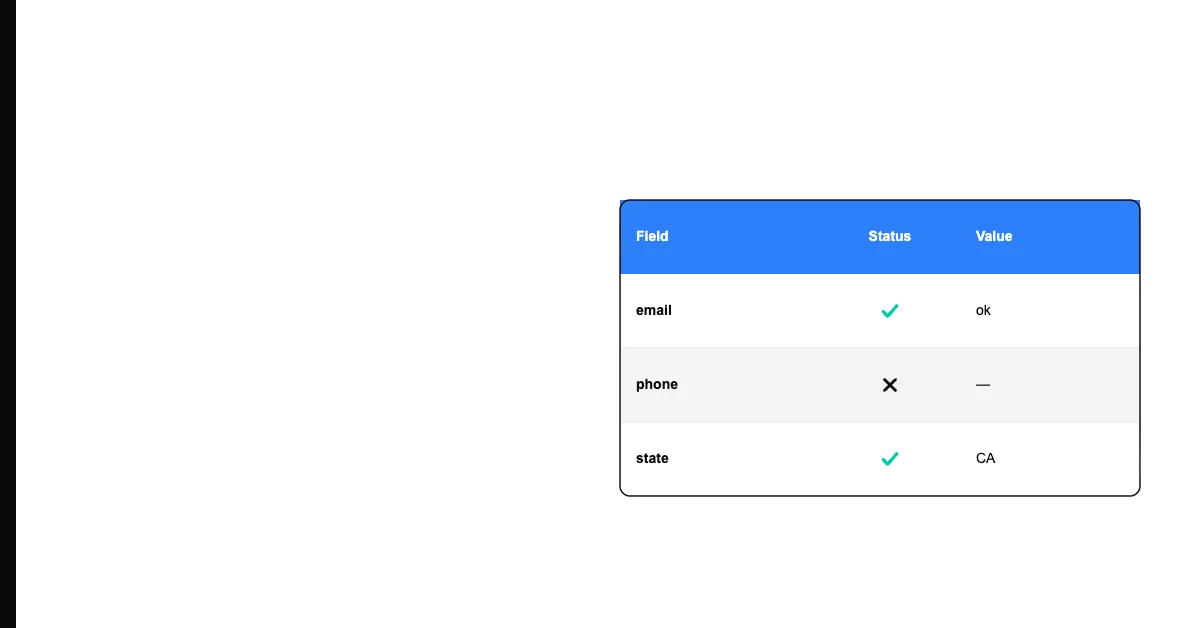
Sohovi automatically finds every duplicate in your dataset — including near-matches — and shows you exactly which rows are affected.
Any one of these is annoying. All of them together — which is the typical state of a CRM that's been in use for more than 12 months — quietly sabotage every campaign you run.
The Real-World Example: SaaS Marketing Ops Team
A mid-size SaaS company with a 40,000-contact HubSpot database ran a Q4 pipeline acceleration campaign. The campaign targeted "VP and Director-level contacts at companies with 50–500 employees in the financial services sector."
The email went to 8,200 contacts. Bounce rate: 6.4%. Open rate: 11%. Meetings booked: 12.
Sohovi validates your email list for invalid formats, duplicates, and missing fields before you send — protecting your sender reputation.
Post-mortem analysis revealed:
- 18% of contacts had no job title — they were included in the "VP/Director" segment by default
- 2,300 email addresses had last engagement dates over 24 months ago — effectively dead addresses
- Company size data was missing for 31% of records — those contacts were included because the filter defaulted to "unknown = include"
- Duplicate records inflated the list by roughly 900 contacts — some people received the email twice
The list wasn't 8,200 qualified contacts. It was closer to 3,500 — padded out with dead weight that tanked deliverability and skewed every reporting metric.
This is what bad CRM data quality looks like in practice. It doesn't announce itself. It just quietly inflates your list size while deflating your results.
The Hidden Revenue Cost of Marketing Data Problems
Industry estimates from IBM and Gartner consistently put the cost of bad data at between 15% and 25% of revenue for companies that don't actively manage data quality. For marketing teams specifically, the costs cluster around three areas.
Wasted campaign spend. Every email sent to an invalid address or unqualified contact is a small waste. Multiply it across thousands of sends, paid re-targeting audiences built from dirty CRM exports, and ABM campaigns targeting the wrong company-size tier — and the number grows fast.
Broken attribution. When your UTM data is inconsistent and your contact records have missing source fields, you can't reliably measure what's working. You end up making budget decisions on incomplete signal. Teams that can't attribute spend accurately tend to over-invest in channels that look good in first-touch reports and under-invest in channels that drive actual pipeline.
Lost credibility with sales. When marketing passes leads with bad phone numbers, wrong companies, or stale email addresses, sales stops trusting the data. That trust gap is expensive — it creates friction, slows follow-up, and eventually turns into a political problem that no amount of data cleaning can fix retroactively.
For a deeper look at the cost calculation, see how much bad data is actually costing you.
Attribution Breaks When Your Data Is Dirty
Attribution is fundamentally a data joining problem. You're trying to connect a contact record in your CRM with a touchpoint in your analytics tool, an ad click in your paid media platform, and an opportunity in your pipeline.
If the contact record has an inconsistent email address format, a missing company name, or a duplicate entry — the join fails. The touchpoint doesn't get attributed. The campaign looks like it didn't work. You cut the budget.
This is why data quality for marketing operations isn't just a hygiene issue. It's a strategic issue. Your ability to make good budget decisions depends directly on the accuracy of your data.
The 5 Most Common Marketing Data Quality Issues
1. Email address decay. Contacts change jobs, abandon old email addresses, and set up catch-all filters. Industry estimates suggest roughly 22–25% of email addresses go stale every year (ZeroBounce, 2023). A list you haven't validated in 18 months could have a bad address rate above 30%.
2. Duplicate contact records. Duplicates typically represent 10–30% of CRM records in systems older than 2 years (enterprise contact data quality vendors). Each duplicate means split engagement history, split lead scores, and inconsistent segmentation.
3. Inconsistent field values. Job titles, industries, company sizes, and country names entered freehand by reps or imported from third-party sources without normalization. Segmentation built on these fields is unreliable by definition.
4. Missing required fields. Contacts that made it into your CRM without completing required fields — usually because a form validation was bypassed, an import skipped validation, or a manual entry was rushed.
5. Stale firmographic data. Company data that was accurate at the point of capture but hasn't been refreshed. Especially problematic for ABM campaigns and account-tier segmentation.
If you're seeing a bounce rate above 2% on a warmed list, that's a strong signal that issues 1 and 2 are already serious. Fix your bounce rate before your next send.
How to Find and Fix Marketing Data Quality Problems (Step-by-Step)
The good news: you don't need a data engineering team or an enterprise data governance platform to tackle this. You need a structured process and the right tool to surface the problems quickly.
Step 1: Profile Your Contact Database
Before you can fix anything, you need to see what you're working with. Export your core contact list from your CRM as a CSV file (name, email, job title, company, source, last engagement date, lead score — whatever fields you actually use for segmentation).
Then profile it. Profiling means analyzing each column for completeness (what % of records have a value?), uniqueness (how many duplicate values?), validity (do formats match expected patterns?), and value distribution (what are the most common values?).
Sohovi lets you upload your CSV and get an instant data quality report — no setup, no code required. It runs in your browser, so your contact data never leaves your machine.
What you're looking for: columns with high null rates, email columns with formatting anomalies, job title columns with hundreds of distinct values (a sign of freehand entry without normalization), and duplicate email addresses. To understand what data profiling looks like, see our plain-English guide.
Step 2: Validate Email Addresses Before Every Send
Email validation is the single highest-ROI data quality action for marketing ops teams. Before any campaign send, run your list through a validation check that flags:
- Syntax errors (missing @ symbol, invalid domain format)
- Disposable email addresses (one-time inboxes used to bypass forms)
- Role-based addresses (info@, sales@, support@ — these often bounce or aren't engaged with by an individual)
- Hard bounce history in your ESP
Most ESPs will show you bounce history, but they won't tell you about addresses that are technically valid but will never engage. Combine your ESP's bounce data with an upfront validation pass to validate your list before every send.
Step 3: Deduplicate Your CRM Records
Run a deduplication pass before any major campaign. Look for exact matches on email address first — those are unambiguous duplicates. Then look for fuzzy matches on name + company (e.g., "Jon Smith at Acme" and "Jonathan Smith at Acme Corp" are probably the same person).
Most CRMs have built-in merge tools for exact duplicates. Fuzzy duplicates typically require exporting to a spreadsheet or using a dedicated deduplication tool.
Step 4: Standardize Your UTM and Campaign Fields
Attribution breaks happen at the source. Before your next campaign, audit your UTM naming conventions. Make sure every link uses the same format for utm_source, utm_medium, and utm_campaign values — lowercase, no spaces, consistent abbreviations.
If you're importing campaign data from a third-party tool, run a quick format check on the campaign name field before the import. Inconsistent values in this field are invisible until you pull an attribution report — then they surface as "(not set)" or dozens of slight variations of the same campaign name.
Step 5: Set Up Ongoing Monitoring (Not One-Time Fixes)
A one-time data cleanup feels good. It doesn't stay clean. The most effective marketing ops teams treat data quality as a continuous process, not a project:
- Run an email validation pass before every send above a certain size threshold
- Set a quarterly reminder to profile your core CRM segments
- Add a data quality checkpoint to your campaign launch checklist
- Review your top 5 segments' completeness rates monthly
Revenue ops teams face the same problem — and the teams that solve it establish continuous quality checks at the pipeline level, not just at campaign launch.
Marketing Data Quality Checklist
Apply this checklist before every major campaign and quarterly for your full database:
Pre-campaign (every time):
- Email addresses validated for syntax errors and disposable domains
- Bounce list from last campaign suppressed
- Segment filters reviewed — confirm no "null = include" behavior
- UTM parameters tested and formatted consistently
- Duplicate records checked for key segment
Quarterly database audit:
- Export core contact list and profile completeness by column
- Identify columns with >15% null rate — flag for remediation
- Run deduplication pass on email + name fields
- Review job title and industry field — check for normalization issues
- Validate firmographic data freshness for ABM target accounts
- Check last engagement date distribution — flag dormant segments
After any data import:
- Validate email column before import (not after)
- Confirm field mapping matches expected formats
- Run row-count check post-import to detect silent failures
- Check for duplicates introduced by the import
Why Traditional Tools Fall Short
Enterprise data quality platforms — enterprise ETL platforms, enterprise ETL platforms, enterprise ETL platforms — are built for data engineering teams managing petabyte-scale pipelines. They cost tens of thousands of dollars, require months of implementation, and need a dedicated engineer to operate.
Marketing ops teams need something different: a fast, no-setup tool that can profile a 50,000-row CRM export in 30 seconds and surface actionable problems without a SQL query.
That's exactly what Sohovi is built for. Upload your CSV, get an instant quality report on completeness, duplicates, format issues, and potential PII — entirely in your browser. No IT ticket, no setup, no data leaving your machine.
What to Do Next
You don't need to fix everything at once. Start with the highest-impact action for your next campaign:
- Export your email segment and run a validation pass — this alone can cut your bounce rate in half
- Profile your contact list for null rates — you'll see immediately which fields are too incomplete to segment on reliably
- Deduplicate before your next ABM campaign — inflated target lists skew every metric you report
If you're ready to stop diagnosing campaigns that should have worked, try Sohovi free — upload your CSV and see your data quality score in under a minute. No credit card, no code, no setup required.