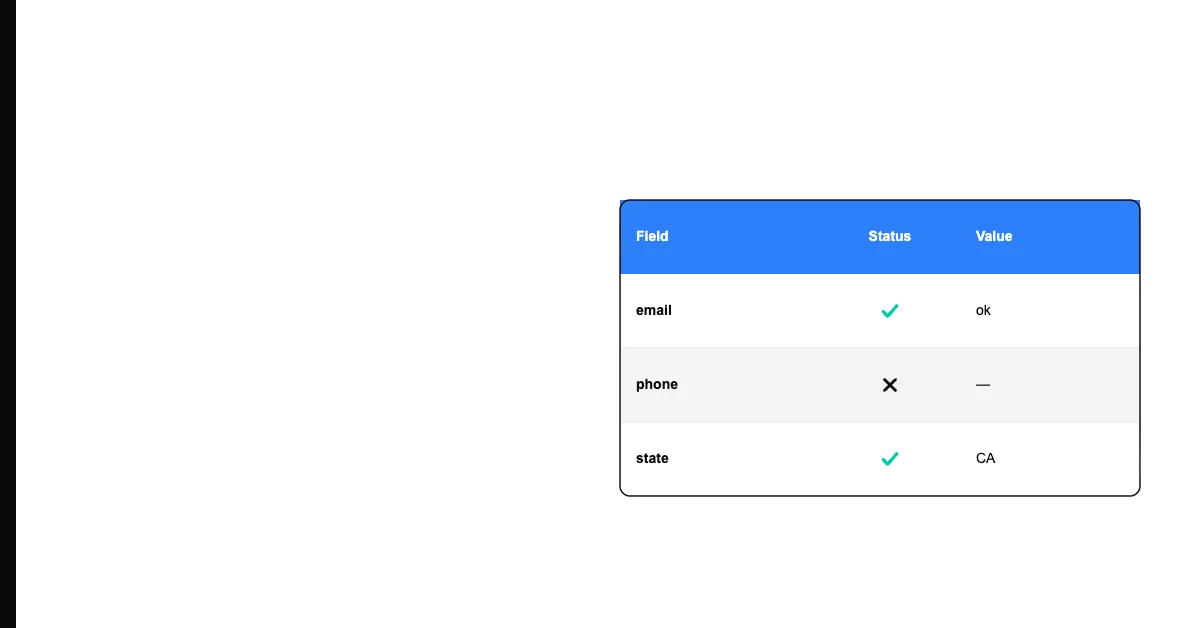
Your data quality is good enough when it meets the defined standards for its intended use case and when the cost of further improvement exceeds the benefit — a judgment that requires specific thresholds, not just a feeling that the data looks clean.
"Good enough" is not a vague comfort. It is a specific, defensible answer to a specific question: does this data perform the job it is supposed to do, reliably, with an acceptable error rate? When you can answer yes with evidence, you have reached good enough.
The Problem With "It Looks Fine"
Most teams declare data quality good enough based on a subjective sense that the data has been cleaned recently or that obvious problems have been addressed. This approach fails because:
- Invisible problems are the most dangerous ones
- "Recently cleaned" degrades without monitoring
- The most impactful quality failures are statistical, not visual — you cannot see that 12% of your email fields are invalid by scrolling through the data
Sohovi tracks quality trends across runs and alerts you when a metric — null rate, duplicate count, score — moves outside its normal range.
Good enough requires measurement, not impression.
How to Define "Good Enough" for Your Dataset
Step 1: Define the purpose. What decisions, processes, or outputs does this dataset drive?
Step 2: Identify the fields that are critical to that purpose. For an email campaign, the email field is critical. For a sales report, the revenue and account fields are critical.
Sohovi validates your email list for invalid formats, duplicates, and missing fields before you send — protecting your sender reputation.
Step 3: For each critical field, define the minimum acceptable quality score. Common thresholds:
- Completeness: 95-99% for customer-facing data
- Validity: 95-99% for fields used in automated processes
- Uniqueness: 99%+ for primary identifiers
- Timeliness: defined by how stale the data can be before it causes problems
Step 4: Measure against those thresholds. You have achieved good enough when all critical fields meet or exceed their defined thresholds.
Signals That You Have Not Reached Good Enough
- Analysts regularly add manual corrections to exports before using them
- Reports require a "known issues" footnote about data limitations
- Outreach campaigns have bounce or error rates above industry benchmarks
- Stakeholders express distrust in data-driven reports or recommendations
- You discover errors because of a customer complaint, not a quality check
Signals That You Are Probably Good Enough
- Quality metrics are stable or improving between checks
- No critical findings in the last two audit cycles
- Downstream processes run cleanly without manual intervention
- Teams use the data confidently without maintaining parallel "clean" copies
- The remaining known issues affect only non-critical fields or a small percentage of records
Frequently Asked Questions
Q: Is there a universal threshold for "good enough" data quality? No universal threshold exists because the right threshold is use-case dependent. A 95% completeness rate might be good enough for trend analysis and unacceptable for a billing database. Define your thresholds before measuring and evaluate against them.
Q: Can data quality ever be "perfect"? In practice, no. Perfect data quality is not a realistic goal for any dataset that is actively used and updated. The goal is fit-for-purpose quality: high enough that the data reliably serves its intended use without causing measurable harm or requiring constant manual correction.
Q: How do you convince stakeholders that current data quality is good enough? Show them measured metrics compared to defined thresholds. "Our email completeness is 97.3%, against a 95% threshold" is a more compelling argument than "we cleaned it last quarter." Stakeholder confidence in data quality comes from evidence, not reassurance.
Q: What happens if you stop improving data quality once you reach good enough? Quality will degrade over time without ongoing maintenance. "Good enough" is not a destination — it is a zone you maintain through scheduled checks and process adherence. If you stop monitoring after reaching your target, you will eventually fall below it without knowing.
Q: How do you define good enough for compliance data specifically? For compliance data, good enough is defined by the regulation, not by you. Review the specific data quality requirements of the relevant framework (GDPR, HIPAA, SOX, etc.) and use those as your minimum thresholds. In compliance contexts, "good enough" is whatever the audit requires.
Q: What if your dataset will never reach the quality threshold you defined? Either the threshold is wrong (set it based on what is achievable given your data sources, not an ideal) or the data source needs to be changed (if the source cannot provide data that meets the threshold, you need a different or supplementary source). A threshold that can never be met is not useful.
Q: How should you communicate data quality status to non-technical stakeholders? Use percentages and counts rather than abstract scores. "97% of our customer email addresses are valid, meaning 1,200 contacts currently cannot be reached by email" is more actionable than "our email validity score is 97/100." Connect quality metrics to business outcomes wherever possible.
Q: What is the risk of declaring data quality good enough too early? Premature declaration of good enough leads to complacency and degradation. If you declare victory before meeting defined thresholds, you stop the improvement work while problems remain. The risk is not failing the next quality check — it is failing a high-stakes business process that depended on data you thought was clean.
Q: Should different teams have different standards for good enough? Yes. Marketing, sales, finance, and compliance teams typically need different quality levels from the same underlying data. A data governance framework should define quality standards by use case rather than by a single organization-wide standard that is either too strict or too lenient for most use cases.
Q: What is the best way to track progress toward good enough? Track quality metrics on a regular schedule and plot them over time. The trend toward your defined threshold — and how long it takes to stabilize there — gives you a realistic picture of your data quality trajectory and a defensible answer to "are we good enough yet."
"Good enough" is one of the most useful concepts in data quality — because it gives you a finish line. Without defined thresholds, improvement efforts have no clear endpoint, and the question of whether the data is ready for use is always open.
Define your thresholds, measure against them, and stop guessing. Sohovi gives you the per-column quality metrics you need to compare against your standards in under a minute.