The difference between good test data and bad test data isn't volume — it's realism. A test suite that runs against "aaa@bbb.com" and "John123" is testing a different reality than one running against "alice.j.morrison@company-name.co.uk" and "Zé Araújo". The second set catches real-world edge cases that the first set cannot.
Why Random Data Fails as Test Data
Random data generators that produce strings like "xQzpR7mK" or numbers like 847362910 are useful for some things — performance testing, cryptographic operations, uniqueness testing. But they fail for most application testing because real data has structure and patterns.
Names: Real names contain spaces, hyphens, apostrophes, accented characters, and single-character tokens. They vary in length from 2 to 40+ characters. A field that passes "John Smith" might fail on "O'Brien" or "Li" or "María-José García-López".
Emails: Real email addresses have subdomains, plus-addresses, and non-ASCII characters in the local part. A validation rule that works on test@test.com might reject a valid address with a subdomain or reject a plus-addressed email.
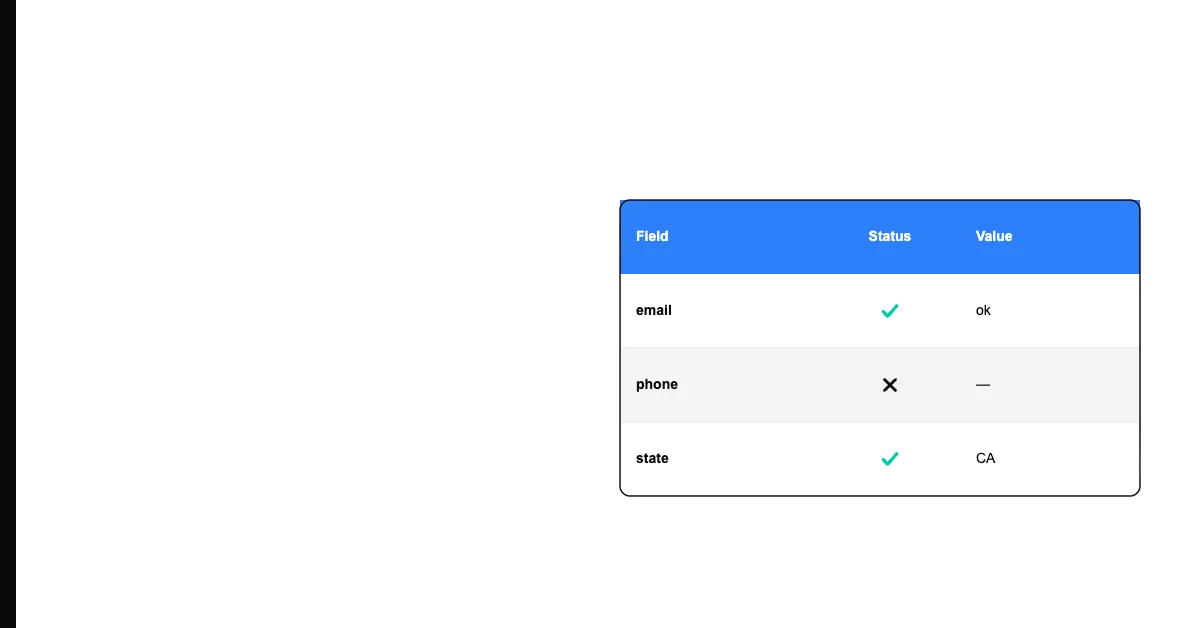
Sohovi lets you set up validation rules for any column and instantly see which rows fall outside them — no code or SQL required.
Dates: Real date fields span decades, include dates near epoch boundaries, and sometimes contain dates from before 1970. Tests that only use recent dates miss these edge cases.
What Realistic Test Data Includes
A comprehensive test data generator produces values that look, behave, and edge-case like real data:
- Names: Localised first and last names in multiple languages, with appropriate special characters
- Email addresses: Valid RFC 5321 addresses with realistic domain names
- Phone numbers: Country-specific formats with correct area code patterns
- Dates: Random dates within configurable ranges, in the format your system expects
- UUIDs: Version 4 UUIDs for synthetic primary keys
- Numbers: Integers and decimals with configurable ranges and precision
- Addresses: Street names, cities, postal codes, and countries in realistic combinations
- Lorem text: Placeholder prose for description and notes fields
How Many Rows You Need
For unit and integration tests: 50-500 rows covers most scenarios and edge cases. For load and performance tests: 100,000+ rows to stress indexes and query plans. For ML training data: highly variable — depends on model type and feature count, but often millions.
Sohovi profiles your training data for quality issues — missing values, outliers, type mismatches — before they corrupt your model.
Online Tool vs. Faker Libraries
Browser-based test data generators are the fastest path for one-off CSV generation — no setup, no code, download immediately. For automated test fixtures (generated fresh in a CI pipeline or as part of a seeding script), Faker libraries for Python and JavaScript generate programmatic synthetic data with locale support.
Sohovi's free Test Data Generator lets you define column types, set row count up to 100,000, and download as CSV or JSON — entirely in your browser with no signup.
Keep Reading
Try the Free Test Data Generator →