Test data generators have a reputation as a developer convenience — something you use to populate a form in a demo or seed a local database. But experienced QA teams use them for much more than that. Here are seven situations where a good fake data generator changes what's possible.
1. Import Pipeline Validation
Every application that imports user data — a CSV upload feature, a bulk contact import, an order import — needs to be tested with realistic data at realistic scale. Generate 10,000 user records with the full range of name formats, email structures, and phone number variants. A test suite that only runs against 10 hand-crafted rows will miss the edge cases that appear at scale: names with apostrophes, emails with subdomains, phone numbers with extensions.
2. Database Performance Testing
An application that performs well with 1,000 rows may slow unacceptably at 1 million. Load tests require data volume that matches or exceeds expected production loads. Generate 500,000-1,000,000 rows of synthetic records to stress-test database indexes, query performance, and pagination logic. This only works with a generator that handles large row counts without choking.
3. Making UI Screenshots Presentable
Development builds that run on "test@test.com" and "John Doe" look unpolished in stakeholder demos, documentation, and marketing materials. Realistic fake names — "Alice Morrison", "Carlos Fernández", "Priya Nair" — and realistic fake emails make screenshots indistinguishable from production at a glance. This matters when the product team needs to communicate with executives or customers.
4. Training New Team Members
Onboarding a new QA engineer, analyst, or customer success manager into a system requires data to explore. Production data carries privacy risk. A realistic synthetic dataset gives new team members a safe sandbox to explore, make mistakes in, and learn from — without any risk of accidentally exposing real customer information.
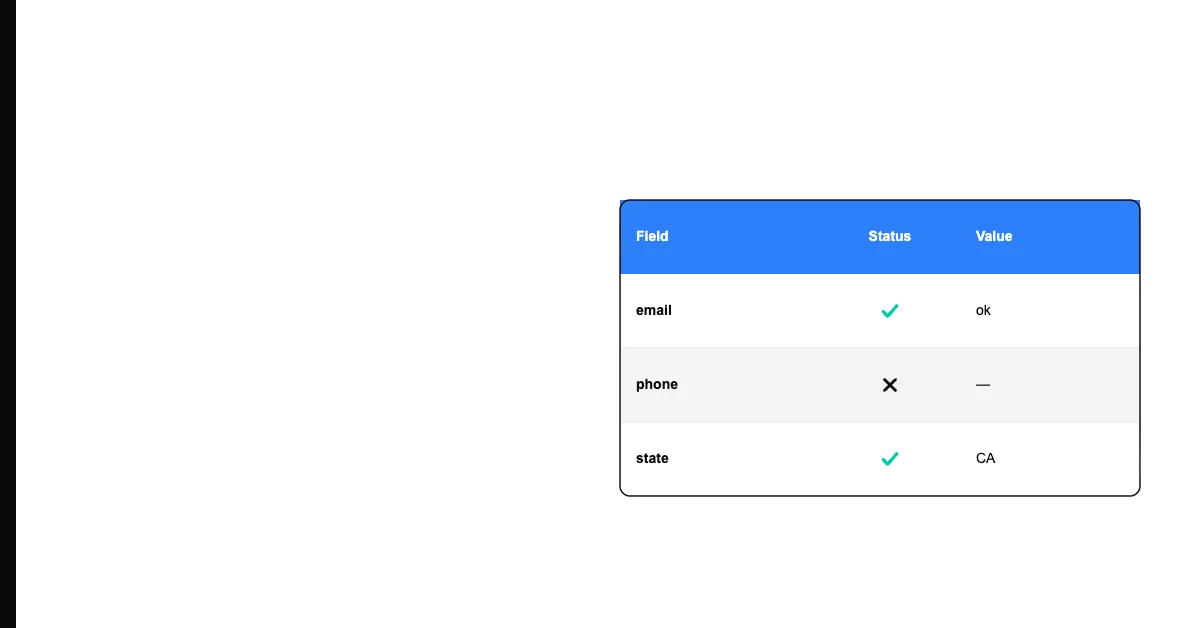
Sohovi automatically detects PII in your datasets — emails, phone numbers, SSNs — all processed client-side so your data never leaves the browser.
5. Regulatory Sandbox Environments
Some regulated industries (finance, healthcare) require testing in designated sandbox environments that must not contain real personal data. Synthetic data generation is the standard solution. Generate data that matches the schema and statistical profile of production data without containing any real records.
6. Machine Learning Feature Development
ML models require labelled training data. In early development, before real training data is available, synthetic data allows feature development and model architecture experiments to begin. Generate synthetic records with the right feature columns and assign synthetic labels to unblock initial development.
7. Reproducible Test Fixtures
Test suites that rely on hand-crafted static fixtures break when the application schema changes. A generator that produces fixtures programmatically — configured via a column definition file — can regenerate fixtures automatically when schemas evolve. The test data stays in sync with the application without manual maintenance.
Sohovi's free Test Data Generator supports all these use cases — configure column types (name, email, phone, UUID, date, number, country, lorem), set row count up to 100,000, and download as CSV or JSON.
Keep Reading
Try the Free Test Data Generator →