The practice is so common that most developers don't think twice about it: take a production database dump, load it into a development or staging environment, and use it for testing. It's fast, it's realistic, and it's almost certainly a GDPR violation.
Why Production Data in Test Environments Is a Problem
GDPR Article 5 establishes the principle of purpose limitation: personal data collected for one purpose should not be processed for an incompatible purpose. Using real customer data — collected to provide your service — to run automated tests or debug new features is a secondary purpose that requires explicit justification.
It's also a data minimisation failure. Article 5 also requires that data be "adequate, relevant and limited to what is necessary." A full production database dump loaded into a developer's laptop is not limited to what's necessary for testing.
Beyond the legal framework, development environments are structurally less secure than production. More team members have access. Data may be logged in plaintext. Backup practices are looser. Error messages may expose data values. The risk profile is simply higher.
Three Approaches to Handling Test Data
Anonymisation: Remove or replace all identifying information with generic values. Irreversible — the original data cannot be reconstructed. True anonymisation places the data outside GDPR scope entirely. The challenge: achieving true anonymisation is harder than it looks. Re-identification through combination of fields (age + postcode + gender) is a known risk.
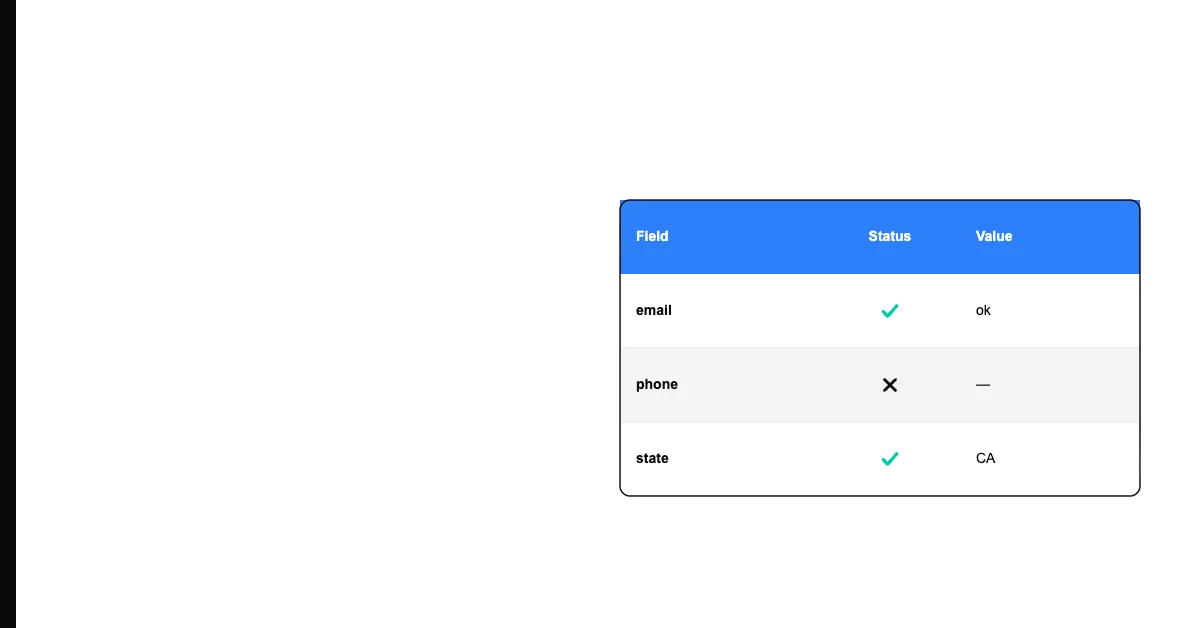
Sohovi automatically detects PII in your datasets — emails, phone numbers, SSNs — all processed client-side so your data never leaves the browser.
Pseudonymisation: Replace direct identifiers (name, email, phone) with pseudonyms (hashed tokens, sequential IDs). The original can be reconstructed with the mapping key. GDPR recognises pseudonymisation as a risk mitigation measure, but pseudonymised data is still personal data — it remains within scope.
Synthetic data generation: Create entirely new data that was never real. No real customer is represented. No re-identification is possible. This is the strongest option from a compliance standpoint. The challenge: the synthetic data must be realistic enough to be useful for testing.
Practical Implementation
Generate a synthetic dataset that mirrors the structure and characteristics of your production data without containing any real records. Use a test data generator to define the column types — name, email, phone, date, UUID, address — set your row count to match production volumes if needed for performance testing, and download.
Load this synthetic dataset into your development and test environments instead of production data. Rotate the synthetic dataset periodically to ensure tests aren't inadvertently relying on specific synthetic values.
Document your test data strategy as part of your GDPR compliance documentation. When a regulator or auditor asks how you handle personal data in test environments, having a clear answer is substantially better than not having one.
Sohovi's free Test Data Generator produces realistic synthetic CSV data up to 100,000 rows — no signup, no upload, fully browser-side.
Keep Reading
Generate GDPR-Safe Test Data Free →