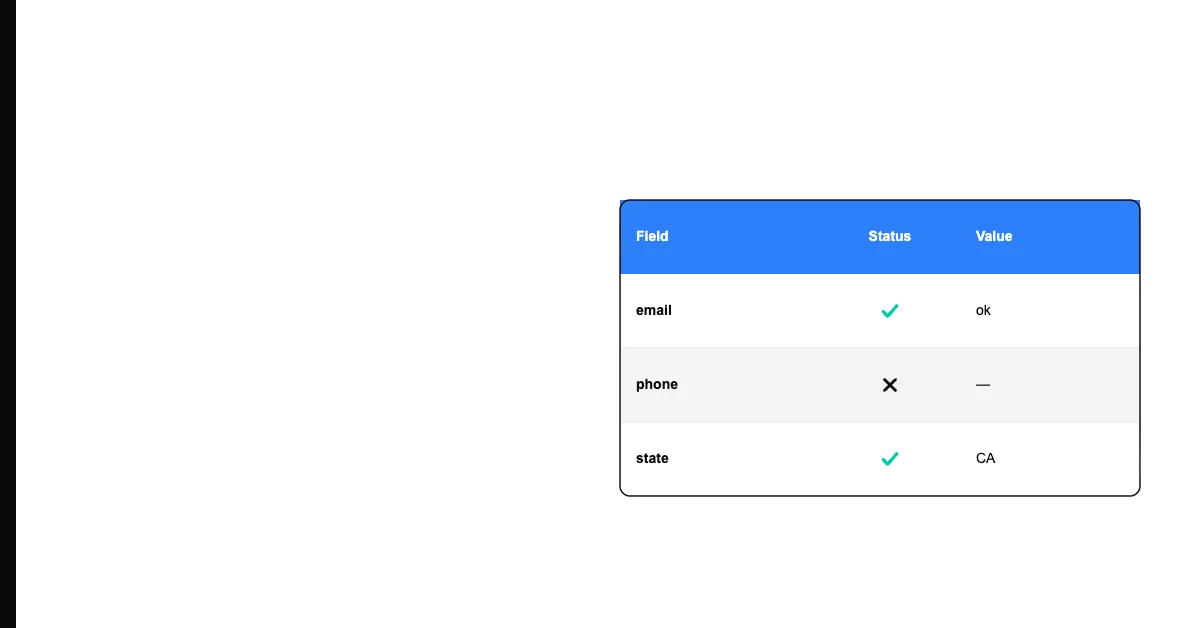
Data accuracy is one of the six to ten dimensions that make up data quality. Data quality is the umbrella concept; accuracy is a specific measure within it — whether the data correctly reflects the real-world entity it represents.
People use "data quality" and "data accuracy" interchangeably, but they are not the same thing. You can have inaccurate data that is otherwise complete, unique, and consistently formatted. You can also have accurate data that is incomplete, full of duplicates, or outdated. All of these are data quality problems — accuracy is just one of them.
Defining Each Term
Data accuracy is the degree to which data correctly represents the real-world entity or event it describes. A customer record with the wrong phone number, a transaction logged with the wrong amount, or a product record with an incorrect weight all have accuracy failures. Accuracy is about correctness.
Sohovi scores your dataset against your own accuracy standards and highlights the columns and rows where values fall outside expected ranges.
Data quality is the degree to which data is fit for its intended purpose. It encompasses multiple dimensions:
- Completeness — are required fields populated?
- Accuracy — are values correct?
- Consistency — is the same data represented the same way across systems?
- Validity — do values conform to expected formats and rules?
- Uniqueness — are there duplicate records?
- Timeliness — is the data current?
- Integrity — are relationships between records intact?
A dataset can score well on most dimensions and still have an accuracy problem. A dataset can be highly accurate but completely unusable because it is 40% incomplete.
Why the Distinction Matters
When teams say "we have a data quality problem," they often mean "we have data that is wrong." That framing leads them to focus only on accuracy — finding and correcting wrong values — while ignoring completeness problems, duplicate records, and format inconsistencies that are equally damaging.
Sohovi automatically finds every duplicate in your dataset — including near-matches — and shows you exactly which rows are affected.
Using the full data quality framework forces a more complete diagnosis. Before deciding what to fix, you need to know which dimensions are failing. A completeness problem requires a different solution than an accuracy problem.
When Accuracy Is the Right Focus
Accuracy is the highest-priority dimension when:
- Data drives financial calculations (wrong numbers produce wrong results)
- Data is used for identity verification or legal purposes
- Data is customer-facing (a customer who receives mail with the wrong name has a poor experience)
- Inaccurate data has compliance implications
When Other Dimensions Are More Important Than Accuracy
For analytics and reporting, completeness often matters more than accuracy. Missing data that is excluded from analysis can produce more misleading results than slightly inaccurate data that is included.
Sohovi profiles every column in your dataset for completeness and flags the exact rows where values are missing — free to try.
For automated workflows, validity often matters more than accuracy. A correctly formatted but slightly wrong phone number will at least not break an automated validation process; an incorrectly formatted phone number might.
Frequently Asked Questions
Q: Is data accuracy the most important dimension of data quality? It depends on the use case. For financial data, yes. For email marketing, completeness and validity often matter more than accuracy — a complete, validly formatted email list produces better campaign results than a smaller list where every record is manually verified as accurate. Rank dimensions by what your specific use case needs most.
Q: Can data be high quality but inaccurate? Yes. A dataset can score well on completeness, uniqueness, consistency, and validity while containing systematically inaccurate values. This happens when bad data was entered consistently in the wrong format (e.g., all zip codes entered with the wrong digit) — it passes format validation but is factually wrong.
Q: What is the hardest dimension of data quality to measure? Accuracy is the hardest because it requires comparing your data against an external ground truth. You can calculate completeness by counting nulls. You can calculate uniqueness by counting duplicates. Measuring accuracy requires access to an authoritative reference source — and those are not always available.
Q: What is the easiest dimension of data quality to improve? Validity and consistency are typically the easiest to improve because they are structural problems — wrong formats, inconsistent values — that can often be corrected with bulk transformation rules. Accuracy is harder because it requires individual record-level judgment or expensive enrichment.
Q: How do you measure data accuracy without ground truth? You can approximate accuracy by checking for implausible values (ages over 150, negative revenue figures), logical inconsistencies (a ship date before an order date), or statistical outliers that are likely errors. These are proxy measures — they catch obvious accuracy failures without requiring an external reference.
Q: Is data validation the same as data accuracy checking? No. Data validation checks whether values conform to expected formats or rules (is this a valid email format, is this a valid date). Data accuracy checks whether values are correct (is this the right email address for this person). Validation is a structural check; accuracy is a factual check.
Q: What causes accuracy problems in data? The most common causes are: manual entry errors, system integration mismatches where fields map incorrectly, data that was correct at the time of capture and has since become outdated (an address after someone moves), and errors introduced during data transformation or migration.
Q: Which industries have the strictest data accuracy requirements? Healthcare (patient records must be accurate to avoid treatment errors), financial services (transaction data must be accurate for regulatory compliance), legal and government (records used in official proceedings), and any industry subject to data reporting regulations. Consumer-facing industries have high accuracy requirements for contact data to maintain customer trust.
Q: How does data accuracy relate to data freshness? They are related but different. Data freshness (timeliness) describes whether the data is current. Data accuracy describes whether the data is correct. A phone number that was correct 3 years ago but the person has since changed is a timeliness problem. A phone number that was never correct is an accuracy problem.
Q: What should you do if you cannot verify whether your data is accurate? Flag it as unverified. Mark records where accuracy cannot be confirmed as low-confidence. This is better than treating unverified data as accurate — at least downstream users know to treat those records with caution. A system that tracks data confidence alongside data values is more useful than one that presents all data as equally reliable.
The distinction between accuracy and quality is not academic — it determines where you look for problems and how you fix them. A team that only improves accuracy while ignoring completeness and uniqueness will still have data that underperforms.
The first step is a full diagnosis across all dimensions. Sohovi profiles your dataset for completeness, uniqueness, and validity across every column — giving you the full picture rather than just the accuracy slice.