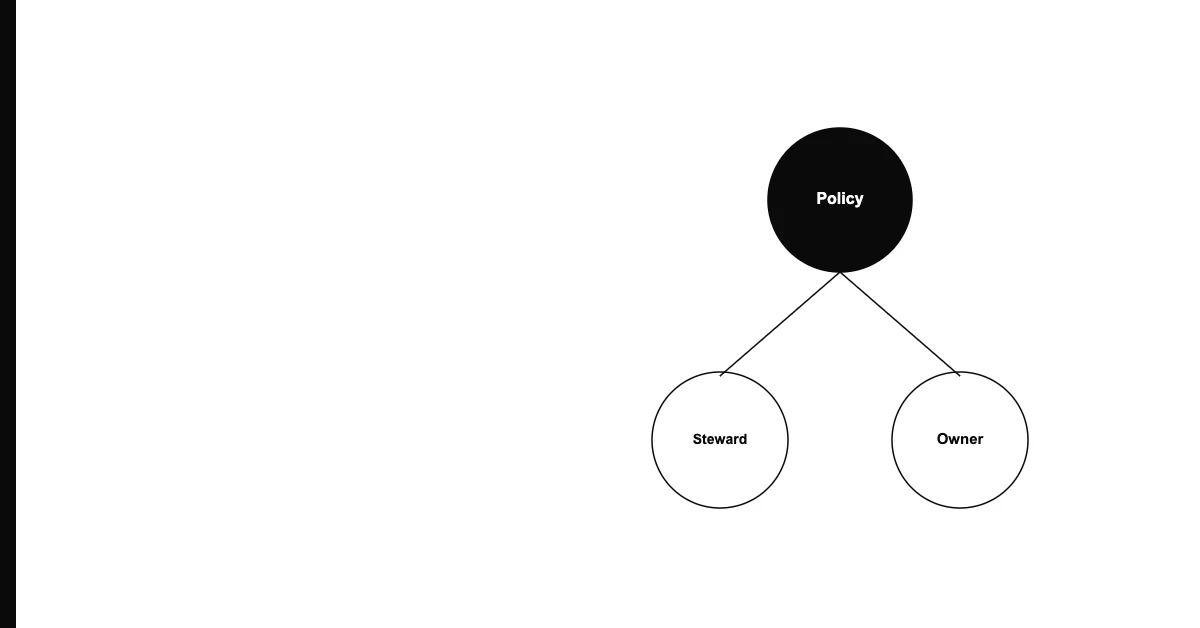
Data stewardship is the practice of assigning individuals — called data stewards — to take day-to-day operational responsibility for the quality, accuracy, and proper use of data within a specific domain or dataset.
Without stewardship, data quality has no human owner. Problems get noticed only when they cause visible damage. With stewardship, someone is watching, measuring, and acting before the damage happens.
In this guide
- What data stewardship actually involves
- The difference between a data steward and a data owner
- What makes a good data steward
- How to set up stewardship without creating bureaucracy
- Common ways stewardship programs fail
What a Data Steward Actually Does
The data steward role is often described in vague terms — "owns the data," "ensures quality," "acts as a guardian." In practice, stewardship is a specific set of operational responsibilities:
Monitoring quality: Regularly reviewing quality metrics for the datasets they own — null rates, duplicate rates, format validity, data freshness. Not waiting for someone else to notice a problem.
Sohovi automatically finds every duplicate in your dataset — including near-matches — and shows you exactly which rows are affected.
Investigating failures: When quality metrics degrade, the steward investigates. Is it a system issue? A process change? A new data source with different formats? They find the root cause rather than just flagging the symptom.
Defining and enforcing standards: The steward is responsible for the data standards for their domain — what fields are required, what formats are acceptable, what constitutes a valid value. They keep standards current as the business evolves.
Coordinating fixes: When quality problems are found, stewards coordinate remediation. They may fix records themselves, work with data producers to correct entry habits, or escalate systemic issues to engineering.
Serving as the go-to expert: When someone in the organization has a question about a dataset — what a field means, where the data came from, why a value looks unexpected — the steward is who they ask.
Data Steward vs. Data Owner: What's the Difference?
These terms are often confused. The distinction matters:
Data owner: A business leader (VP, director, or senior manager) who is accountable for the quality and proper use of data in their domain. They set direction, approve standards, and are responsible for quality outcomes at the organizational level. They are NOT involved in day-to-day quality management.
Data steward: An operational person (analyst, team lead, ops manager) who carries out the day-to-day quality management work within the domain the owner is accountable for. They execute what the owner is responsible for.
Think of it like this: the data owner is the VP of Engineering who is accountable for production reliability. The data steward is the senior engineer who actually monitors the dashboards, responds to alerts, and keeps things running.
Sohovi tracks quality trends across runs and alerts you when a metric — null rate, duplicate count, score — moves outside its normal range.
In small organizations, one person often plays both roles. That's fine — the important thing is that the responsibilities exist, not that they're held by different people.
What Makes a Good Data Steward
A data steward needs a specific combination of skills that isn't always obvious:
Business context understanding: They need to understand what the data means, not just what it contains. A steward who knows that "active" means "purchased in the last 12 months" in one system but "logged in the last 30 days" in another is far more valuable than one who knows only the field name.
Enough technical ability to measure: They don't need to be a data engineer, but they need to be able to run a basic query, export data and profile it, or use reporting tools to check quality metrics. A steward who can't measure quality can't manage it.
Organizational credibility: The steward regularly needs to tell other people to change their data entry behavior, or ask engineering to fix a validation rule. They need enough standing to make those asks and follow through.
Sohovi lets you set up validation rules for any column and instantly see which rows fall outside them — no code or SQL required.
Attention to patterns: Good stewards notice when metrics drift before they become critical. They're the ones who see that the null rate on phone_number went from 8% to 11% to 15% over three months — and act at 11%, not 15%.
Tools like Sohovi make the monitoring part of stewardship accessible without SQL knowledge — upload your data file and get a quality report showing null rates, format issues, and duplicates in minutes.
How to Set Up Data Stewardship Without Creating Bureaucracy
Stewardship programs fail when they become too formal too quickly — elaborate role definitions, committee structures, and approval chains that add overhead without adding quality. Here's a lightweight starting structure:
Step 1: Identify your critical datasets. Start with the 3–5 datasets whose quality most directly affects business outcomes. Don't try to steward everything at once.
Step 2: Assign one steward per dataset. Choose someone who already works closely with that data — ideally the most knowledgeable person on the team that produces it. Don't create a new headcount; make it an explicit part of an existing role.
Step 3: Define what the steward is responsible for. Write it down: what do they monitor, how often, what do they do when quality degrades, and who do they escalate to? One page is enough.
Step 4: Give them visibility. The steward needs access to quality metrics — either a dashboard, a regular report, or a tool they can use independently to check their data.
Step 5: Connect stewardship to regular operations. The steward should bring a brief quality update to existing team reviews. This takes 2 minutes per meeting and keeps quality visible without adding new meetings.
Step 6: Expand as the practice matures. Once the first 3–5 stewardships are working, extend to the next tier of datasets. Don't expand before the initial stewardships are producing visible results.
Common Ways Stewardship Programs Fail
Assigning stewardship without authority. If a steward has responsibility but can't require data producers to change their practices, or can't get engineering time to fix a validation rule, they become a quality reporter rather than a quality manager. Authority needs to accompany accountability.
Making it someone's entire job too early. Full-time data steward roles make sense at enterprise scale. For most companies, stewardship starts as a defined part-time responsibility within an existing role. Forcing it to be a full-time job before the organizational need justifies it leads to underutilized headcount and resentment.
No measurement, just responsibility. Assigning stewardship without defining what gets measured is assigning accountability for something invisible. Quality outcomes need metrics — specific, trackable, regularly reviewed.
Steward becomes a fixer instead of a preventer. If the steward spends all their time fixing individual records instead of identifying and resolving the systemic causes of quality problems, they're on a treadmill. Good stewardship catches root causes; bad stewardship cleans up symptoms.
No executive sponsorship. Stewardship programs that exist below the visibility of senior leadership rarely have the organizational weight to change behavior. Someone at the director or VP level needs to treat data stewardship as a business function, not an IT project.
Frequently Asked Questions
Q: Is a data steward the same as a data analyst? No. A data analyst interprets data — they build reports, find insights, and support decision-making. A data steward manages the health of the data itself — they ensure it's accurate, complete, and properly defined. A data analyst depends on good data; a data steward is responsible for providing it. Many analysts take on steward responsibilities informally, and this overlap is common in smaller organizations.
Q: Who should be assigned as a data steward — a technical person or a business person? Ideally someone who bridges both: a business analyst, operations lead, or senior team member who understands both what the data means and how to measure it. Purely technical stewards often lack business context; purely business stewards often lack the measurement skills. The sweet spot is someone in between.
Q: Can one person be the steward for multiple datasets? Yes, but with limits. One person can effectively steward 2–4 closely related datasets — for example, all customer-related tables in a CRM. Beyond that, the monitoring and investigation work becomes too diluted. When datasets are unrelated (e.g., customer data and financial transactions), separate stewards with domain expertise are better.
Q: Should data stewards report to the data team or to the business? This varies by organization. In distributed stewardship models (most common), stewards are embedded in business teams and report to business managers. They coordinate with the central data team but aren't part of it. This gives them better business context at the cost of some data team coordination. In centralized models, stewards sit in the data or IT department. Distributed models are generally more effective for data quality because business context is harder to import than technical skills.
Q: What tools does a data steward need? At minimum: access to the datasets they steward, a way to measure quality metrics (SQL access, a BI tool, or a data profiling tool), and a way to document standards (even a shared document works). Formal data catalog tools and quality monitoring platforms add efficiency at scale but aren't necessary to start.
Q: How do you measure whether data stewardship is working? Track: quality metrics over time for stewarded datasets (are null rates, duplicate rates, and format validity improving?), time-to-remediation for quality issues, and the ratio of proactively detected problems vs. reactively reported ones. A working stewardship program should shift that ratio toward proactive detection over time.
Q: What's the difference between data stewardship and data governance? Data governance is the overall framework — the policies, roles, and processes for managing data across the organization. Data stewardship is one specific function within governance: the human accountability layer for data quality at the domain level. Governance without stewardship is a framework without operators.
Q: How does data stewardship relate to GDPR and data privacy? Data stewards are often involved in privacy compliance for their domain — ensuring that personal data is handled according to policy, that retention rules are followed, and that data subject requests are coordinated. However, stewardship is distinct from a Data Protection Officer (DPO) role. Stewards focus on quality; privacy compliance is a separate responsibility, though they often overlap.
Q: What happens when a data steward leaves the company? The stewardship responsibility doesn't leave with them — but the institutional knowledge often does. This is why standards documentation and data dictionaries are essential: the successor needs to be able to pick up the steward role without depending entirely on knowledge transfer. Offboarding a steward should include a formal knowledge transfer session.
Q: Can small businesses benefit from data stewardship? Yes — in fact, small businesses often benefit disproportionately because they tend to have less formal data management and fewer resources to fix quality problems reactively. Even a 10-person company can designate one person on each major data-producing team as the data quality go-to. The formality scales up; the principle applies at any size.
If you want to give your data stewards a fast, code-free way to measure data quality, Sohovi lets anyone upload a CSV and get an instant quality report — null rates, format issues, duplicates — in minutes. Try it free — no technical setup needed.