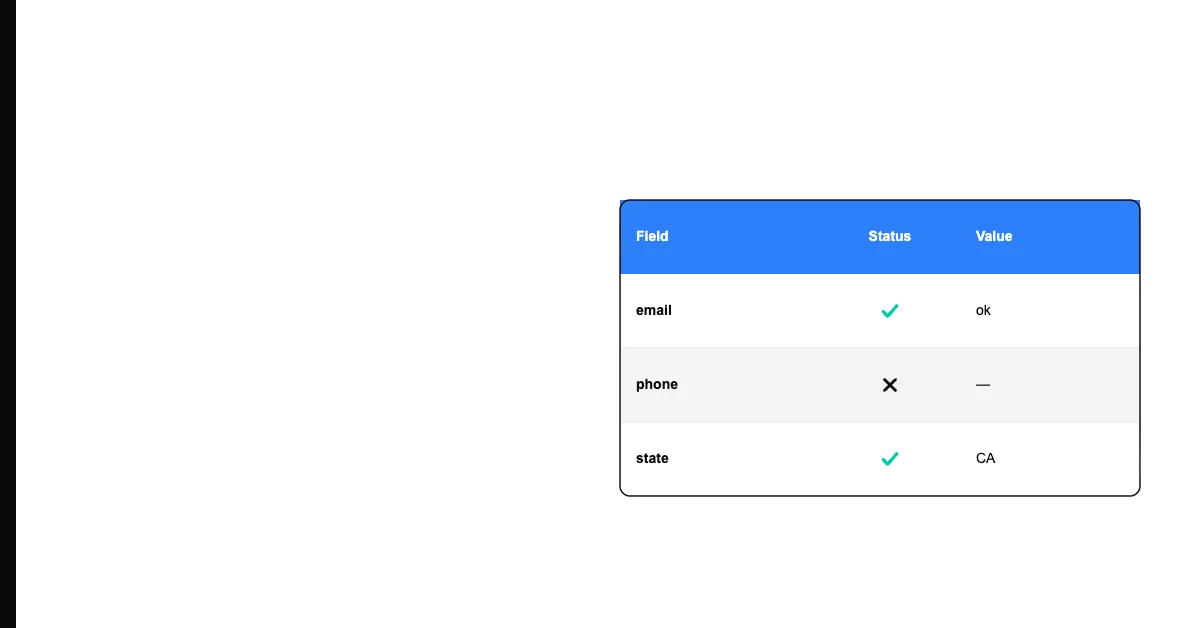
Schema validation is the process of verifying that a dataset conforms to an expected structural definition — confirming that it has the correct column names, data types, required fields, and format before any downstream processing or analysis begins.
Schema validation is the structural gate that confirms you're working with what you think you're working with. Before you can validate values or analyze data, you need to know the dataset has the structure your processing expects.
What Schema Validation Checks
A schema check typically verifies:
- Column presence: Are all expected columns in the file?
- Column names: Are columns named exactly as expected (correct case, no typos)?
- Data types: Is each column storing the expected type (string, integer, date)?
- Column count: Does the file have the expected number of columns?
- Required fields: Are mandatory fields present?
- Column order: For position-dependent systems, are columns in the expected sequence?
Why Schema Validation Must Come First
Schema validation must run before field-level quality checks, because schema failures invalidate all other checks. If the "email" column is missing, your email validity rule has nothing to check. If the "price" column contains text instead of numbers, your range validation will fail on every row.
Sohovi lets you set up validation rules for any column and instantly see which rows fall outside them — no code or SQL required.
A schema failure at the start of a pipeline catches structural problems when they're cheapest to fix — before any downstream processing has occurred.
Frequently Asked Questions
Q: What is schema validation? Schema validation checks that a dataset has the expected structure — the right column names, data types, required fields, and number of columns — before any downstream processing or analysis begins. It's the structural prerequisite for all other data quality checks.
Q: Why should schema validation come before field-level validation? Schema failures invalidate field-level checks. If a required column is missing, the rules that operate on that column have nothing to check. Running field-level validation on a structurally wrong file produces misleading results.
Q: What is schema drift and how does schema validation catch it? Schema drift occurs when a source system changes its output structure without notification. Schema validation catches drift by comparing the incoming data structure to the expected schema and alerting immediately when there's a mismatch.
Q: What is a JSON Schema? JSON Schema is a standard vocabulary for validating the structure of JSON documents — specifying required fields, data types, allowed values, and nested structure. It's the JSON equivalent of database schema definitions or XML Schema (XSD).
Q: How does schema validation differ from data type validation? Schema validation checks the dataset's overall structure. Data type validation checks whether individual values in each column match the expected type. Schema validation is the broader structural check; data type validation is one component of field-level validation.
Q: Can schema validation be automated? Yes. Most data pipeline tools (Fivetran, dbt, Airbyte) include schema monitoring that automatically detects changes. In custom pipelines, schema validation scripts run on every incoming file. Setting up automated schema validation is standard practice in data engineering.
Q: What happens when a file fails schema validation? Best practice: reject the file, route it to an exception queue, notify the source (vendor, system, team), and don't process it further. Attempting to process a structurally wrong file produces unpredictable results.
Q: What is the difference between schema validation and data profiling? Schema validation checks structure — do the right columns exist in the right format? Data profiling examines content — what values are actually in each column, what are their distributions, null rates, and patterns? Both are needed; schema validation is typically the first step.
Q: What is a strict vs. flexible schema? A strict schema rejects any file that doesn't match exactly — wrong column names, extra columns, or missing columns all cause rejection. A flexible schema allows for additional columns beyond what's expected, or optional fields that may be absent. Choose based on how controlled your data sources are.
Q: How does schema validation apply to APIs? API schema validation checks that the response from an API call matches the expected structure. When an API changes its response format (a breaking change), schema validation catches it before the malformed data propagates downstream.
Schema validation is the first and cheapest data quality check — catching structural problems before they corrupt any downstream processing. Add it to every import and integration workflow.