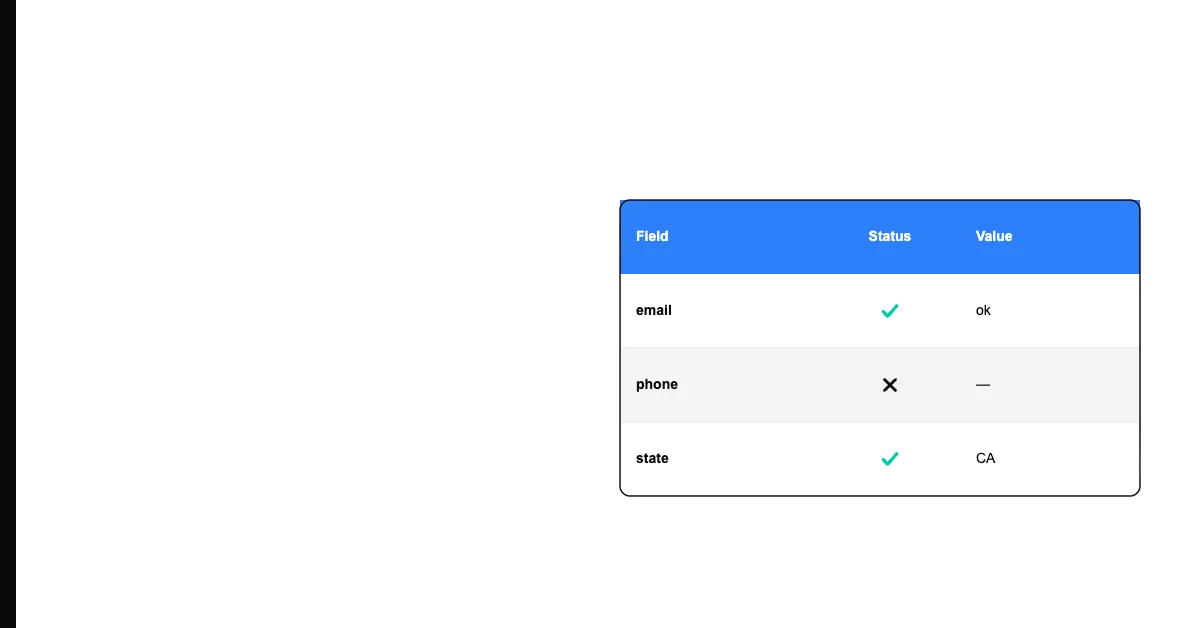
Data normalization refers to two distinct concepts: in database design, it means organizing tables to reduce redundancy; in data quality, it means converting data values from varied representations into a single consistent format — for example, converting all phone numbers to E.164 format regardless of how they were originally entered.
Both meanings appear frequently in data quality conversations, which creates confusion. This guide covers both clearly.
Normalization in Database Design
In relational database design, normalization is the process of structuring tables to eliminate redundancy and improve data integrity. It follows a set of rules called Normal Forms:
First Normal Form (1NF): Each column contains atomic (indivisible) values. No repeating groups.
Second Normal Form (2NF): All non-key attributes fully depend on the entire primary key — no partial dependencies.
Sohovi profiles your datasets for quality issues in minutes — see what's broken before it breaks your pipeline — try Sohovi free.
Third Normal Form (3NF): No non-key attribute depends on another non-key attribute — no transitive dependencies.
The practical effect: instead of storing a customer's address on every order record, you store the address once in a customer table and reference it by customer ID. This prevents update anomalies — if the customer moves, you update one record, not hundreds.
Normalization in Data Quality
In data quality, normalization means converting different representations of the same value into a single canonical form:
- All phone numbers → E.164 format (+15551234567)
- All state names → two-letter ISO code (California → CA)
- All company name suffixes → one form (Corp., Corporation, Corp all → Corp.)
- All dates → ISO 8601 (YYYY-MM-DD)
This type of normalization is a prerequisite for deduplication (records can't be matched if the same value is stored differently), reporting (a pivot on "state" will fragment data across "NY", "New York", and "new york"), and cross-system joins (join keys must be in consistent format).
Sohovi automatically finds every duplicate in your dataset — including near-matches — and shows you exactly which rows are affected.
Which Type of Normalization Do You Need?
Database design normalization: Relevant when designing a new database schema or restructuring an existing one. Primarily a concern for database architects and engineers.
Data quality normalization: Relevant whenever you're cleaning, standardizing, or preparing data for analysis. Applicable to anyone working with real-world data files.
Frequently Asked Questions
Q: What is data normalization in plain English? In database design, normalization means organizing tables to avoid storing the same information in multiple places. In data quality, normalization means converting varied representations of the same value (phone number formats, state names, date formats) into a single consistent form.
Q: What is the most common type of data normalization in data quality work? Format normalization — converting values to a consistent structural format. Date normalization (all to YYYY-MM-DD), phone normalization (all to E.164), and categorical normalization (all state names to two-letter codes) are the most common examples.
Q: What is the difference between data normalization and data standardization? In data quality contexts, the terms are often used interchangeably. Some practitioners distinguish them: standardization refers to converting to an industry-defined standard (like E.164 for phone numbers), while normalization refers to making values consistent with each other regardless of external standards.
Q: Why do databases have normal forms? Normal forms (1NF, 2NF, 3NF) are design rules that prevent data anomalies — situations where inserting, updating, or deleting one record causes unintended effects on other records. A fully normalized database is easier to maintain and less prone to these anomalies.
Q: What is denormalization and when is it appropriate? Denormalization intentionally introduces redundancy into a database to improve query performance. It's common in data warehouses and analytics environments where read speed is more important than update efficiency. Most analytical tables are deliberately denormalized.
Q: How does normalization help with deduplication? Records representing the same entity can only be matched if their key fields are in a consistent format. "555-123-4567" and "5551234567" are the same phone number — but an exact matching algorithm treats them as different. Normalizing phone formats first makes deduplication dramatically more accurate.
Q: What tools help with data normalization in data quality? Spreadsheet formulas (UPPER, LOWER, TRIM, SUBSTITUTE) handle simple string normalization. Data quality platforms and ETL tools have built-in normalization transformations. Python pandas has string methods for programmatic normalization at scale.
Q: Does normalization ever cause data quality problems? Yes. Overly aggressive normalization can lose meaningful distinctions — collapsing "New York City" and "New York State" to "NY" loses information. Automated normalization that maps ambiguous values incorrectly can introduce errors. Always review normalization mappings for edge cases.
Q: What is numeric normalization in data science? In data science and machine learning, numeric normalization scales feature values to a standard range (typically 0-1 or -1 to 1) so that features of different magnitudes don't disproportionately influence model training. This is distinct from both database normalization and data quality normalization.
Q: Should normalization happen at the source or in the pipeline? Both, ideally. Source-level normalization (form validation, CRM picklists) prevents new non-normalized values from entering. Pipeline normalization cleans historical data during ETL or transformation. The earlier normalization is applied, the fewer downstream quality problems it creates.
Whether you're designing a database or cleaning a spreadsheet, normalization creates the consistency that makes data reliable. In data quality work, it's the prerequisite for deduplication, cross-system joins, and trustworthy reports.