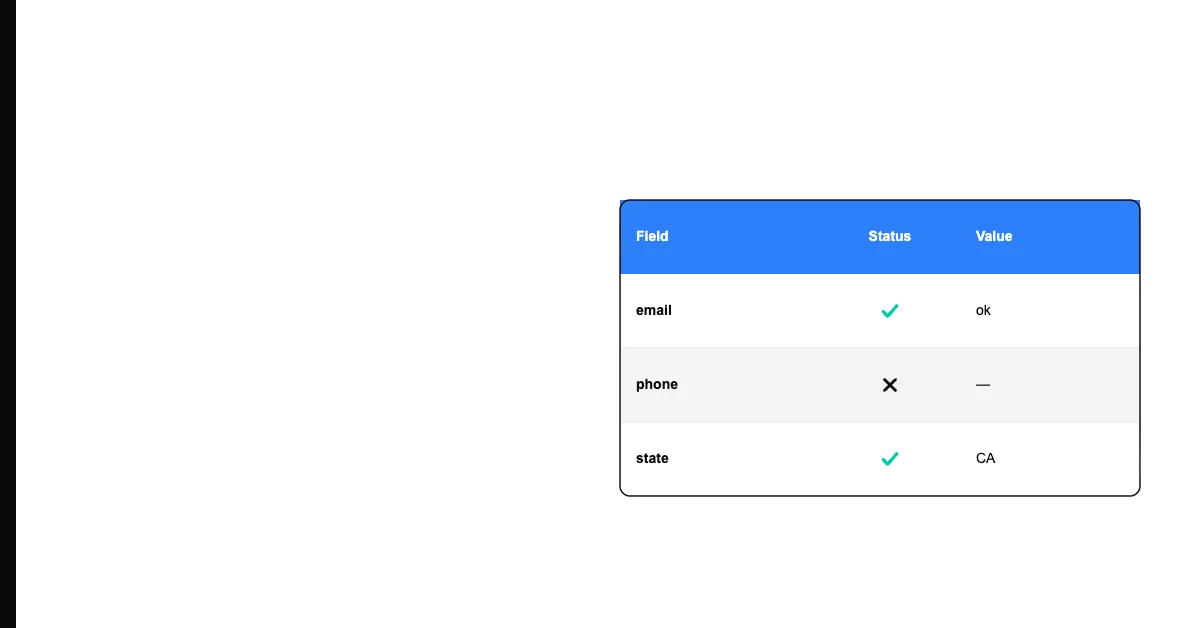
Data standardization is the process of converting data from varied or inconsistent representations into a single, canonical format — ensuring that the same information is always expressed the same way across all records, systems, and sources.
When your database contains "New York," "NY," "new york," and "N.Y." all meaning the same state, every filter, join, and segment that depends on the state field produces fragmented results. Data standardization converts all four to a single canonical form — eliminating the inconsistency and making the data reliable for analysis.
What Data Standardization Addresses
Categorical values: Status fields with "Active," "active," "ACTIVE," and "1" all meaning the same thing. Country fields with "US," "USA," "United States," and "U.S." Standardization maps all variants to a single canonical form.
Date formats: MM/DD/YYYY, DD/MM/YYYY, YYYY-MM-DD, and "March 5, 2024" all in the same field. Standardization converts all to ISO 8601 (YYYY-MM-DD).
Phone numbers: "(555) 123-4567," "555-123-4567," and "+15551234567" all representing the same number. Standardization converts all to E.164 format.
See exactly what's wrong with your data — try Sohovi free — try Sohovi free.
Company names: "IBM Corp," "IBM Corporation," "I.B.M.," and "International Business Machines." Standardization maps all to a single canonical form.
Addresses: "123 Main St.," "123 Main Street," and "123 MAIN ST" all representing the same address. Standardization converts all to USPS standardized format.
Why Standardization Is the Prerequisite for Everything Else
Data standardization isn't an end in itself — it's the prerequisite for every other data quality operation:
- Deduplication can't accurately identify duplicates if the same entity is spelled differently across records
- Joining data across systems fails when shared key fields use different formats
- Segmentation and filtering produces incomplete results when categorical fields have inconsistent values
- Reporting fragments metrics when the same concept is expressed multiple ways
Sohovi automatically finds every duplicate in your dataset — including near-matches — and shows you exactly which rows are affected.
Frequently Asked Questions
Q: What is data standardization? Data standardization is the process of converting inconsistent or varied representations of the same information into a single, consistent canonical format — ensuring that the same data is always expressed the same way across records and systems.
Q: What is the difference between data standardization and data normalization? In data quality contexts, these terms are often used interchangeably. Some practitioners distinguish them: standardization converts to an externally defined standard (E.164 for phone numbers), while normalization converts to internal consistency regardless of external standards. The underlying goal — making values consistent — is the same.
Q: What is a canonical form? A canonical form is the single, official representation that all variants of a value should be converted to. For ISO country codes, "US" is canonical. For phone numbers, "+15551234567" (E.164) is canonical. Choosing the canonical form is the first step of any standardization effort.
Q: Why is data standardization necessary for deduplication? Deduplication algorithms match records based on field values. If "IBM Corp" and "IBM Corporation" are both in the database, exact matching won't identify them as duplicates. After standardization — both become "IBM Corp" — exact matching works correctly.
Q: How does data standardization improve report accuracy? When categorical fields contain multiple representations of the same value, reports fragment that value across multiple groups. A pivot on "state" with "NY," "New York," and "new york" shows three rows where there should be one. After standardization, the pivot shows one correct row with the combined total.
Q: What are the most common data standardization use cases? Date format standardization (all to ISO 8601), phone number standardization (all to E.164), state/country standardization (all to ISO codes), company name standardization (one canonical form per company), and categorical value standardization (controlled vocabulary enforcement).
Q: What tools are used for data standardization? Spreadsheet formulas for small datasets (UPPER, LOWER, SUBSTITUTE, VLOOKUP-based mapping tables). Python pandas for programmatic standardization at scale. ETL tools with built-in transformation functions. Data quality platforms with standardization features. OpenRefine for file-based wrangling.
Q: Does data standardization risk losing data? It can, if done carelessly. Converting "New York City" and "New York State" both to "NY" loses meaningful information. Converting all name suffixes to "Inc." without preserving that some were "LLC" loses legal entity information. Always consider whether standardization discards meaningful distinctions.
Q: How do I standardize data that comes from multiple sources with different conventions? Build a normalization mapping table: for each source convention, document the canonical form it should map to. Apply the mapping during your ETL or import process. For sources you control, enforce the canonical form at the point of entry.
Q: How is data standardization enforced going forward after an initial cleanup? At data entry: use dropdown menus, picklists, and form validation to prevent non-standard values from entering. At import: add a pre-import standardization step that converts incoming data to canonical forms. In the database: add validation constraints that reject non-canonical values.
Data standardization is the foundation that makes everything else in data quality work. Consistent data is joinable, deduplicated, and reportable. Inconsistent data is none of these things.