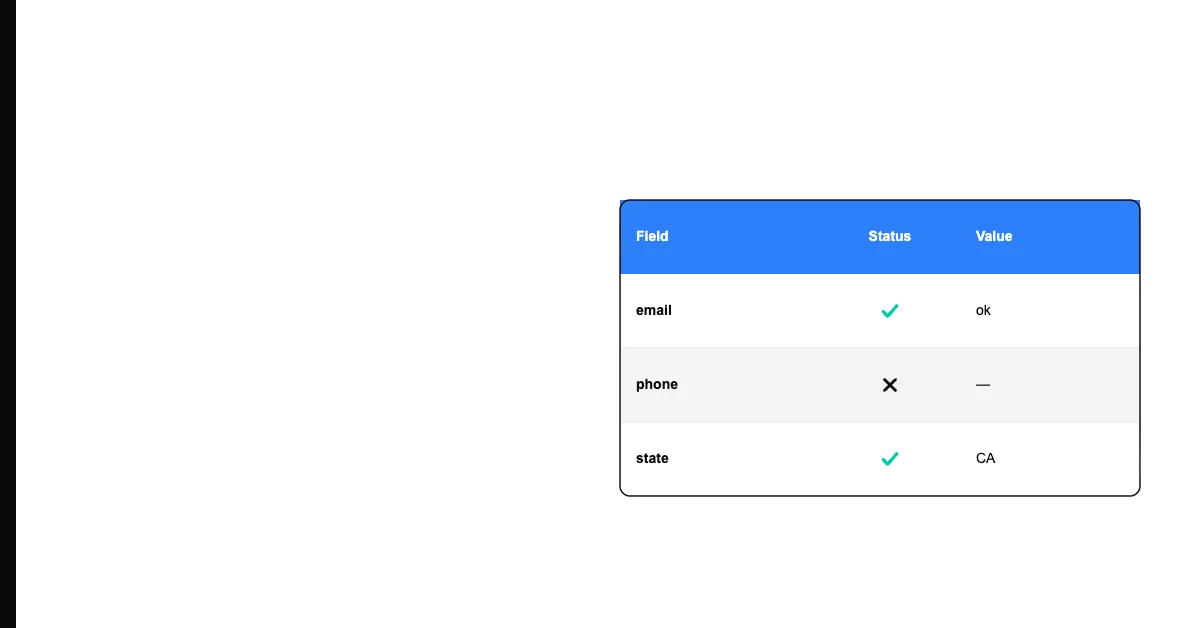
A data audit is a structured evaluation of a dataset's quality, completeness, accuracy, consistency, and compliance — producing a documented report of findings and prioritized recommendations for remediation.
A data audit answers the question: "Is this data actually trustworthy?" It goes beyond a quick spot-check to provide a systematic, documented assessment that can be shared with stakeholders, used to justify remediation investment, and compared against future audits to show improvement.
What a Data Audit Examines
Completeness: What percentage of required fields are populated? Which fields have high null rates?
Sohovi profiles every column in your dataset for completeness and flags the exact rows where values are missing — free to try.
Accuracy: Do values reflect reality? This is the hardest dimension to audit — it requires comparing data against an external ground truth.
Consistency: Are values represented the same way across the dataset and across systems? Are related fields internally consistent?
Validity: Do values conform to defined formats, ranges, and allowed values?
Uniqueness: Are there duplicate records for entities that should appear only once?
Sohovi automatically finds every duplicate in your dataset — including near-matches — and shows you exactly which rows are affected.
Timeliness: Is the data current? When was it last updated?
Compliance: Does the data meet regulatory requirements? Is personal data handled appropriately?
Data Audit vs. Data Quality Check
A data quality check is typically fast, focused, and may be automated — run before an import or on a recurring schedule. A data audit is more comprehensive, documented, and usually conducted periodically (quarterly, annually) or before a major decision (a system migration, a strategic planning cycle). A quality check is operational; an audit is evaluative.
Sohovi validates your dataset before it enters the warehouse — catching format errors, nulls, and duplicates at the source.
Frequently Asked Questions
Q: What is a data audit? A data audit is a structured, documented evaluation of a dataset's quality across multiple dimensions — completeness, accuracy, consistency, validity, uniqueness, timeliness, and compliance. It produces findings and prioritized recommendations.
Q: What is the difference between a data audit and a data quality check? A data quality check is a focused, often automated test of specific rules on a specific dataset — typically fast and operational. A data audit is broader and more comprehensive — it examines multiple quality dimensions, produces formal documentation, and is typically conducted periodically rather than continuously.
Q: Who conducts a data audit? Data audits can be conducted by the team that owns the data, by an internal data governance function, or by external auditors. For regulatory compliance (financial services, healthcare), external audits are sometimes required. For operational data quality, internal audits by data owners or data analysts are most common.
Q: What is included in a data audit report? A data audit report typically includes: scope and methodology, key findings per quality dimension (with specific metrics), data quality scores, prioritized recommendations, ownership assignments, and a baseline for future comparison.
Q: How is a data audit different from a financial audit? A financial audit examines whether financial statements are accurate and comply with accounting standards. A data audit examines whether data assets are complete, accurate, consistent, and compliant. Both produce formal findings reports, but they operate on different types of records.
Q: How often should a data audit be conducted? Major data audits typically occur annually or before significant business events (system migrations, regulatory reviews, M&A). Lighter audits of critical datasets should occur quarterly. Continuous monitoring complements periodic audits by catching problems between formal reviews.
Q: What should I do with data audit findings? Prioritize findings by impact and effort. Schedule remediation for high-impact findings. Assign owners for each finding. Set a timeline for re-audit to verify improvement. Share findings with data owners and leadership to secure remediation resources.
Q: Can a data audit help with GDPR compliance? Yes. A data audit can identify personal data stored inappropriately, data retained beyond its necessary period, missing consent records, and inaccurate personal information — all of which are GDPR compliance concerns.
Q: What is a data quality baseline and why does it matter for audits? A baseline is the documented quality state of a dataset at a specific point in time. It provides the reference for measuring improvement — without a baseline, you can't prove that remediation efforts actually made a difference.
Q: How long does a data audit take? A focused audit of one critical dataset can be completed in a day using the right tools. A comprehensive audit of multiple systems and data domains may take weeks. The time depends on dataset size, complexity, and how much of the process is automated.
A data audit turns vague concerns about data quality into specific, documented findings you can act on. Even a one-day focused audit of your most critical dataset produces insights that would take months of ad-hoc investigation to discover otherwise.
If you want to run a fast data audit on your most important CSV, Sohovi gives you a complete quality breakdown — completeness, duplicates, format issues — in under a minute. Free to try, no code required.