Most business owners know that names and email addresses are PII. Fewer know about the long list of data points that also qualify — and the "combination" effect that turns individually non-sensitive data into PII when combined.
Here's the practical checklist.
Clearly PII (Always Treat as Personal Data)
- Full name (first + last)
- Email address
- Home, work, or mailing address
- Phone number (mobile, home, or work)
- Date of birth
- Social Security Number / National Insurance Number / equivalent government ID
- Driver's license number
- Passport number
- Financial account numbers (bank account, credit/debit card)
- Medical record numbers and health information
- Biometric data (fingerprints, face scans, voice prints)
- IP addresses (in most jurisdictions)
- Username + password combinations
- Photos that clearly identify an individual
Contextually PII (Depends on Use and Combination)
These aren't always PII, but become PII in certain contexts:
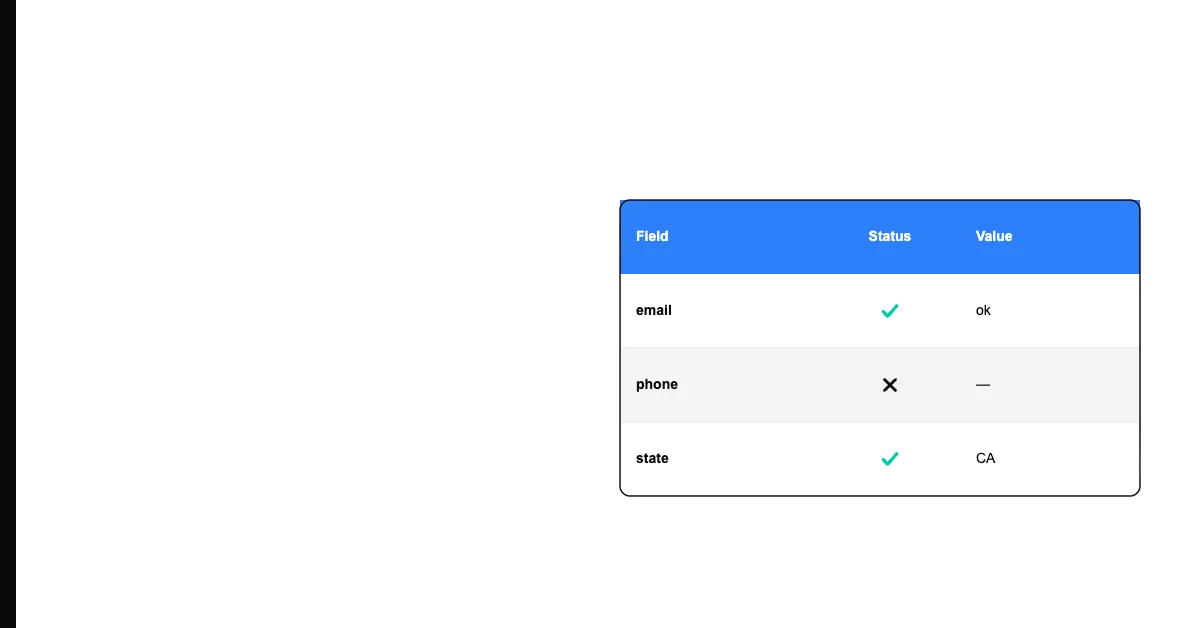
Sohovi automatically detects PII in your datasets — emails, phone numbers, SSNs — all processed client-side so your data never leaves the browser.
- Job title: "CEO of Acme Corp" + company name = identifying
- ZIP code alone: Not PII, but ZIP + birthdate + gender can be uniquely identifying
- Device identifiers: Phone IMEI, browser fingerprint — often treated as PII in GDPR context
- Location data: Repeated location data that reveals home and work address patterns
- Behavioral data: Clickstream, purchase history — can be identifying when combined
- Voice recordings: May or may not identify an individual depending on context
- Employment records: May include identifying information depending on content
Not PII (Aggregate or Non-Identifying Data)
- "Our customers are 45% female" — aggregate, not individual
- Revenue totals, averages, statistical summaries
- Anonymized data that has been irreversibly de-identified
- Business-to-business contact data (company name, work department) — though work email and direct phone may still be PII
The Combination Rule
Data that isn't PII individually can become PII when combined. The classic example: ZIP code + birth date + sex can uniquely identify 87% of US residents (Sweeney, 2000). When combining multiple data points about individuals, consider whether the combination is identifying even if the individual points aren't.
What This Means Practically
Before sharing a dataset internally or externally, check it against this checklist. Unexpected PII — especially in free-text fields, "ref" columns, or concatenated identifiers — creates compliance obligations you didn't intend.
Sohovi scans your CSV for PII patterns across all columns, flagging personal data in expected and unexpected locations — running entirely in your browser so your data stays on your machine.
When in doubt, treat it as PII and handle accordingly. The cost of over-classifying is minimal; the cost of under-classifying can be significant.