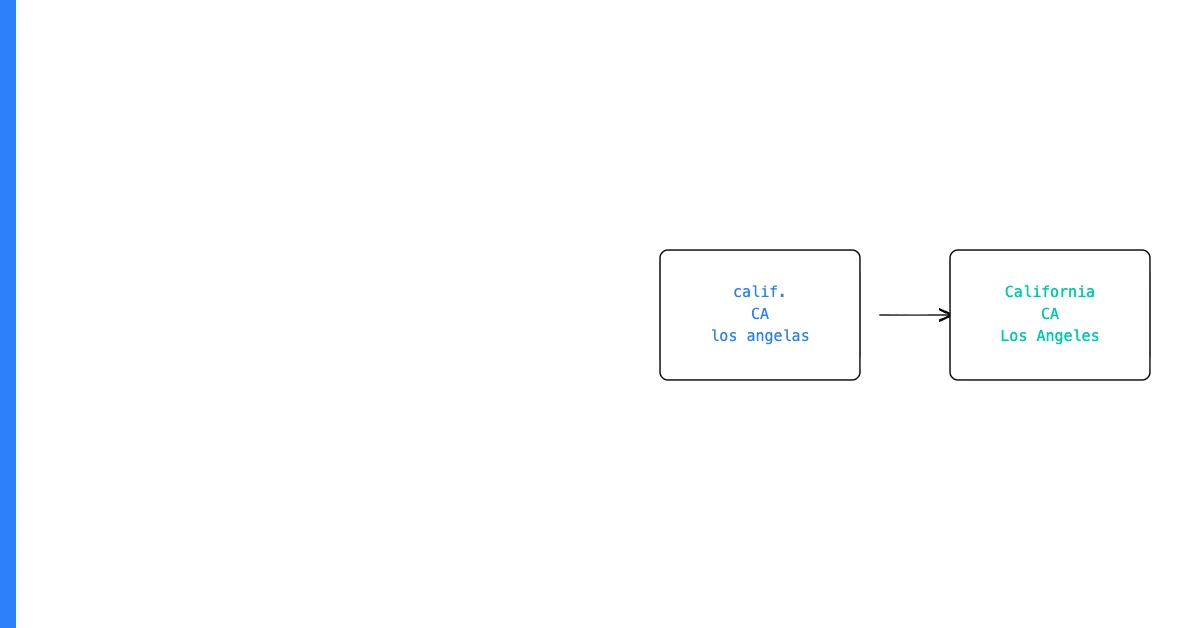
You can standardize company names across duplicate records by creating a canonical name mapping that converts all known variants to a single approved form — then applying fuzzy matching to catch variations that are too similar to be different companies.
Company name standardization is one of the most impactful and most underinvested data quality practices. Every analytics operation that aggregates by company — vendor spend analysis, account-based marketing, customer segmentation, CRM deduplication — is only as accurate as the company name data it depends on.
Why Company Names Are Hard to Standardize
Unlike phone numbers (a fixed format exists) or dates (a clear standard exists), company names have no universal standard. "Apple Inc." and "Apple" are both correct names for the same company. "International Business Machines Corporation" and "IBM" are both official names for the same entity.
Variations appear through:
- Different levels of formality ("Apple" vs. "Apple Inc.")
- Abbreviations ("IBM" vs. "International Business Machines")
- Punctuation differences ("A.B.C. Corp" vs. "ABC Corp")
- Suffix variations ("LLC" vs. "L.L.C." vs. "Limited Liability Company")
- Subsidiary and parent company confusion ("Google" vs. "Google LLC" vs. "Alphabet Inc.")
A Practical Approach to Company Name Standardization
Step 1: Identify your canonical names. Choose the version of each company name that your organization will use as the standard. For public companies, the legal entity name from their most recent SEC filing or company registration is typically the most defensible choice. For private companies, the name on their website or business registration is standard.
See exactly what's wrong with your data — try Sohovi free — try Sohovi free.
Step 2: Build a variant mapping table. Document all variants you've found and map them to the canonical name. This is a one-time effort for common companies and an ongoing process for new additions.
Step 3: Apply suffix normalization. Standardize common corporate suffixes to a single form:
- "LLC", "L.L.C.", "Limited Liability Company" → "LLC"
- "Inc", "Inc.", "Incorporated" → "Inc."
- "Corp", "Corp.", "Corporation" → "Corp."
- "Ltd", "Ltd.", "Limited" → "Ltd."
Step 4: Apply string normalization.
- Remove punctuation: "A.B.C. Corp" → "ABC Corp"
- Standardize case (Title Case typically)
- Remove extra whitespace
- Expand or contract common abbreviations
Step 5: Use fuzzy matching for remaining variants. After rule-based normalization, use fuzzy string matching to identify records that are similar but not identical — catching "Googl" (a typo for "Google") or "Microsft Corp" that rule-based normalization won't catch.
Sohovi's data profiling shows you the distinct company name values in your dataset at a glance — helping you identify how many variants exist before you start building your normalization mapping.
Sohovi runs a full data profile on any CSV or spreadsheet in under a minute — completeness rates, type distributions, outliers, and more.
Frequently Asked Questions
Q: What is company name standardization? Company name standardization is the process of converting all variants of a company's name to a single canonical form — ensuring that "IBM", "I.B.M.", "IBM Corp", and "International Business Machines" are all recognized as the same entity.
Q: What is fuzzy matching and why is it useful for company name standardization? Fuzzy matching measures the similarity between two strings rather than requiring exact equality. It's useful for catching company name variants that are close but not identical — misspellings, extra spaces, single character differences. Algorithms like Levenshtein distance, Jaro-Winkler, and token-based similarity are commonly used.
Q: What is the best canonical form for a company name? Use the official legal entity name from a reliable source — SEC EDGAR for US public companies, Companies House for UK companies, or the company's own registration documents. For informal use, the name as it appears on the company's official website is typically appropriate.
Q: How should I handle parent company vs. subsidiary naming? Decide based on your use case. For vendor spend analysis, you typically want to aggregate at the ultimate parent company level ("Google" for any Google entity). For customer account management, you may want to keep subsidiaries as separate records linked to the parent. Document your decision and enforce it consistently.
Q: How do I standardize company names at scale without reviewing every record? Start with the highest-frequency names — the companies that appear most often in your data. A small number of companies typically accounts for a large proportion of records. Standardize these manually and use fuzzy matching to catch less-common variants automatically.
Q: What's the most common mistake in company name standardization? Being too aggressive with abbreviation expansion or contraction. "AT&T" shouldn't be expanded to "American Telephone and Telegraph" — the abbreviation is the canonical name. Similarly, "3M" shouldn't be expanded based on its history. Verify canonical forms against official sources.
Q: How do I handle company name changes (acquisitions, rebranding)? Maintain a historical mapping table that records the canonical name at different points in time. This is especially important for financial analysis where you need to aggregate activity that occurred under the old name with activity under the new name.
Q: What tools support automated company name standardization? Commercial data enrichment services (Clearbit, D&B, ZoomInfo) can match company names against their reference databases and return standardized canonical names. Open-source fuzzy matching libraries (Python's fuzzywuzzy, rapidfuzz) support rule-based normalization combined with similarity matching.
Q: How does company name standardization relate to deduplication? Standardization is a prerequisite for accurate deduplication. Two records for the same company with different name formats will look like different companies to a deduplication algorithm. Standardize names first, then run deduplication — the match rate will be significantly higher.
Q: How often should the company name mapping table be updated? Review and update after any significant data import, after any major business event (acquisition, rebranding), and at minimum quarterly. Companies rename, merge, and rebrand regularly — your mapping table needs to keep pace.
Company name standardization unlocks accurate vendor analysis, reliable deduplication, and trustworthy ABM targeting. The investment in building a canonical name mapping pays returns on every analytics operation that aggregates by company.