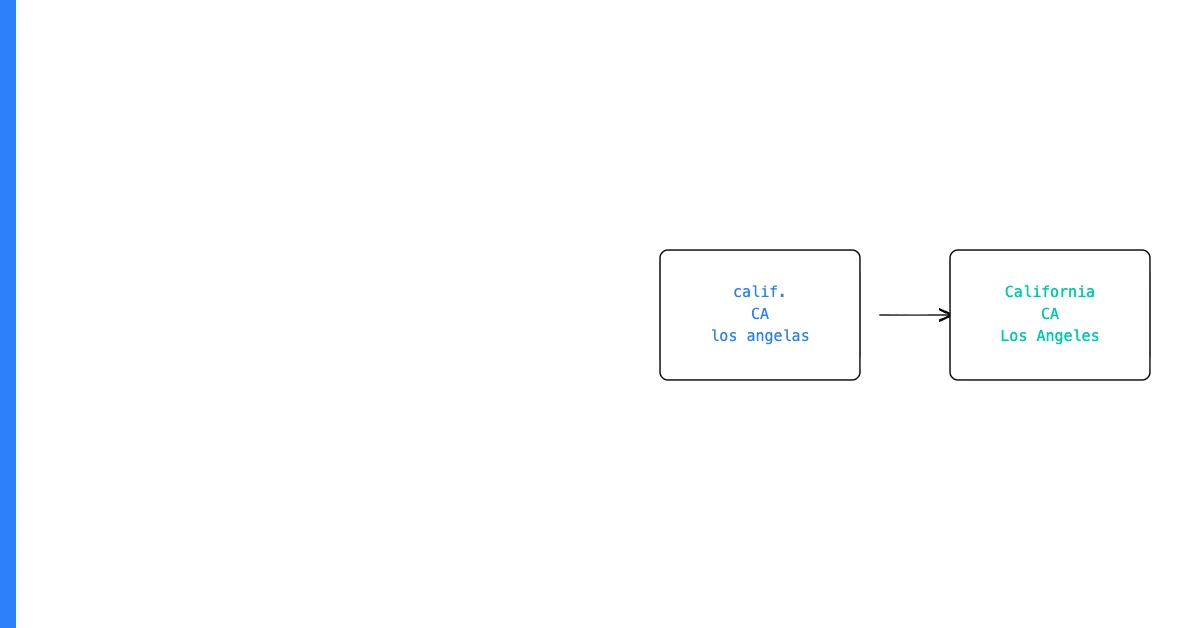
Data normalization and data standardization both improve data consistency, but they operate at different levels: standardization converts values to a consistent format (making "NY" and "New York" the same), while normalization in a database context organizes table structures to reduce redundancy and improve data integrity.
The confusion between these terms is understandable — they're often used interchangeably in everyday conversation, and in some contexts they do overlap. This post clarifies both meanings and shows when each concept applies to your work.
Data Standardization: Making Values Consistent
In data quality, standardization is the process of converting inconsistent representations of the same information into a single canonical form.
Examples:
- Dates: converting MM/DD/YYYY, DD/MM/YYYY, and "March 5, 2024" all to YYYY-MM-DD
- Phone numbers: converting "(555) 123-4567", "555-123-4567", and "5551234567" all to "+15551234567"
- State names: converting "California", "Calif.", "CA", and "california" all to "CA"
- Company names: converting "IBM Corp", "I.B.M.", and "International Business Machines" all to "IBM"
Standardization operates on the values within a field. It doesn't change the structure of the data.
See exactly what's wrong with your data — try Sohovi free — try Sohovi free.
Database Normalization: Organizing Table Structures
In relational database design, normalization is the process of organizing tables to reduce data redundancy and improve data integrity. It follows a set of rules called Normal Forms (1NF, 2NF, 3NF, BCNF).
The core idea: store each piece of information in exactly one place. If a customer's address is stored in five different order records, updating the address requires changing five records — creating a consistency problem. Normalized: store the address in a separate customer table and reference it from order records.
Value Normalization: A Third Meaning
A third use of "normalization" — common in analytics and data science — refers to scaling numeric values to a standard range (typically 0 to 1) for comparison or modeling purposes. Normalizing revenue to a 0–1 scale allows meaningful comparison with other variables of very different magnitudes.
This use of normalization is conceptually similar to standardization (making values comparable) but is specifically about numeric scaling.
Which Meaning Applies to Your Work?
| Context | Term used | What it means | |---|---|---| | Data quality / data cleaning | Standardization | Converting values to a consistent format | | Database design / SQL | Normalization | Organizing tables to reduce redundancy | | Analytics / machine learning | Normalization | Scaling numeric values to a standard range |
Frequently Asked Questions
Q: Are data normalization and data standardization the same thing? Not exactly — though they're often used interchangeably in data quality conversations. Standardization typically refers to converting values to a consistent format. Normalization in database design refers to organizing table structure to reduce redundancy. In practice, many data quality practitioners use both terms to mean "making data consistent."
Q: What is the goal of data standardization? To ensure that the same information is always represented the same way — so that joins, filters, aggregations, and deduplication operations produce accurate results. Mixed representations of the same value produce fragmented analytics and failed matches.
Q: What is database normalization and what problems does it solve? Database normalization organizes table structures to eliminate data redundancy and update anomalies. Instead of storing the same information in multiple places (customer address in every order record), normalized design stores it once (in a customer table) and references it where needed.
Q: What are the Normal Forms in database normalization? The most commonly used are: 1NF (each column has atomic, indivisible values; no repeating groups), 2NF (all non-key attributes fully depend on the primary key, not just part of it), 3NF (no non-key attribute depends on another non-key attribute). Most production databases target 3NF.
Q: When should I use standardization vs. database normalization? Standardization is a data quality operation applied to existing data. Database normalization is a design decision made when creating or restructuring tables. They address different problems: standardization fixes inconsistent values; normalization prevents structural redundancy.
Q: Does database normalization improve data quality? Indirectly yes. A normalized database makes it harder for certain types of data quality problems to occur — specifically, inconsistencies that arise from updating the same information in multiple places. But normalization doesn't fix the quality of the data values themselves.
Q: What is over-normalization and why is it a problem? Over-normalization means breaking data into too many tables in pursuit of eliminating all redundancy. This produces a database that is technically clean but slow to query (requiring many joins for simple operations). Practical database design balances normalization with query performance requirements.
Q: Is it possible to normalize or standardize too much? Yes. Excessive value standardization can lose important detail — collapsing "New York City" and "New York State" to "NY" loses information. Excessive database normalization makes queries complex. Both should be applied to the degree necessary for the intended use, not universally maximized.
Q: What is the relationship between standardization and deduplication? Standardization is a prerequisite for effective deduplication. Two records with the same phone number in different formats look like different records to a deduplication algorithm. After standardization, the same information looks identical, making deduplication more accurate.
Q: In the context of machine learning, what does data normalization mean? In ML, normalization typically means scaling numeric features to a consistent range (0 to 1, or -1 to 1) so that features of very different magnitudes don't disproportionately influence model training. This is distinct from both data quality standardization and database normalization — it's a feature engineering step for model preparation.
Whether you call it standardization or normalization, the goal is the same: make data consistent so it can be reliably used. The terminology matters when you're talking to database engineers (who will interpret "normalization" as table design) vs. data quality practitioners (who will interpret it as value consistency).