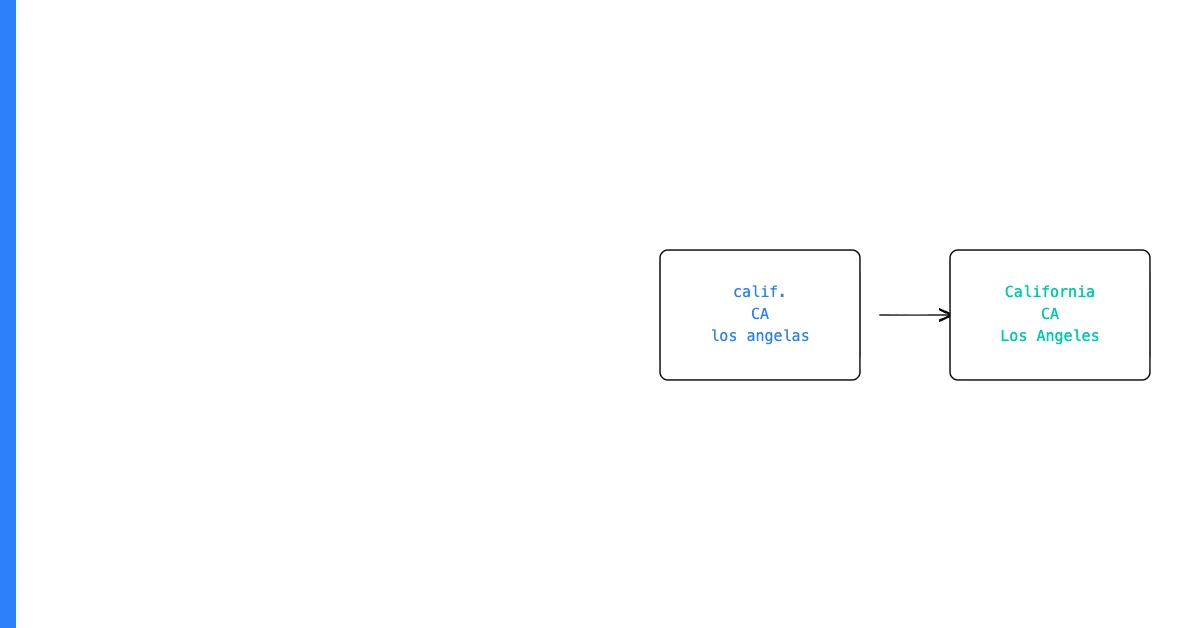
You can standardize categorical data by first profiling the distinct values in each categorical field, then creating a canonical value list and normalization mapping, and finally applying the mapping to all existing records and enforcing the approved list at entry going forward.
Categorical data standardization is the single most impactful quick win in data quality. Most businesses have at least one categorical field — status, industry, region, product category — that has accumulated dozens of inconsistent variants of the same underlying values. Fixing this field immediately improves every report, filter, and segment that depends on it.
Why Categorical Data Gets Messy
The root cause is almost always free-text entry without controlled vocabulary enforcement. When users can type anything in a "status" field, you get "Active", "active", "ACTIVE", "Actv", "1", and "yes" all representing the same status. Over months and years, these variants accumulate.
The secondary cause is data from multiple sources. A CRM export uses "New York" for state; a form export uses "NY"; an import from a partner uses "new york." Three formats, same value.
Sohovi finds gaps, duplicates, and format errors in your CRM data — so your team is working from records they can trust.
Step-by-Step Categorical Standardization
Step 1: Profile the distinct values. Run a GROUP BY count on each categorical field to see every distinct value and how many records use it. This is your starting inventory.
Step 2: Create the canonical value list. Decide what the approved values are and what format they should use (Title Case? UPPERCASE? Specific abbreviations?). Write this down — this is your controlled vocabulary.
Step 3: Build the normalization mapping. For each non-canonical value, map it to the correct canonical value:
- "active" → "Active"
- "ACTIVE" → "Active"
- "Actv" → "Active"
- "1" → "Active"
- "NY" → "New York" (or vice versa — choose canonical form consistently)
- "new york" → "New York"
Step 4: Apply the mapping. Use SQL CASE statements, Python dictionaries, or find-and-replace to update all existing records.
Step 5: Enforce the canonical list going forward. Replace free-text entry with a dropdown/picklist that only allows approved values. Add a validation rule to any import process that rejects records with unapproved categorical values.
Sohovi lets you set up validation rules for any column and instantly see which rows fall outside them — no code or SQL required.
Sohovi's profiling report shows you the distinct value distribution for every categorical column instantly — so you can see how many variants exist before building your normalization mapping.
Frequently Asked Questions
Q: What is categorical data standardization? Categorical data standardization is the process of converting all variants of a categorical value to a single canonical form — ensuring that "Active", "active", "ACTIVE", and "Actv" all become "Active" in a standardized dataset.
Q: What is a controlled vocabulary in data quality? A controlled vocabulary is the approved list of values for a categorical field. When enforced (through dropdowns, picklists, or validation rules), it prevents new variants from entering the dataset. Building a controlled vocabulary is the first step of categorical standardization.
Q: How do I choose the canonical form for each categorical value? Choose based on: official standards (ISO country codes, NAICS industry codes), system requirements (if a downstream system expects specific values, use those), or organizational conventions (what does the rest of your organization use?). Document the choice so it can be applied consistently.
Q: Should I use abbreviations or full names as the canonical form? Depends on the use case. For reports and dashboards visible to end users, full names ("New York") are clearer. For data processing and database joins, abbreviations ("NY") are more efficient. Choose one and be consistent. Avoid using both in different contexts for the same field.
Q: What should I do with categorical values that I can't map to a canonical value? Investigate further. "Unknown" or unrecognizable values may represent: a new category that should be added to the canonical list, a data entry error that can be corrected with more context, or a placeholder that should be null. Don't force-map ambiguous values — flag them for review.
Q: How do I handle categorical values where multiple canonical forms are valid? If both "Active" and "Enabled" are used as synonyms for the same status and both are defensible, pick one and document the decision. Consistency matters more than which specific form you choose. Over time, a single canonical form is essential for reliable analytics.
Q: What's the difference between categorical standardization and enum validation? They're two phases of the same process. Enum validation identifies records whose categorical values don't belong to the approved list (the problem). Categorical standardization converts non-canonical values to their canonical equivalents (the fix).
Q: How do I prevent categorical data from getting messy again after standardization? Replace free-text entry with dropdowns or picklists that only allow approved values. For data imports, add a validation rule that rejects records with unapproved categorical values. For CRM and other platforms, configure picklist restrictions at the system level.
Q: How do I handle categorical fields that have different canonical values in different contexts? Create context-specific canonical lists and document which context applies where. For example, "state" might use two-letter abbreviations for US addresses and full names for international reports. Document this explicitly and ensure your data pipelines apply the right canonical form for each context.
Q: What's the most efficient way to create a normalization mapping for a large categorical field? Start with the high-frequency values — the values that appear in the most records. These give you the most coverage for the least effort. Then work down the frequency list, adding mappings for less-common variants. Values that appear in very few records (<0.1% of total) may not be worth mapping individually if they're too obscure to categorize confidently.
Categorical standardization is one of the highest-ROI data quality operations available. A few hours of work on one field immediately improves every report, filter, and segment that depends on it.