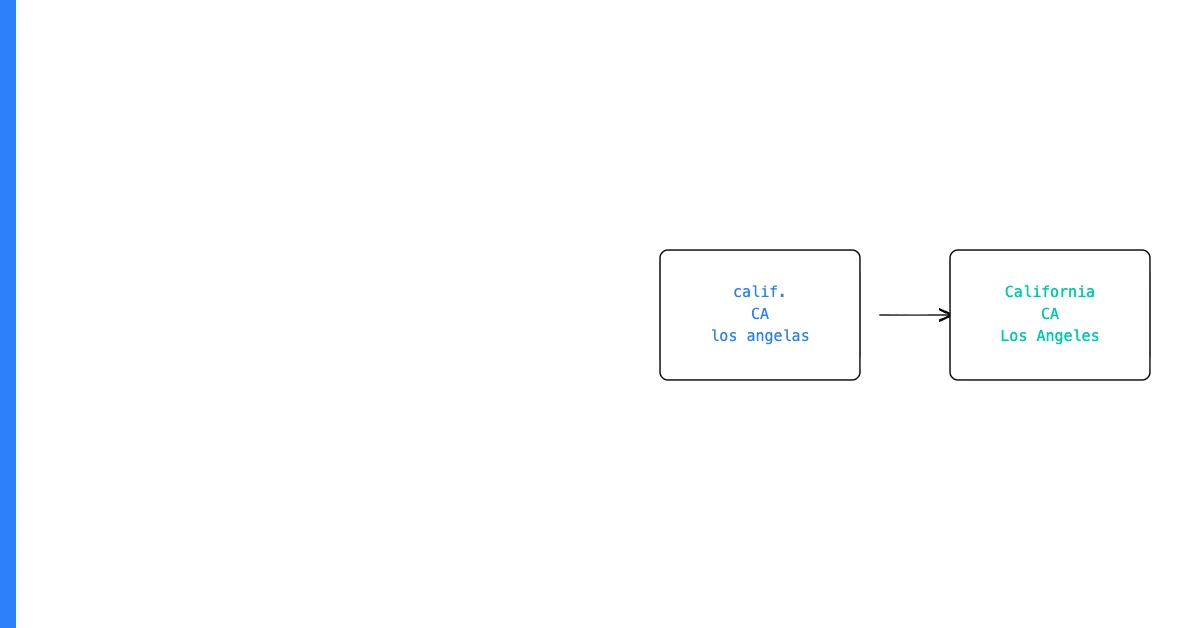
You can normalize addresses in your database by parsing address components into consistent fields, standardizing abbreviations and formats using USPS or postal authority standards, and validating against a reference address database to confirm the address is real and correctly formatted.
Address normalization is one of the hardest data standardization problems — and one of the most important for businesses that rely on address data for shipping, geolocation, customer deduplication, or compliance.
Why Address Data Is Particularly Hard to Standardize
Address data has more variation than almost any other field type. A single physical location can be legitimately expressed in dozens of ways:
- 123 Main Street Suite 400
- 123 Main St., Ste. 400
- 123 MAIN ST STE 400
- 123 Main St Suite #400
- 123 Main (without suite)
Add in misspellings, abbreviation variants, and data entry errors, and you have a field that resists simple standardization rules.
Sohovi profiles your datasets for quality issues in minutes — see what's broken before it breaks your pipeline — try Sohovi free.
The Three Steps of Address Normalization
Step 1: Parse the address into components. Break the address string into structured components: street number, street name, street type (St, Ave, Blvd), unit/suite, city, state, postal code, country. Parsing allows you to standardize each component independently.
Step 2: Standardize each component.
- Street types: "Street" → "St", "Avenue" → "Ave", "Boulevard" → "Blvd" (using USPS abbreviation standards for US addresses)
- State names: "California" → "CA", "New York" → "NY"
- Case normalization: Convert to Title Case or uppercase consistently
- Unit designators: "Suite", "Ste", "Ste.", "#" → standardize to one form
- Remove punctuation inconsistencies: periods after abbreviations, commas between components
Step 3: Validate against a reference database. Postal address validation services (USPS CASS certification, Google Maps, SmartyStreets, Melissa Data) verify that the standardized address actually exists and return the official USPS-formatted version. This step catches misspellings, wrong ZIP codes, and non-existent addresses.
Sohovi lets you set up validation rules for any column and instantly see which rows fall outside them — no code or SQL required.
Address Normalization for Deduplication
Normalized addresses enable much more accurate deduplication. "123 Main Street Suite 400" and "123 Main St., Ste. 400" are the same address — but to a simple string-matching deduplication, they look different. After normalization, they look identical.
For contact deduplication, address normalization combined with name normalization significantly improves match rates.
Frequently Asked Questions
Q: What is address normalization? Address normalization is the process of converting address data from varied, inconsistent representations into a consistent, standardized format — typically using a postal authority standard (like USPS for US addresses) as the canonical form.
Q: What is USPS CASS certification and do I need it? CASS (Coding Accuracy Support System) certification is a USPS program for address validation and standardization software. Tools with CASS certification verify addresses against the USPS address database and return officially standardized addresses. It's important for businesses that do large-volume direct mail (it qualifies for postal discounts) and highly recommended for any business that relies on address accuracy.
Q: What's the difference between address standardization and address verification? Standardization converts the address to a consistent format. Verification confirms that the address actually exists and is deliverable. USPS address validation tools do both — standardize and verify in one step.
Q: How do I handle PO Box addresses? PO Box addresses have their own format (PO Box 12345, City, State, ZIP) and typically can't be matched to physical delivery addresses. Handle them as a separate address type in your normalization logic and ensure your business rules account for them — some processes require a physical address, others accept PO Box.
Q: How do I normalize international addresses? International address normalization is significantly more complex than domestic (US) normalization because every country has different address formats, component structures, and postal code systems. Country-specific postal standards exist for most countries. For international normalization, a multi-country address validation API is generally the most practical approach.
Q: What causes address data to be inconsistent in the first place? Manual data entry without a format requirement, data from multiple sources with different format conventions, legacy data collected before address standards were enforced, incomplete addresses entered to satisfy required fields, and data imported from external systems with different formatting rules.
Q: How accurate is automated address normalization without validation? Rule-based normalization (standardizing abbreviations, case, and punctuation) can significantly improve consistency without external validation. But it can't catch misspellings, wrong ZIP codes, or non-existent addresses. For applications where address accuracy matters (mail, shipping, geographic analysis), external validation is necessary.
Q: How does address normalization improve deduplication accuracy? Normalized addresses make string-matching deduplication much more accurate. Two records for the same address with different formatting will look different to a simple string match. After normalization, they look identical, allowing the deduplication algorithm to correctly identify them as matches.
Q: What's the best way to normalize addresses in a spreadsheet? For simple normalization (case standardization, basic abbreviation replacement), Excel/Sheets formulas and find-and-replace work for small datasets. For complete normalization including validation, an address validation API or service is needed. These typically offer batch processing via file upload.
Q: Should I normalize addresses before or after deduplication? Before. Normalize first so that records with the same address but different formatting will match during deduplication. Running deduplication on unnormalized addresses produces false negatives — records that represent the same address but look different to the matching algorithm.
Address normalization requires more effort than most field standardization tasks, but it pays disproportionate returns for any business that depends on address data for shipping, deduplication, or geographic analysis.
Sohovi automatically finds every duplicate in your dataset — including near-matches — and shows you exactly which rows are affected.