Most small businesses think of GDPR as a consent and privacy law — you need permission to contact people, you need to be able to delete their data on request. All true. But GDPR also includes a data quality requirement that most businesses miss: Article 5(1)(d) requires that personal data be "accurate and, where necessary, kept up to date."
This isn't aspirational. It's a legal obligation. And it has real implications for how you maintain your customer and contact data.
What GDPR's Data Quality Requirements Actually Mean
Accuracy: The personal data you hold must reflect reality. A customer address entered incorrectly, a phone number that was correct when captured but has since changed, or an email address for a person who has left the company — all represent accuracy failures under GDPR.
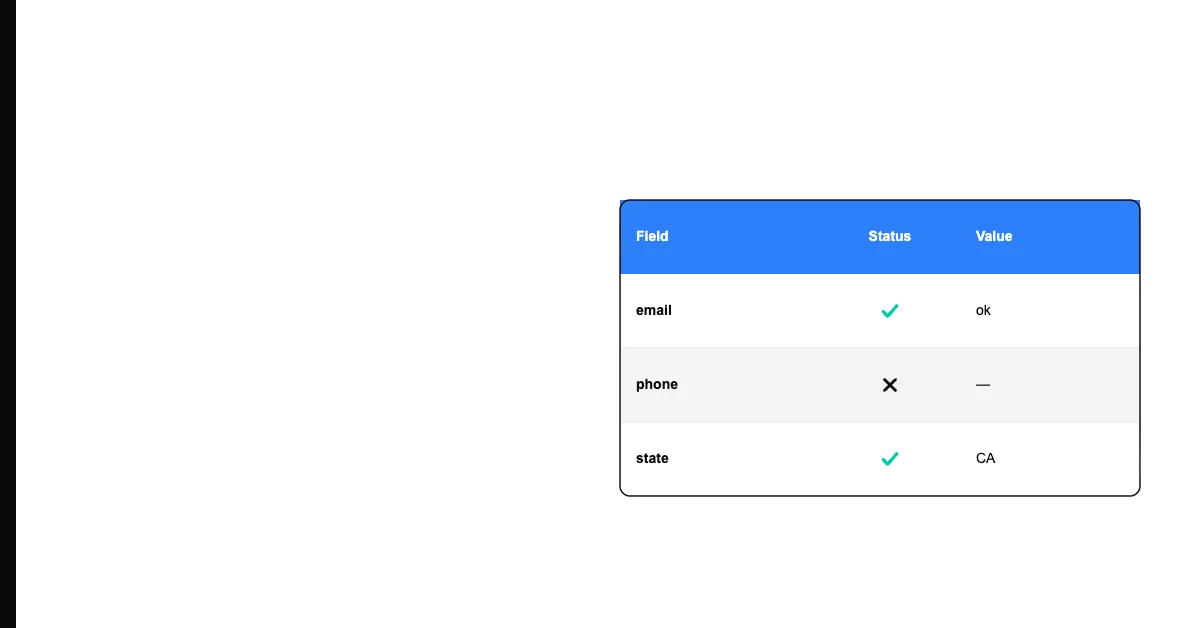
Sohovi scores your dataset against your own accuracy standards and highlights the columns and rows where values fall outside expected ranges.
Up to date: Where accuracy requires currency (it does for most contact data), you must have processes to keep data current. This means regular review and update cycles, not just capturing data correctly at entry.
Not kept longer than necessary: You can't hold personal data indefinitely. Data that's no longer needed for its original purpose must be deleted or anonymized. This means data retention policies and processes to act on them.
The Practical GDPR Data Quality Checklist for Small Businesses
- Know what personal data you hold — Run a PII scan on your key datasets. Knowing what you have is prerequisite to managing it.
- Know where it came from — Each piece of personal data should have a documented collection source and legal basis.
- Keep it accurate — Implement a process for updating data when customers notify you of changes. Run email validation before major sends to flag decayed addresses.
- Purge old data — Define how long you need each type of data. Build a process to delete or anonymize records past that retention period.
- Be able to fulfill data subject requests — When a customer requests their data be corrected or deleted, you need to be able to find all their data and act on it within 30 days.
Sohovi lets you set up validation rules for any column and instantly see which rows fall outside them — no code or SQL required.
The Connection Between Data Quality and GDPR Compliance
A CRM full of outdated contact information, duplicate records, and data of unknown provenance isn't just a quality problem — under GDPR, it's a compliance risk. The practices that produce good data quality (regular profiling, accuracy checks, data retention management) are the same practices that support GDPR compliance.
Sohovi's browser-based PII detection lets you scan your customer data without your data ever leaving your machine — a privacy-safe approach to understanding what personal data you hold and where it is.
Good data quality and GDPR compliance are not separate programs. They're the same program.
Sohovi automatically detects PII in your datasets — emails, phone numbers, SSNs — all processed client-side so your data never leaves the browser.