The Risk Is Real
You send a campaign to 10,000 contacts. 2,000 bounce. The ESP flags the account. Deliverability tanks for weeks. The client blames you.
As the freelance marketer managing the send, you're responsible — even if the list came from the client. Validating the list before you hit send is not optional.
What Makes an Email List Dirty
Email lists go bad faster than most clients realize. Industry averages show 20–30% annual decay — people change jobs, companies fold, inboxes get abandoned. A list that was clean 18 months ago may have 25% invalid addresses now.
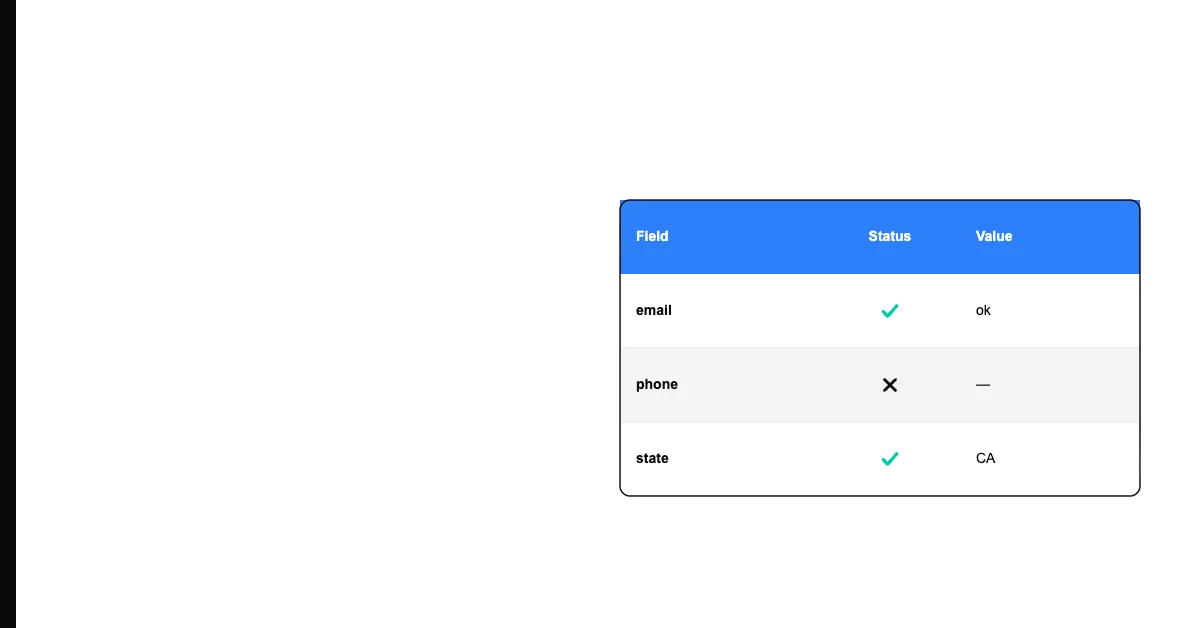
Sohovi validates your email list for invalid formats, duplicates, and missing fields before you send — protecting your sender reputation.
Common issues:
- Hard bounces: addresses that don't exist (user@company.com where company.com is dead)
- Role addresses: info@, support@, admin@ — often shared inboxes that filter bulk email
- Typos: gmial.com, yhaoo.com, hotmal.com
- Duplicates: same address appearing 3 times means 3 sends, 3x the unsubscribes
- Unsubscribes not honored: contacts who opted out but weren't removed
Step 1: Deduplication
Before anything else, remove duplicates. One address should appear once. If you're using a CSV, sort by email, then scan for consecutive duplicates or use a formula.
Sohovi automatically finds every duplicate in your dataset — including near-matches — and shows you exactly which rows are affected.
A COUNTIF in Excel identifies every address that appears more than once in under a minute.
Step 2: Format Validation
Every address should follow the pattern: something@something.something
Quick checks:
- No spaces in the email address
- Exactly one @ symbol
- At least one dot after the @
- No obviously invalid TLDs (addresses ending in .con, .cmo, etc.)
A simple regex in Python, Google Sheets, or most email tools catches format errors immediately.
Sohovi lets you set up validation rules for any column and instantly see which rows fall outside them — no code or SQL required.
Step 3: Domain Check
For B2B lists especially, verify the sending domain still exists. If a client has 500 contacts from one company that was acquired two years ago, those addresses are likely dead. A quick DNS lookup confirms whether the domain resolves.
Step 4: Use an Email Verification Service
For lists over 500 contacts, use a paid verification service: NeverBounce, ZeroBounce, or Kickbox. They check whether addresses are live without actually sending. Prices are typically $0.002–0.008 per email — cheap insurance.
Always verify before the first send to a new list. For ongoing campaigns, re-verify quarterly.
Step 5: Segment the Risk
After verification, you'll typically have:
- Valid: safe to send
- Catch-all: the domain accepts all email (can't confirm if the specific address is live)
- Invalid: don't send
- Unknown: couldn't verify
Send only to Valid. Treat Catch-all with caution — send to a small subset first and monitor bounce rates before sending to the full group.
Protect Yourself With Documentation
Before every campaign send, save a record:
- Original list size
- Deduplication results
- Verification results (what % valid, invalid, catch-all)
- Cleaned list used for send
If the client pushes back on your "we can't send to all 10,000," you have the data to explain why. And if something goes wrong, you have proof you followed best practices.