Zapier and Make (formerly Integromat) automations connect your apps and move data between them automatically. When they work correctly, they save hours of manual work. When they have data quality issues — wrong field mappings, format mismatches, missing transformations — they silently move bad data at scale, creating problems in your destination systems that are hard to trace back to the automation.
How Zapier/Make Automations Introduce Data Quality Problems
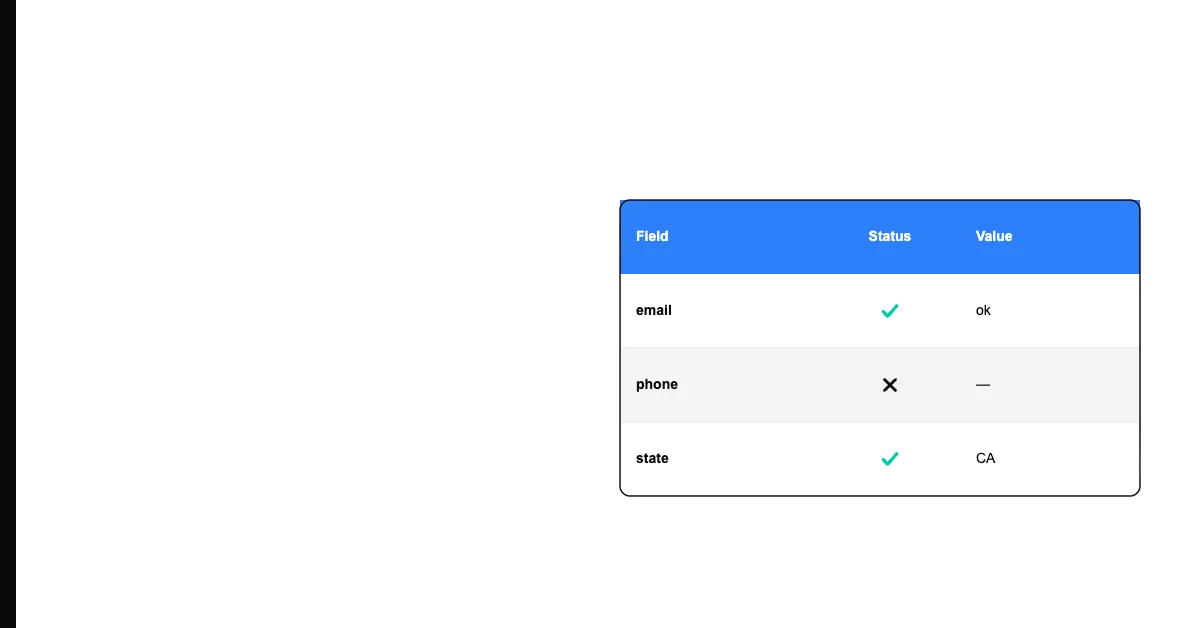
Missing field mappings: When a new field is added to the source app but the Zap/scenario isn't updated, that field is left blank in the destination. A new "Company Size" field in your CRM never makes it to your MAP because the integration was built before that field existed.
Wrong value transformations: An automation that maps "Lead Status" from your form (values: "New," "Interested," "Not Interested") to your CRM (values: "New," "Qualified," "Disqualified") without a proper value mapping leaves contacts with values that don't exist in your CRM's approved list.
Sohovi scores your dataset against your own accuracy standards and highlights the columns and rows where values fall outside expected ranges.
Creating instead of updating: Automations configured to "create" records in the destination instead of "find or create" (upsert) create new records every time, even when the contact or company already exists. This is the most common source of automation-induced duplicates.
Format mismatches: A date field that comes from a form in MM/DD/YYYY format gets written to a system that expects YYYY-MM-DD — producing date errors across every record the automation processes.
Incomplete record creation: Required fields in the destination system aren't mapped in the automation, so every record created by the Zap/scenario has null values in fields that should be populated.
Sohovi profiles every column in your dataset for completeness and flags the exact rows where values are missing — free to try.
Diagnosing Automation-Induced Quality Problems
Check automation logs: Both Zapier and Make have detailed execution logs showing every run — what data came in, what was sent to the destination, and any errors. Review logs from a sample period to identify patterns in missing or wrong values.
Compare record counts: If your Zap creates CRM contacts from form submissions, compare form submission counts to new CRM contact counts for the same period. A 3:1 ratio suggests the Zap is creating 3 CRM contacts for every form submission — a triplication error.
Profile the destination data: Export records from the destination system that were created by the automation (filter by creation source or creation date range). Check completeness rates for all fields — fields consistently null were likely never mapped in the automation.
Frequently Asked Questions
Q: What are the most common data quality problems caused by Zapier/Make automations? Duplicates (created instead of updated because upsert wasn't configured), missing field values (fields not mapped in the automation), wrong categorical values (no value transformation step), date format mismatches, and partial records (required fields not mapped).
Q: What is an upsert and why is it important for automation data quality? An upsert (update or insert) checks whether a record with the matching key already exists before deciding to create or update. Without upsert, automations create new records every time the trigger fires, even for contacts that already exist. Most automation platforms support upsert via "Find or Create" steps.
Q: How do I set up upsert (find-or-create) in Zapier? Add a "Find Contact" (or equivalent) step before your "Create Contact" step. If the Find step returns a match, route to an "Update Contact" step. If it returns no match, proceed to "Create Contact." This creates-if-not-exists, updates-if-exists behavior.
Q: How do I map value transformations in Zapier/Make? In Zapier, use the "Formatter" tool with a "Lookup Table" action to map source values to destination values. In Make, use the "Switch" function in field mappings. Both let you define "source value → destination value" pairs without coding.
Q: What is a field mapping audit and how do I perform one for a Zapier/Make automation? Review every field in the destination system that should be populated by the automation. Check whether each destination field has a corresponding source field mapped in the Zap/scenario. Check that the data types match. Verify that categorical values are transformed appropriately.
Q: How do I detect automation-caused duplicates in my destination system? Filter destination records by creation source (look for records created "by Zapier" or with the creation timestamp matching when your automation runs). Run a deduplication check on these records by email or other identifier. A high duplicate rate among automation-created records indicates missing upsert logic.
Q: What should I do when I find a persistent mapping error in a live automation? Fix the automation mapping first. Then remediate the affected records: identify all records created during the period when the error was active, and correct or update the affected field values. Turn on error notifications in your automation platform to catch mapping failures faster in the future.
Q: How do I test an automation before running it at full scale? Most automation platforms support test runs with sample data. Before going live, run the automation with 5-10 representative records and manually verify the destination system received them correctly. Check that all expected fields are populated, values are in the correct format, and no duplicates were created.
Q: What is the most important setting to configure in any Zapier/Make integration for data quality? Error notifications. Configure your automation platform to email you (or post to Slack) when a Zap/scenario encounters an error. Silent failures — automations that fail without notification — are among the most common sources of persistent data quality problems.
Q: How do I handle data format mismatches between apps connected via Zapier/Make? Use the Formatter step (Zapier) or Text/Date functions (Make) to transform data between systems. For date formats, convert to ISO 8601 before sending. For phone numbers, strip formatting before sending. Add format standardization as a transformation step in the automation rather than relying on the destination system to handle it.
Automations are only as good as their field mappings, transformation logic, and upsert configuration. Audit your most important Zaps/scenarios periodically — the data quality problems they create compound silently until something obvious breaks.