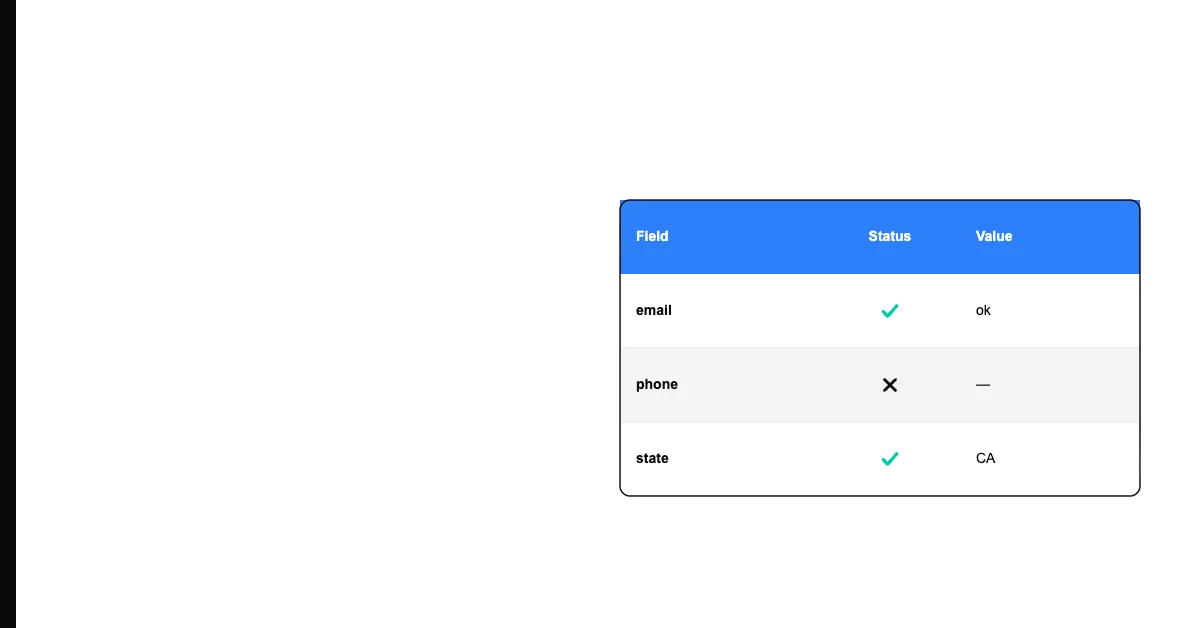
You don't need a data scientist to profile a spreadsheet. You don't need one to deduplicate a contact list, validate email formats, or check whether a vendor file is complete. These are data quality tasks that non-technical people do every day — the question is whether they're doing them systematically or just hoping for the best.
What Data Scientists Are Actually Good For
Data scientists are valuable for building predictive models, running statistical analyses, developing machine learning systems, and interpreting complex datasets at scale. They're expensive precisely because those skills are rare.
They're not uniquely valuable for: checking whether your customer list has duplicate emails, verifying that a CSV import was complete, standardizing date formats across columns, or identifying which fields in your contact list are mostly empty. These tasks require thoroughness and the right tools, not advanced statistical knowledge.
Sohovi automatically finds every duplicate in your dataset — including near-matches — and shows you exactly which rows are affected.
The Non-Technical Data Quality Toolkit
Profiling tool — A no-code tool that examines your data and surfaces completeness rates, duplicates, format issues, and outliers. You understand the output without needing to know how it was calculated.
Spreadsheet skills — Basic competency with COUNTIF, COUNTBLANK, and sorting covers many common data quality checks. Not sophisticated, but sufficient for most situations.
Validation checklists — A written checklist for what you check before importing or using a dataset. Checklists don't require expertise — they require consistency.
Sohovi lets you set up validation rules for any column and instantly see which rows fall outside them — no code or SQL required.
Vendor/tool documentation — Understanding what your CRM, marketing platform, or analytics tool expects for data formats lets you validate before import rather than debug after.
Where to Start
Pick your most important dataset — the one that, if wrong, causes the most problems. Profile it with a tool like Sohovi. Look at what the profile reveals: which fields are mostly empty, where duplicates exist, what format problems appear.
Fix the three most impactful issues you find. Build a habit of running the profile before the next time you use that dataset.
Data quality is a habit, not a skill. Anyone can develop the habit. You don't need a data scientist to start.