When your team worked in the same office, data problems were caught in passing. Someone noticed the spreadsheet was wrong and fixed it. Now your team is distributed across three time zones and six cities, and data problems compound silently for weeks before anyone catches them.
Remote work creates specific data quality risks that in-person teams don't face at the same intensity.
The Remote Team Data Quality Problem
Inconsistent entry practices — Without shared physical space, different team members develop different habits for how they enter data. One person uses "CA", another uses "California", another uses "CALIFORNIA". In an office, someone would notice and correct it. Remotely, it accumulates.
No one "owns" shared datasets — In office environments, data ownership happens informally. Remotely, without explicit assignment, critical shared databases become everyone's responsibility and therefore no one's responsibility.
Proliferating local files — Remote teams create more local copies of shared data — spreadsheets downloaded, modified locally, and re-uploaded, or simply kept locally and never reconciled with the master. This creates version control problems and inconsistency.
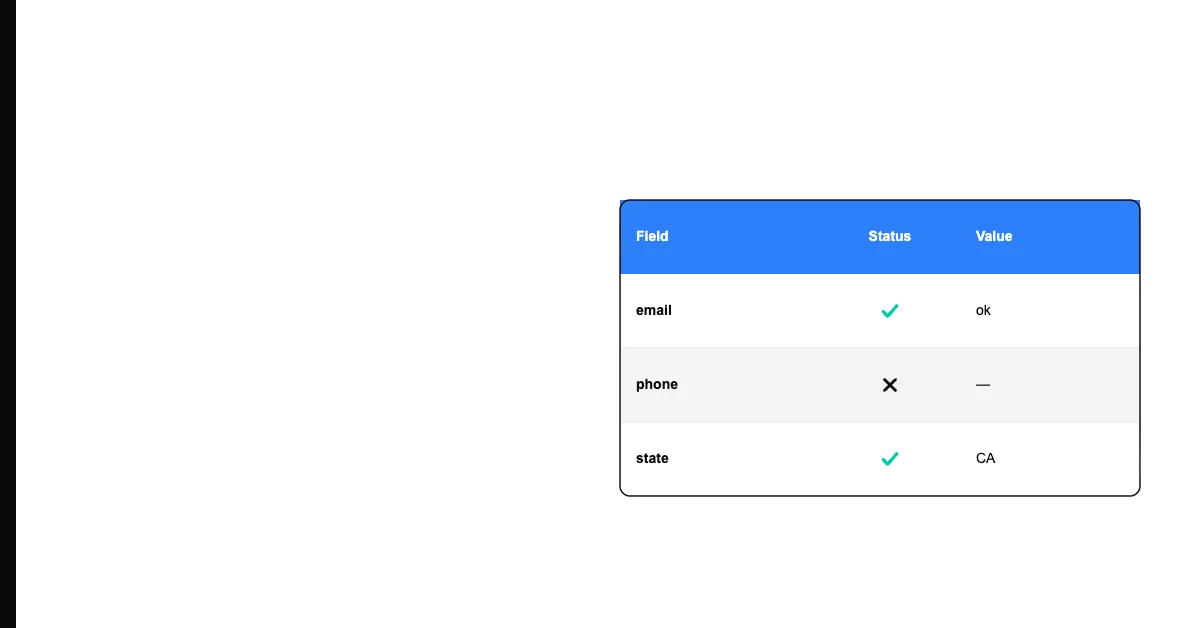
Sohovi gives you a full quality report on any spreadsheet in seconds — upload your file and see exactly what needs fixing.
Tool fragmentation — Remote teams often end up using more tools than in-person teams, with data siloed across each. Customer data might be in the CRM, Notion, Airtable, and a team member's personal spreadsheet simultaneously.
Remote-Specific Data Quality Practices
Assign explicit data owners — Every critical dataset has a named owner who is responsible for its quality. This is documented, not assumed. The owner runs the monthly quality review.
Centralize the master record — Identify which tool holds the authoritative version of each dataset. Everyone works from that version. Local copies are used for analysis but not for updates.
Standardize at entry, not cleanup — Add validation rules and controlled vocabularies to shared tools. It's easier to prevent bad data than to clean it up retroactively.
Sohovi lets you set up validation rules for any column and instantly see which rows fall outside them — no code or SQL required.
Run monthly remote quality reviews — A 30-minute monthly team meeting focused on data quality: what did we find, what got fixed, what's the plan for the recurring problems?
Profile imports systematically — Anytime data comes from an external source (vendor files, customer exports, partner data), profile it before importing. Tools like Sohovi make this a 60-second task before any import.
Remote teams can absolutely maintain good data quality — it just requires more intentional process design than in-person teams, where quality was partially maintained by proximity.