The fastest way to stop bad data from breaking your operations workflows is to catch it at the point of entry — before it reaches the automation that acts on it.
Your fulfillment automation sent 200 packages to wrong addresses because a postal code field contained city names in 12% of records. Your customer routing logic sent enterprise accounts to a self-serve queue because the account tier field was blank in the CRM sync. Your billing automation charged one customer twice because a duplicate record wasn't caught before the payment trigger fired.
None of these are software bugs. They're data quality failures that look exactly like software bugs until you trace them to the source.
Why Operations Data Quality Problems Are Different
Operations data quality failures are particularly costly because they trigger automated actions. A bad postal code in an operations workflow might mean 200 wrong shipments, 200 customer service calls, and 200 reships — all from one field that wasn't validated.
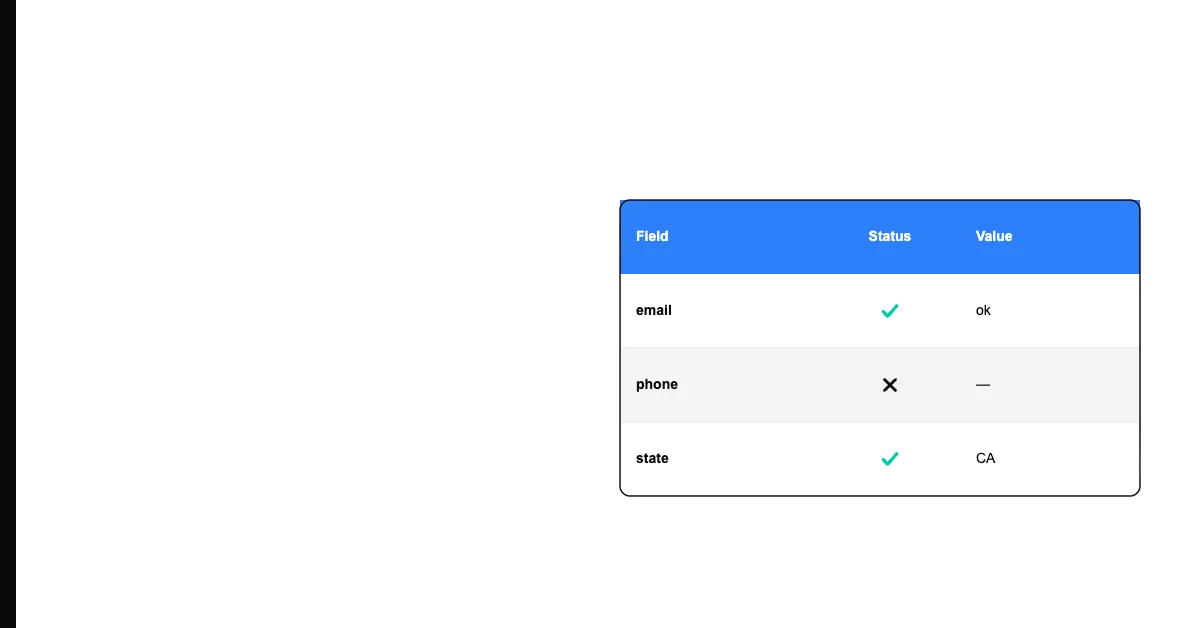
Sohovi lets you set up validation rules for any column and instantly see which rows fall outside them — no code or SQL required.
The automation that makes operations efficient is also the mechanism that scales errors. The same logic that processes 10,000 records correctly will process 1,000 records incorrectly if those records have the data quality problem that the logic doesn't handle.
The Silent Failure Problem
Operations data quality failures are often silent. The workflow completes. The record processes. No error is raised. But the outcome is wrong — a routing decision sent to the wrong team, an SLA calculated against a wrong date, a tier-based discount applied to the wrong account level.
Where Operations Data Quality Breaks Most Often
Upstream Input Data
Operations workflows are only as reliable as the data they receive as input. The operations team typically doesn't control the quality of incoming data — they're downstream of the systems that create it. This is why validation at the boundary is critical.
Reference Data and Lookup Tables
Operations workflows often depend on lookup tables — valid account tiers, postal codes to regions, approved vendor IDs. When those lookup tables are stale, the lookup fails silently and the workflow produces wrong results.
Process Handoffs
The most common place for data quality to degrade in an operations context is at the handoff between systems or teams. Each handoff is a potential quality failure point that's often invisible until something downstream breaks.
Practical Steps for Operations Teams to Improve Data Quality
1. Validate data at every workflow boundary. Before any automated workflow acts on incoming data, validate required fields, formats, and value ranges. Route records that fail validation to an exception queue rather than letting them propagate.
2. Audit your lookup tables and reference data on a schedule. Set a quarterly review for all reference data used in automated workflows. Active/inactive account tiers, region mappings, vendor lists — all need to be kept current.
3. Build exception queues, not just error logs. When data fails a validation check, route it to a visible exception queue for human review — not just to a log file no one monitors.
4. Trace high-error workflows back to their input sources. When a workflow produces wrong outputs frequently, the problem is almost always in the input data. Trace upstream to the source system or process that's generating bad data.
5. Document expected data formats for every integration. For every system that feeds data into your operations workflows, document the expected field names, types, formats, and required values.
Sohovi lets you upload any data file heading into a workflow and run a complete quality check — completeness, validity, format consistency, duplicates — before the workflow touches a single record.
Frequently Asked Questions
Q: Why are data quality problems in operations harder to catch than in other functions? Operations workflows are often fully automated, which means there's no human review step where an error would be noticed before it produces a wrong outcome. Catching errors requires intentional validation steps added to the workflow itself.
Q: What is a data quality validation gate and why should operations teams use them? A validation gate is a check that runs on incoming data before a workflow acts on it. Records that pass proceed through the workflow. Records that fail are routed to an exception queue for human review. Validation gates prevent bad data from entering a workflow.
Q: How do operations teams handle data quality in high-volume automated workflows? The practical approach is automated validation on every record, combined with a low-friction exception handling process for the small percentage of records that fail. Automate the quality check; manually handle the exceptions.
Q: What is a silent data quality failure? A silent failure occurs when a workflow processes a record with bad data without raising an error — the workflow completes "successfully" but the output is wrong. Silent failures are the most dangerous type because they produce wrong outcomes without any signal that something went wrong.
Q: How does bad data in a CRM affect downstream operations workflows? CRM data is often the source of truth for customer-facing operations workflows — routing, SLA assignment, pricing tiers. When CRM data is wrong, every workflow that depends on it produces wrong results.
Q: What's the best way to identify which data fields are causing the most operations errors? Build error logging that captures which records fail and which field values triggered the failure. Over time, this creates a distribution of which fields cause the most workflow errors — telling you exactly where to invest in quality improvement.
Q: How should operations teams manage data quality when vendors send files with inconsistent formats? Establish a data specification for every vendor-supplied file. Run automated validation against that specification when the file arrives. Return files that don't meet specification with a description of the failures.
Q: What is process handoff data quality and why does it matter? Process handoff quality refers to the accuracy of data at the point where it passes from one system or team to another. Each handoff involves format conversions, field mappings, and often manual steps — all high-risk points for quality degradation.
Q: How can a small operations team prioritize data quality improvements without dedicated resources? Start with your highest-volume workflows and the fields those workflows depend on. A completeness and validity check on those specific fields gives you the highest return on the smallest investment of time.
Q: When should an operations team escalate a data quality problem to IT or engineering? Escalate when the root cause is in a source system that operations doesn't control — a broken integration, an API that maps fields incorrectly, or a form that accepts values operations workflows can't process. Document the error pattern and business impact before escalating.
Operations data quality isn't about perfection. It's about not letting a bad postal code format bring down your fulfillment workflow. Start with your highest-volume workflows, validate their inputs, and build the exception process that catches the rest.
When your operations team is ready to see exactly where your workflow data has quality gaps, Sohovi gives you a field-by-field quality report on any data file — free, instant, and private.