GDPR's data quality requirements are often summarized as "keep personal data accurate." The practical implications are more specific than that — and more actionable. Here's a step-by-step guide to addressing the data quality components of GDPR compliance.
Step 1: Know What Personal Data You Hold (Data Mapping)
You can't manage what you can't see. The starting point for GDPR data quality compliance is understanding what personal data you hold, where it lives, and how it got there.
Run a PII scan on your key datasets. Map which systems hold personal data. Document what fields contain personal information.
Sohovi automatically detects PII in your datasets — emails, phone numbers, SSNs — all processed client-side so your data never leaves the browser.
Step 2: Verify Accuracy of Key Data Fields
GDPR Article 5(1)(d) requires that personal data be accurate and up to date. For your highest-volume personal data (customer contacts, subscriber lists), run a validation pass:
- Email addresses: Validate format and check for bounce history. Stale, invalid email addresses are accuracy failures under GDPR.
- Addresses: Verify against address databases where possible. Addresses that haven't been updated in 2+ years are likely stale.
- Consent records: Verify that consent flags are accurate — that records marked as consenting have actually provided consent, and records marked as unsubscribed are correctly suppressed.
Step 3: Deduplicate Your Records
Duplicate records create multiple compliance problems: you might delete one copy and retain another when fulfilling a deletion request; you might communicate with the same person twice because they appear twice in your system.
Sohovi automatically finds every duplicate in your dataset — including near-matches — and shows you exactly which rows are affected.
Run a deduplication pass on your primary personal data repositories. Eliminate exact duplicates; review and merge near-duplicates.
Step 4: Apply Retention Policies
GDPR requires that personal data not be kept longer than necessary for its original purpose. Define retention periods for each category of personal data:
- Active customers: retain for the duration of the relationship + X years
- Inactive contacts: retain for Y years after last activity, then delete or anonymize
- Leads who never converted: retain for Z months after collection
Build a process to identify and delete records past their retention period.
Step 5: Document Your Quality Practices
GDPR's accountability principle requires that you not only comply but be able to demonstrate compliance. Document your data quality practices: when you run validation, what you check for, how you handle identified inaccuracies.
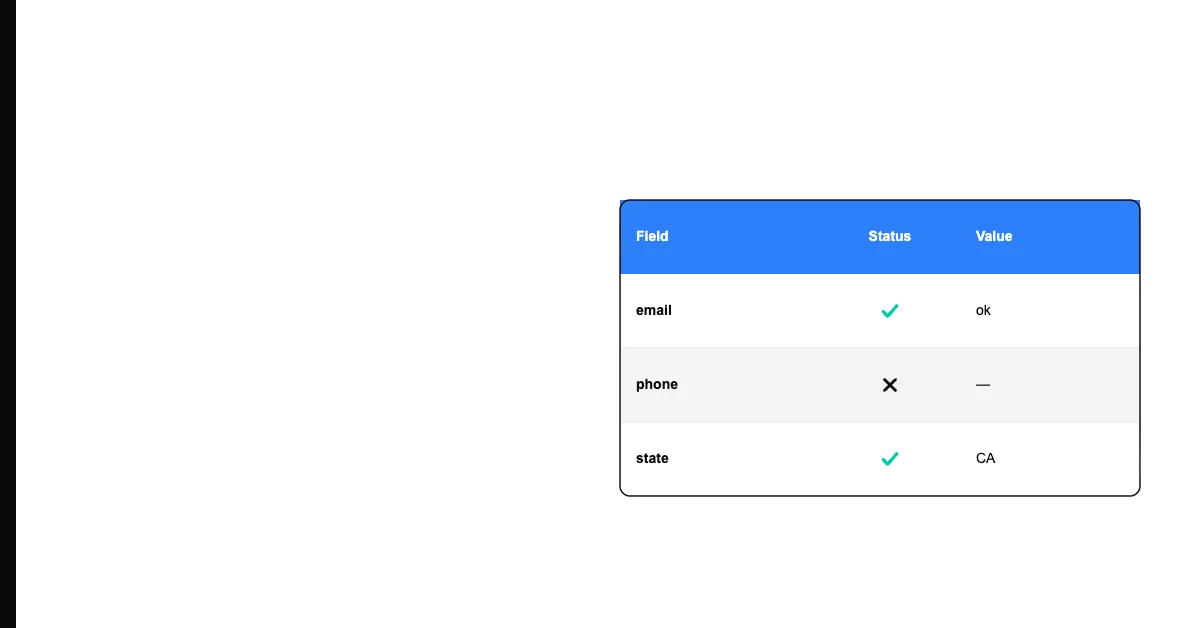
Sohovi lets you set up validation rules for any column and instantly see which rows fall outside them — no code or SQL required.
Sohovi's profiling output can be saved as documentation of your data quality assessment — a record of what you checked and when.
Step 6: Build Ongoing Quality Into Your Process
GDPR compliance is ongoing, not one-time. Build data quality checks into your standard workflow:
- Pre-send validation for all email campaigns
- Quarterly profile of key personal data repositories
- Annual full data quality audit against GDPR requirements
Data quality and GDPR compliance are the same practice. The sooner you treat them as one, the more efficient your compliance program becomes.