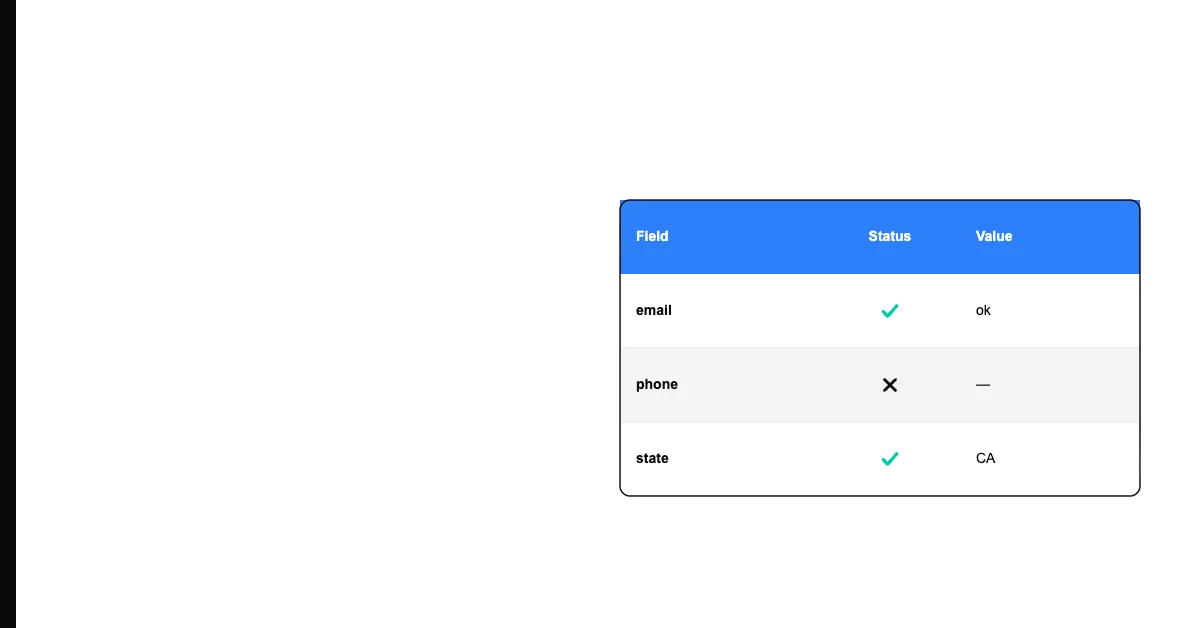
Two teams pull reports from the same CRM. One team says there are 4,200 active customers. The other says 4,750. Same system, same time, different numbers. The culprit is almost always data consistency — or the lack of it.
Data consistency measures the degree to which data is represented the same way throughout a dataset and across systems. Consistent data uses the same formats, values, and conventions to represent the same information, no matter where or when it appears.
What Data Inconsistency Looks Like
Inconsistency manifests in several forms:
Value representation inconsistency: The same concept is represented as different values across records.
- "Active," "active," "ACTIVE," "Yes," "Y," "1" — all meaning "this is an active customer" in the same status field
- "USA," "United States," "US," "U.S.A." — same country, multiple spellings
Format inconsistency: The same type of information stored in different formats.
- Dates: "01/15/2024" and "2024-01-15" and "January 15, 2024" — same date, three formats
- Phone numbers: "(415) 555-1234" and "4155551234" and "415.555.1234"
See exactly what's wrong with your data — try Sohovi free — try Sohovi free.
Cross-system inconsistency: The same data stored differently in different systems.
- CRM says a deal is "Closed-Won"; billing system hasn't updated the account status yet
- One system uses customer email as the ID; another uses a numeric code, and the mapping isn't perfect
Structural inconsistency: Different tables or files use different column names or schemas for the same data.
- "customer_email" in one file, "email_address" in another, "cust_mail" in a third
Why This Breaks Reports
When you run a report that groups or filters by an inconsistent field, you get fragmented results. If your status field has 12 variants of "Active," your count of active customers is split across 12 groups — none of which shows the true total.
The reports aren't wrong because the data system failed. They're wrong because the data is inconsistent. The report counts exactly what's in the field; the problem is that what's in the field isn't consistent.
Consistency vs. Other Quality Dimensions
| | Consistency | Accuracy | Validity | |---|---|---|---| | What it checks | Are values represented the same way? | Are values correct? | Do values conform to rules? | | Example failure | "USA" in one record, "United States" in another | Wrong phone number | Phone number with letters | | Primary fix | Standardization, controlled vocabulary | Verification, correction | Validation rules |
A dataset can be consistent but inaccurate: every record says "Active" (consistent), but many are actually inactive. It can be valid but inconsistent: all values match the correct format patterns, but the formats differ from record to record.
Sohovi scores your dataset against your own accuracy standards and highlights the columns and rows where values fall outside expected ranges.
What Causes Data Inconsistency
Multiple data entry points with no standards: Different teams, channels, or systems create records without following the same conventions.
No controlled vocabulary: A status field that accepts free text gets filled in differently by everyone who uses it.
System migrations: Data migrated from one system to another often brings format differences from the source.
Sohovi validates your dataset before it enters the warehouse — catching format errors, nulls, and duplicates at the source.
Manual data entry without validation: Humans enter the same thing different ways without realizing it matters.
Third-party data without standardization: Data from external sources follows the source system's conventions, not yours.
Accumulated history: Conventions change over time. Data entered under the old convention and new convention both exist in the same field.
How to Fix Data Inconsistency
Define a controlled vocabulary: For categorical fields, create an approved list of values and enforce it. Only "Active," "Inactive," and "Pending" are allowed in the status field — no variants.
Standardize formats: Choose a canonical format for each field type (ISO 8601 for dates, E.164 for phone numbers, ISO 3166 for countries) and convert all existing records.
Enforce at entry: Dropdowns and controlled inputs prevent new inconsistencies from being introduced. If the field only accepts values from a list, it can only be consistent.
Map variants to canonical values: Build a lookup table that converts known variants to the standard form. "USA" → "United States." "active" → "Active." Apply the lookup during imports.
Audit regularly: Check field-level value frequency distributions on a regular schedule. A field that should have 5 values but shows 20 distinct values has a consistency problem that needs investigation.
Sohovi surfaces value distribution for categorical fields in your CSV — letting you immediately see how many variants exist in each field and which ones are outliers.
Consistency Within a Single Dataset
Not all consistency problems involve multiple systems or format variants — some are logical relationships between fields in the same record that should always hold true:
order_dateshould never be later thanship_date, which should never be later thandelivery_daterevenueshould equalunits × price— if it doesn't, one of the three values is wrong
Measure this the same way you'd measure any consistency rate:
Consistency Rate = Records passing the rule / Total records × 100
Run it separately for cross-system consistency (does the CRM agree with billing?) and internal-rule consistency (do the fields within one record agree with each other?) — a dataset can score well on one and poorly on the other.
Consistency Between Systems
Cross-system consistency is harder to manage than within-dataset consistency. When the same entity (a customer, a product, a deal) exists in multiple systems, keeping them synchronized requires:
- A single system of record (the authoritative source of truth for that entity)
- Clear data flow rules (which system updates which, in what order, when)
- Regular reconciliation (comparing records across systems to identify divergence)
- Reference data management (shared lookup tables that all systems use for categorical values)
Frequently Asked Questions
Q: What's the difference between data consistency and data accuracy? Accuracy asks: is this value correct? Consistency asks: is this value represented the same way as similar values? A dataset where every customer's country is listed as "USA" is internally consistent, but might be inaccurate for customers in other countries.
Q: Is consistency the same as conformity? These terms overlap. Conformity (also called standardization) refers specifically to whether data follows an agreed-upon format. Consistency is broader — it includes conformity but also addresses whether the same concept is represented the same way across records, even when there's no single "standard" format defined.
Q: How do you detect consistency problems? Run a frequency distribution analysis on your categorical and formatted fields. If a field that should have 3 possible values shows 15 distinct values, you have a consistency problem. Format inconsistency shows up as multiple distinct patterns for the same type of value.
Q: Can data be consistent but wrong? Yes. Consistently wrong data is actually a specific quality problem — a systematic error where every record contains the same incorrect value due to a faulty import, formula, or data entry convention. Consistency doesn't guarantee accuracy.
Q: Why does data become inconsistent over time? Because people and processes change, systems accumulate entries from multiple sources, and there's rarely a single enforced standard at every data entry point. Inconsistency is the natural state of unmanaged data; consistency requires active design and maintenance.
Data consistency is what makes aggregation trustworthy. When your status field has 12 variants of "active," your pipeline report is wrong — not because the system failed, but because the data doesn't agree with itself. Fix consistency problems at the source with controlled inputs, and at the data level with standardization, and your reports will stop disagreeing.