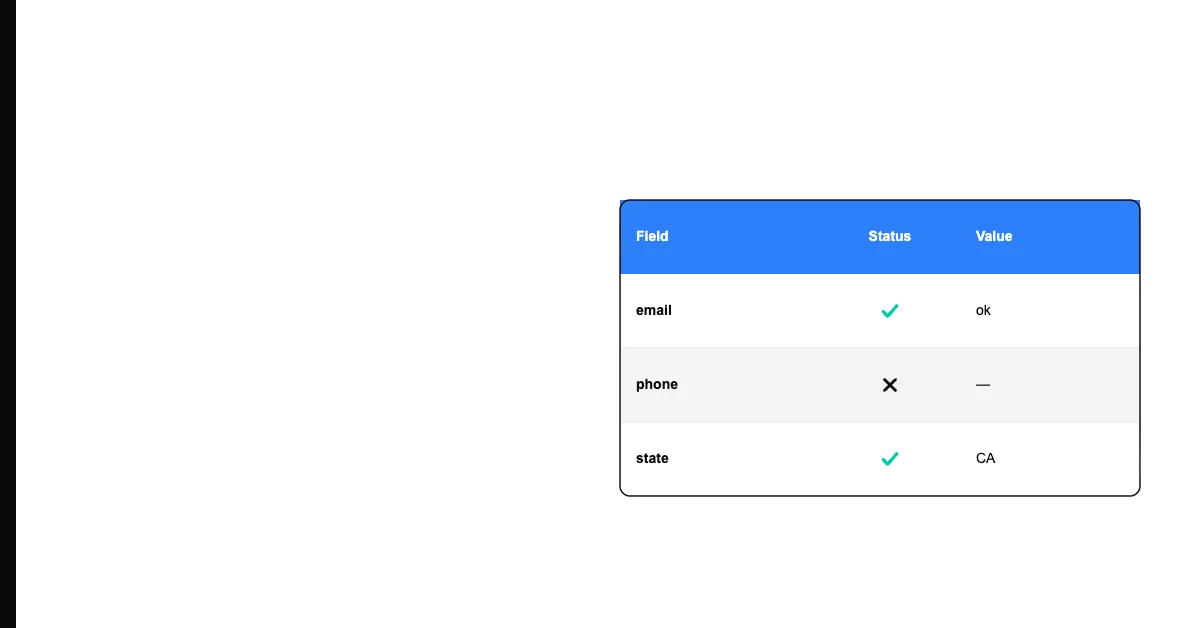
The Confusion Is Understandable
Both completeness and accuracy deal with whether you have the right data. But they ask fundamentally different questions:
- Completeness: Is a value present?
- Accuracy: Is the value that's present correct?
A record can fail one, the other, both, or neither independently.
Four Possible States for a Data Field
| State | Complete? | Accurate? | Example | |---|---|---|---| | Present and correct | ✅ | ✅ | Email is filled in and belongs to this person | | Present but wrong | ✅ | ❌ | Email is filled in but it's a typo (gmial.com) | | Missing but "would be correct" | ❌ | N/A | Email field is blank for a customer who has one | | Missing by design | ❌ | N/A | Optional field not filled in — acceptable |
A field that's 100% complete but 30% inaccurate is worse for most purposes than a field that's 85% complete and 98% accurate.
Sohovi scores your dataset against your own accuracy standards and highlights the columns and rows where values fall outside expected ranges.
Why the Distinction Matters for Diagnosis
Completeness problems have clear causes: entry wasn't required, users skipped a step, data wasn't collected at the right point in the process. The fix is usually a process or system change (require the field, add a form step).
Accuracy problems have different causes: data was entered incorrectly, data has decayed since entry, data was inferred rather than verified, self-reporting bias. The fix is usually validation, verification, or an enrichment source.
Applying the wrong fix to the wrong problem wastes resources. Making a field required doesn't fix wrong values that are already there. Enriching from an external source doesn't help if the problem is that the field doesn't exist yet.
Diagnosing Which Problem You Have
For any field with suspected quality problems:
- Count non-null values: low count → completeness problem
- Sample non-null values: verify against reality → wrong values → accuracy problem
- Check format: wrong format → conformity problem (related to validity, not accuracy)
A systematic diagnosis before a remediation project prevents wasted effort.
Remediation by Problem Type
Completeness fix: require the field at entry, add it to intake forms, populate from enrichment for existing records
Sohovi profiles every column in your dataset for completeness and flags the exact rows where values are missing — free to try.
Accuracy fix: verify against an authoritative source, add validation that catches common errors at entry, prompt users to verify stale values
Both: a field can have both problems — fix completeness first (get values in), then fix accuracy (verify the values)