Your legal team says you need a privacy compliance audit of your customer data. Your IT team is busy. Your budget is tight. And you're not technical. Here's how to do a meaningful privacy data audit yourself — without IT involvement.
What a Privacy Data Audit Actually Involves
A privacy compliance audit answers three questions:
- What personal data do we hold?
- Why do we hold it (what's our legal basis)?
- How is it being protected?
The first question is primarily a data quality problem. The second is a documentation problem. The third is a security problem. You can address the first two without IT involvement.
Step 1: Map Your Data Sources
List every system and file that contains customer or contact data:
- CRM
- Email marketing platform
- E-commerce platform
- Payment processor records
- Support ticket system
- Spreadsheets stored on shared drives or locally
- Marketing databases
Sohovi finds gaps, duplicates, and format errors in your CRM data — so your team is working from records they can trust.
For each, note: what personal data fields are stored, how many records, and when the data was collected.
Step 2: Scan for PII in Your Files
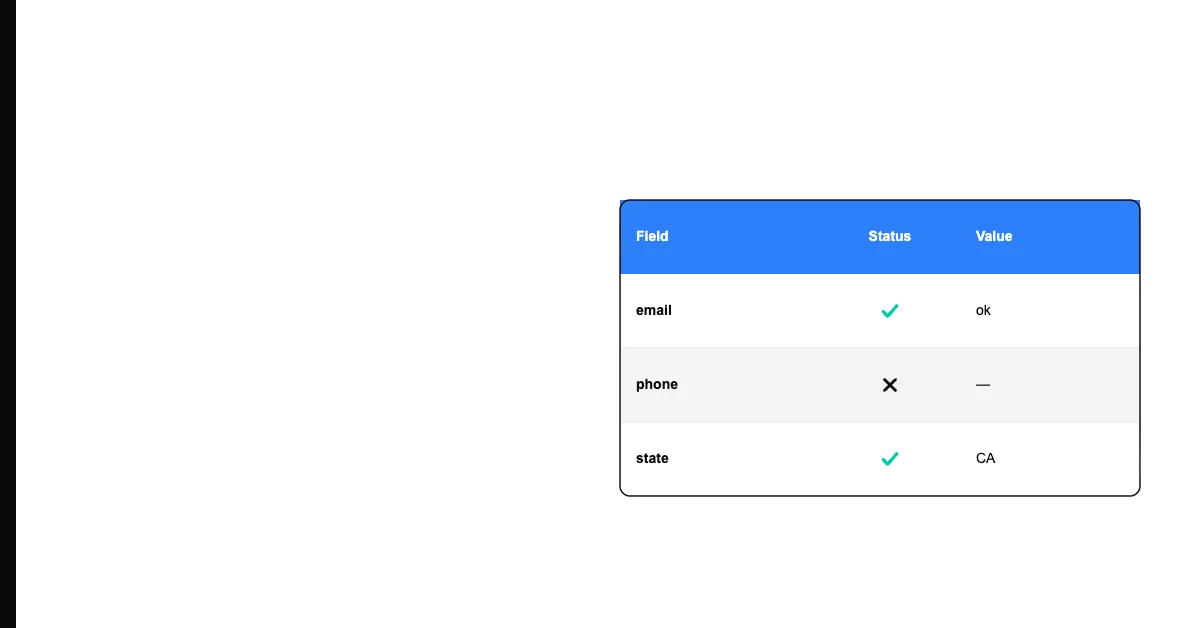
For any CSV or Excel files in your list, run a PII scan. Sohovi scans for personal data patterns in every column of your uploaded file — in your browser, with no data transmitted externally. This identifies what personal data exists in your spreadsheets and documents you might have overlooked.
Step 3: Document Collection Sources and Legal Basis
For each category of personal data you find, document:
- How was it collected? (Form signup, purchase, manual entry, imported from a vendor)
- What is the legal basis for holding it? (Consent, legitimate interest, contractual necessity)
- How long is it retained? (Your current practice, and whether that's documented)
Sohovi automatically detects PII in your datasets — emails, phone numbers, SSNs — all processed client-side so your data never leaves the browser.
You don't need IT for this — it's documentation work.
Step 4: Identify and Close Gaps
Common gaps found in privacy audits:
- Personal data in files or systems that aren't in your data map
- Data held beyond its retention period
- Unclear or undocumented legal basis for specific data categories
- Personal data being shared internally without appropriate access controls
For each gap, document what it is, what risk it creates, and what action is needed to close it.
Step 5: Build an Ongoing Process
An audit is a point-in-time assessment. Privacy compliance requires ongoing maintenance:
- Quarterly review of new data sources
- Annual full audit
- Immediate review when new data collection methods are introduced
The good news: if you do the first audit thoroughly, subsequent audits are much faster. You're updating a known inventory, not discovering it from scratch.