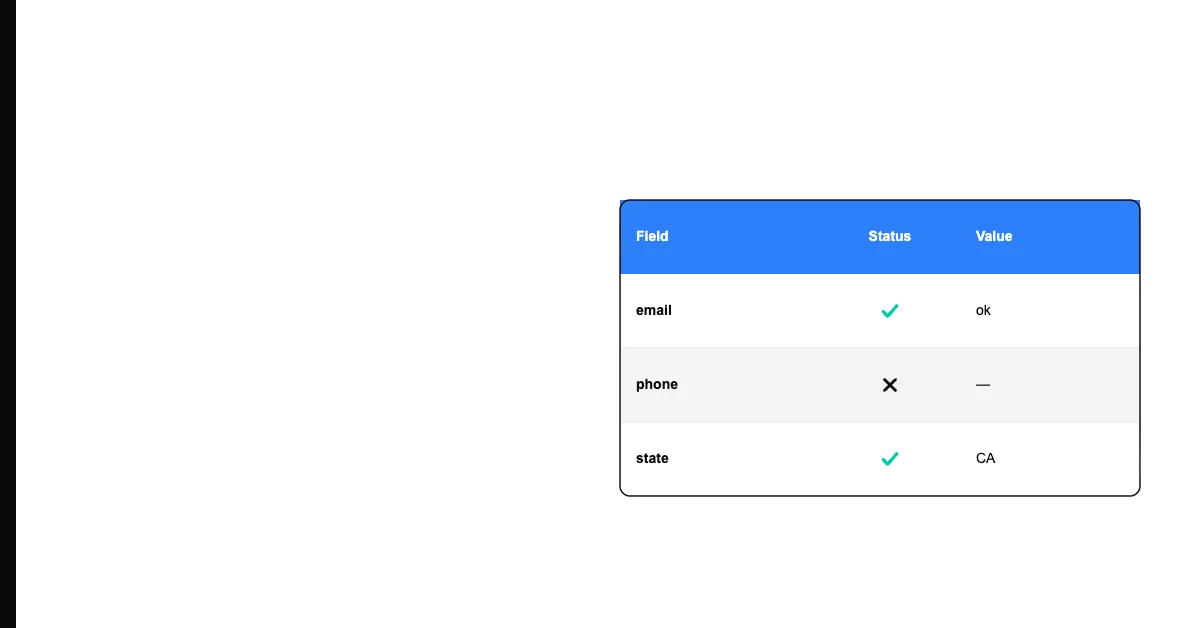
AI-powered data quality rule builders let you describe what your column must satisfy in plain English — "email must not be blank and must be a valid format" — and automatically generate the correct technical rule configuration.
Writing data quality rules has always required technical expertise. You needed to know which dimension applied (completeness? validity? conformity?), which specific rule type to choose (not_null? format_check?), what parameters were required (which template? which regex?), and what threshold made sense. For a non-technical analyst, this is a significant barrier.
AI rule generation removes that barrier entirely.
The Problem with Traditional Rule Builders
Traditional DQ rule builders present a cascade of choices:
- Select a dimension (completeness, validity, accuracy, uniqueness…)
- Select a rule type within that dimension
- Fill in required parameters (regex pattern, allowed values, min/max, etc.)
- Set a threshold percentage
Sohovi profiles every column in your dataset for completeness and flags the exact rows where values are missing — free to try.
This works well for engineers who know what they want and understand the terminology. But for most users — data analysts, marketing operations teams, finance staff managing their own datasets — the mental overhead is significant.
The result is that DQ rules are either written by the few technical people who understand the taxonomy, or they're skipped entirely. Neither outcome is good.
How AI Rule Generation Works
Modern AI rule builders use language models to translate plain-English descriptions into structured rule configurations. You describe what you want; the AI translates that into the correct dimension, rule type, and parameter values.
For example, you select the 'phone_number' column and type:
"Phone must not be blank and must be a valid US phone format"
The rule builder understands that:
- "not blank" → Completeness → 'not_null' rule (threshold: 0.99)
- "valid US phone format" → Conformity → 'format_check' rule with template "phone" (threshold: 0.95)
Both rules are generated in under 3 seconds, with a confidence score and plain-English reason for each.
Sohovi's AI Builder (available in the Rules tab → "AI Builder" tab) uses local keyword pattern matching to translate your description into rules. It runs entirely in your browser — no external service, no API key, no data transmitted anywhere.
What Makes a Good Rule Description
The AI interprets your intent, but clearer descriptions produce better results. The most effective descriptions follow a pattern:
Field-level constraints: "Must not be blank," "Must be unique," "Must be a valid email"
Value constraints: "Must be positive," "Must be between 0 and 10000," "Must be one of: active, inactive, pending"
Format constraints: "Must match date format YYYY-MM-DD," "Must be a US zip code," "Must be a UUID"
Cross-field constraints: "Must be greater than the start_date column"
Vague descriptions like "should be good" or "needs to be correct" are harder to parse. The more specific you are about the constraint, the better the rule.
Reviewing AI-Generated Rules
AI-generated rules come with a confidence score. High-confidence rules (85%+) are well-matched to the description and column type. Lower-confidence rules are more interpretive and should be reviewed carefully.
Always check:
- Threshold: The AI suggests a default (usually 95%). Adjust it based on your data — a required field might need 99%, a best-effort field might use 80%.
- Parameters: For regex patterns and enum lists, verify the values are correct.
- Dimension: Confirm the rule is in the right quality dimension — this affects how it contributes to dimension-level scores.
Sohovi lets you set up validation rules for any column and instantly see which rows fall outside them — no code or SQL required.
The AI is a starting point, not the final word. Review and adjust before accepting.
Privacy and Security
A common concern with AI rule builders is privacy: does my data get sent to the AI? In a well-designed system, no. Only the column name, inferred data type, and your plain-English description are sent. The actual row values in your CSV stay entirely in your browser.
Sohovi's AI Builder enforces this by design: rules are generated locally in your browser using pattern matching — no server call, no external service, and no data transmitted at all.
Use Cases Where AI Rule Building Shines
Non-technical analysts owning their own data quality. A marketing analyst managing a contact list can now add DQ rules without needing a data engineer.
Rapid onboarding of new datasets. When a new CSV arrives from a vendor, describe the expected column constraints in plain English and generate a baseline ruleset in minutes.
Documenting institutional knowledge. Subject matter experts know what valid data looks like in their domain. AI rule builders let them express that knowledge without learning DQ tool syntax.
Iterative rule refinement. Describe the constraint, accept the rule, run DQ, see which rows fail, refine the description, regenerate.
Key Takeaways
- AI rule builders translate plain-English constraint descriptions into technical DQ rule configurations
- Rules are generated locally — no data leaves your browser, no external service is called
- Generated rules come with confidence scores and reasons — review before accepting
- AI rules complement manual rules; they don't replace the need for expert review
- The quality of output depends on the specificity of your description
FAQ
Q: Which AI model powers the rule builder? A: None — Sohovi's rule builder uses local keyword pattern matching that runs in your browser. No AI model or external API is involved.
Q: Is my data sent to the AI? A: No. Only your column name, inferred type, and description text are sent. Your actual data values stay in your browser.
Q: What if the AI generates the wrong rule? A: Don't accept it. Each generated rule has an "Accept" button — you review before any rule is saved.
Q: Can I generate rules for multiple columns at once? A: Currently one column at a time. Select the column, describe the constraint, generate, accept. Repeat for each column.
Q: What rule types can the AI generate? A: All 27 rule types across all 10 quality dimensions. The AI picks the best match based on your description.
Q: How confident should I be in the generated rules? A: High-confidence rules (85%+) are generally reliable. Below 70%, review carefully and consider adjusting the description to be more specific.
Q: Do I still need manual rules? A: Yes. Complex cross-column logic, business-specific constraints, and nuanced thresholds often require manual configuration.
Q: How long does rule generation take? A: Typically 2–4 seconds depending on description complexity.
Q: Can the AI suggest rules I didn't think of? A: Yes. If you describe a general constraint ("must be a valid phone number"), the AI may suggest both a format check and a completeness rule — catching constraints you didn't explicitly request.
Q: Is the AI builder available on all plans? A: Yes — the AI Rule Builder runs entirely in your browser using local pattern matching. It requires no API key, no external service, and no additional configuration. It is available on all Sohovi plans.